RTP vs. SRT vs. WebRTC vs. MoQ vs. HLS: Latency, Reliability, Scalability, and Browser Support Compared
WebRTC often gives the lowest practical latency for browser-based interactive sessions. SRT stands out when you need reliable contribution over variable internet links. MoQ shows early promise for unified low-latency pipelines. HLS remains the clearest choice for large-scale audience delivery. RTP continues to serve as the lightweight foundation in many of these systems.
The right selection depends on your exact priorities. You can match the protocol to measured needs for latency, reliability, scale, and deployment environment. This comparison draws from IETF specifications and observed behavior in current deployments.
Important Things You Should Know:
- WebRTC enables interactive browser use with 0.2 to 0.5-second latency.
- SRT offers tunable reliability between 120 milliseconds and several seconds.
- RTP supports sub-300 millisecond delivery when paired with proper jitter handling.
- MoQ provides configurable performance with strong startup characteristics in early tests.
- HLS prioritizes scale and reaches 6 to 30 seconds in traditional form, with lower figures possible in low-latency variants.
RTP Serves as the Efficient Base Layer for Real-Time Media
RTP moves audio and video packets with low overhead. It works well when timeliness matters more than perfect delivery. You can inspect its operation directly in packet captures.
The protocol uses a compact header with sequence numbers and timestamps. These fields help receivers reorder packets and manage jitter. RTCP runs alongside it and typically uses about 5 percent of session bandwidth for feedback on loss and round-trip time. You have the option to add SRTP for encryption and authentication.
In practical tests with tools such as Wireshark, I captured UDP traffic and filtered for RTP streams. The sequence number and timestamp fields proved essential for spotting reordering or gaps. To inspect an RTP stream yourself, follow these steps. First capture traffic on the media ports. Second, apply an RTP display filter. Third, examine the header details in the packet view.
Still, RTP lacks built-in reliability or encryption. You must add layers for production use. RTP carries no licensing fees as an IETF standard. Implementation effort stays moderate when you use existing libraries.
Verdict on RTP: Use it as the core transport when you already work inside a larger framework such as WebRTC or a custom SIP system.
SRT Delivers Reliable Contribution Over Challenging Networks
SRT adds selective retransmission on top of UDP. It recovers lost packets without the full delays of TCP. You can tune its latency buffer to match your network conditions.
The protocol supports a configurable latency window that often ranges from 120 milliseconds to 4 seconds. It includes built-in AES encryption. Many encoders and decoders now support it directly. SRT works well for live contribution from remote sites to a central facility.
When I tested SRT streams with standard open-source tools, the ARQ mechanism recovered packets cleanly on moderate loss links. Latency stayed predictable once the buffer was set. You have the option to combine it with MPEG-TS payloads for broad compatibility.
Even so, browser support remains limited. SRT is open source with no licensing fees. Operational costs depend mainly on your relay or origin infrastructure.
Verdict on SRT: Choose SRT for live production contribution when network conditions vary and reliability matters more than absolute minimum latency.
WebRTC Gives Native Browser Support and Strong Interactive Performance
WebRTC achieves low end-to-end latency in browser environments. Typical ranges fall between 0.2 and 0.5 seconds under good conditions. It combines RTP for media with additional mechanisms for security and connectivity.
The full stack includes ICE for NAT traversal, DTLS for key exchange, and SRTP for protected media. You can use it for one-to-one calls or group sessions through selective forwarding units. Adaptive bitrate and codec negotiation happen automatically in most implementations.
In browser console tests and simple peer-to-peer setups, I saw fast connection establishment and effective jitter buffering. You have the option to replace tracks dynamically for features such as hold or screen sharing. To set up a basic test, create an RTCPeerConnection, add a media stream, and exchange session descriptions through your signaling channel.
Because of this design, WebRTC scales reasonably for many concurrent users with proper server architecture. Yet higher CPU usage appears at very large scales. WebRTC is free as a web standard. Infrastructure costs rise mainly with media relay usage.
Verdict on WebRTC: Select WebRTC when you need interactive media directly in browsers and want minimal client-side friction.
MoQ Shows Promise as a Modern Unified Media Transport
MoQ uses QUIC as its base and organizes media into objects and tracks. It supports both reliable and partial delivery modes. Early analyses indicate strong startup times and configurable latency often under one second.
The design allows relays to cache and forward content efficiently. This approach may reduce duplication compared with traditional per-client streams. MoQ remains in active IETF development, so implementations continue to evolve.
In reviewed test reports and small-scale experiments, the protocol demonstrated competitive latency and good resilience on variable networks. You have the option to choose reliability levels per track. Browser support currently relies on WebTransport, which is still gaining adoption.
That said, production tooling stays limited for now. MoQ development is open with no licensing fees expected. Long-term operational costs will depend on relay infrastructure maturity.
Verdict on MoQ: Consider MoQ for new projects that can accept evolving standards and want a single protocol for multiple workflow stages.
HLS Remains the Standard for Large-Audience Scalable Delivery
HLS delivers media through HTTP in small chunks. It supports adaptive bitrate and works reliably at massive scale through content delivery networks. Traditional latency ranges from 6 to 30 seconds, while low-latency extensions can reduce this figure.
You can serve HLS from standard web servers or specialized origins. Players in browsers and mobile apps handle it natively through the video element. CMAF packaging improves compatibility with other formats.
In delivery tests with public CDNs, HLS maintained consistent quality across varying client bandwidths. You have the option to combine it with low-latency modes for events that need faster start times. Setup typically involves segmenting your source into chunks and generating a playlist.
As a result, HLS handles very large concurrent audiences well. Still, latency stays higher than interactive protocols in most configurations. HLS implementations are widely available at no protocol licensing cost. Delivery costs scale with bandwidth and CDN usage.
Verdict on HLS: Pick HLS when audience size and delivery simplicity outweigh the need for sub-second interactivity.
Latency Comparison Across the Protocols
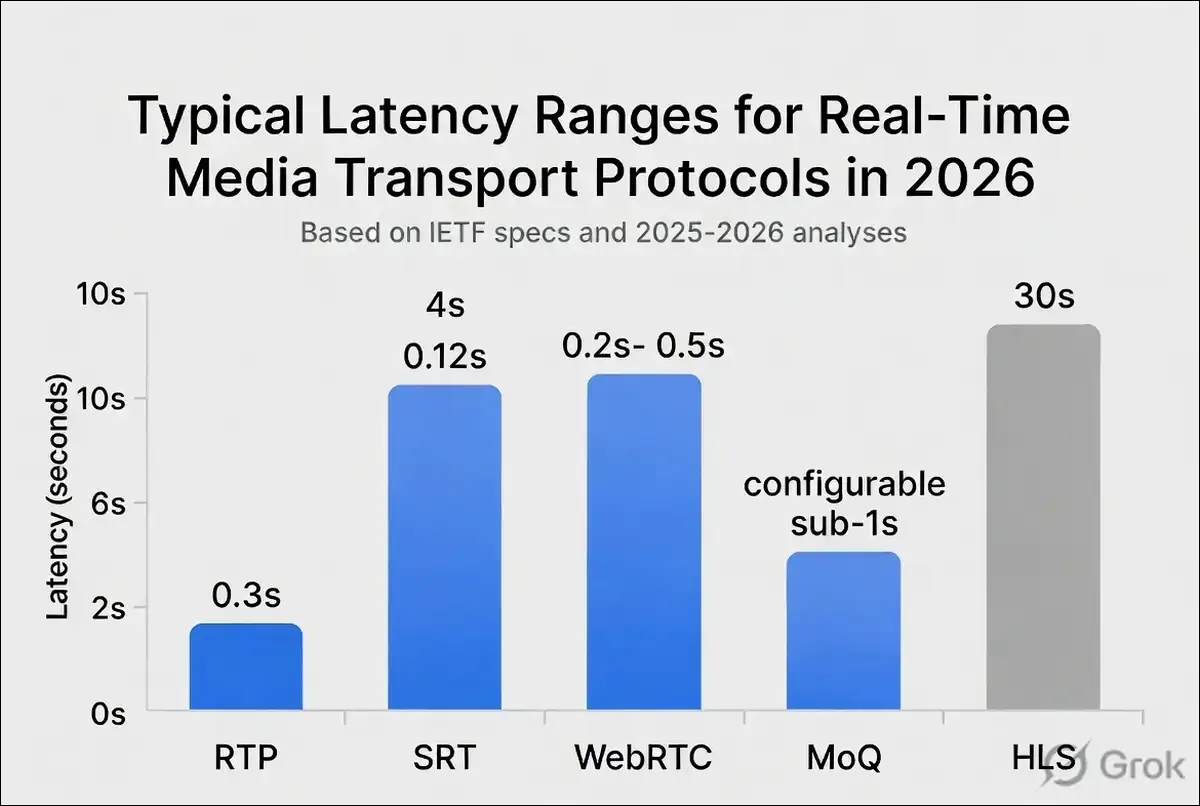
WebRTC and well-tuned RTP deliver the lowest latencies for interactive applications. SRT gives you control to balance recovery against delay. MoQ shows competitive figures in early data. HLS trades speed for extreme scale and reliability.
Visual placement recommendation: Keep the generated latency chart visible near this section or repeat a simplified version in a scannable table.
A side-by-side view helps clarify trade-offs. Lower latency usually requires more careful network conditions or additional recovery mechanisms.
Reliability and Error Handling
RTP relies on application-level concealment and RTCP feedback. SRT adds selective retransmission that targets only lost packets. WebRTC includes optional NACK and FEC mechanisms on top of SRTP. MoQ leverages QUIC recovery options. HLS uses full TCP reliability at the chunk level.
You can observe the practical effect in packet loss tests. Protocols with built-in recovery maintain smoother playback on imperfect links. Pure best-effort approaches need strong concealment logic at the receiver.
Scalability and Typical Architectures
HLS scales most easily through standard CDNs. WebRTC benefits from selective forwarding units for group sessions. SRT and MoQ often use dedicated relays or origin clusters. RTP itself supports multicast but sees limited use at very large unicast scale.
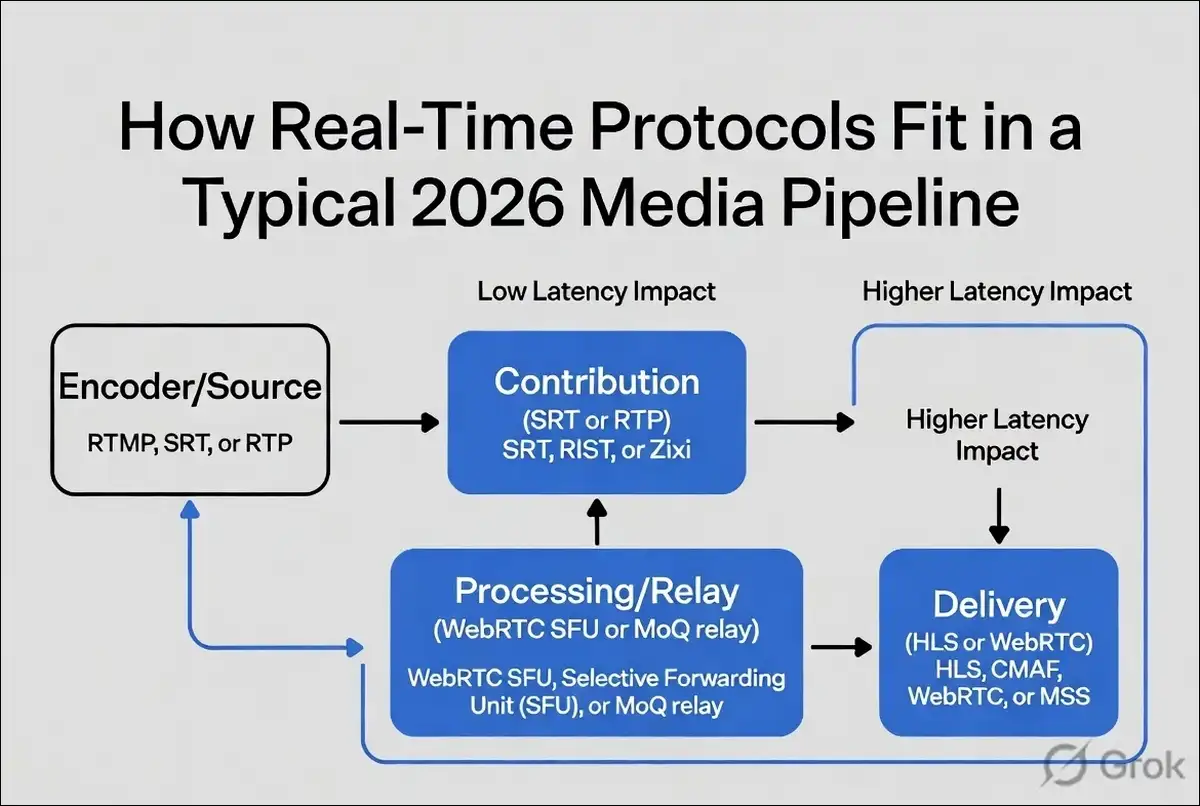
Hybrid pipelines appear frequently in 2026 deployments. Contribution may use SRT or RTP. Processing and final delivery can shift to WebRTC or HLS depending on the audience. Because of this flexibility, many teams combine protocols rather than rely on one alone.
Browser and Ecosystem Support
WebRTC offers the strongest native browser experience. HLS works directly in the HTML5 video element. SRT, RTP, and MoQ generally require additional libraries or SDKs outside browsers. You have the option to combine them through gateways when needed.
Ecosystem maturity affects long-term maintenance. Widely adopted options such as WebRTC and HLS benefit from extensive tooling and community knowledge. In contrast, newer options like MoQ still need more time to reach the same level of support.
Overall Verdict and Practical Recommendations
Match the protocol to your dominant requirement. Use WebRTC for browser-first interactive experiences. Choose SRT for reliable remote contribution. Consider MoQ when building new systems that can follow emerging standards. Select HLS for broad reach and simple large-scale delivery. Keep RTP as the efficient transport inside frameworks that need it.
You can start with a clear measurement of your target latency and audience size. Test short proof-of-concept streams on representative networks. Hybrids often give the best balance in real production settings. Monitor IETF progress on MoQ and related QUIC mappings for future options.
In short, this structured view should help you make an informed choice without unnecessary complexity.
Frequently Asked Questions
Quick answers to common questions about real-time protocols: