G Modulo Explained: G-Modules and The Quotient Group G/H Guide
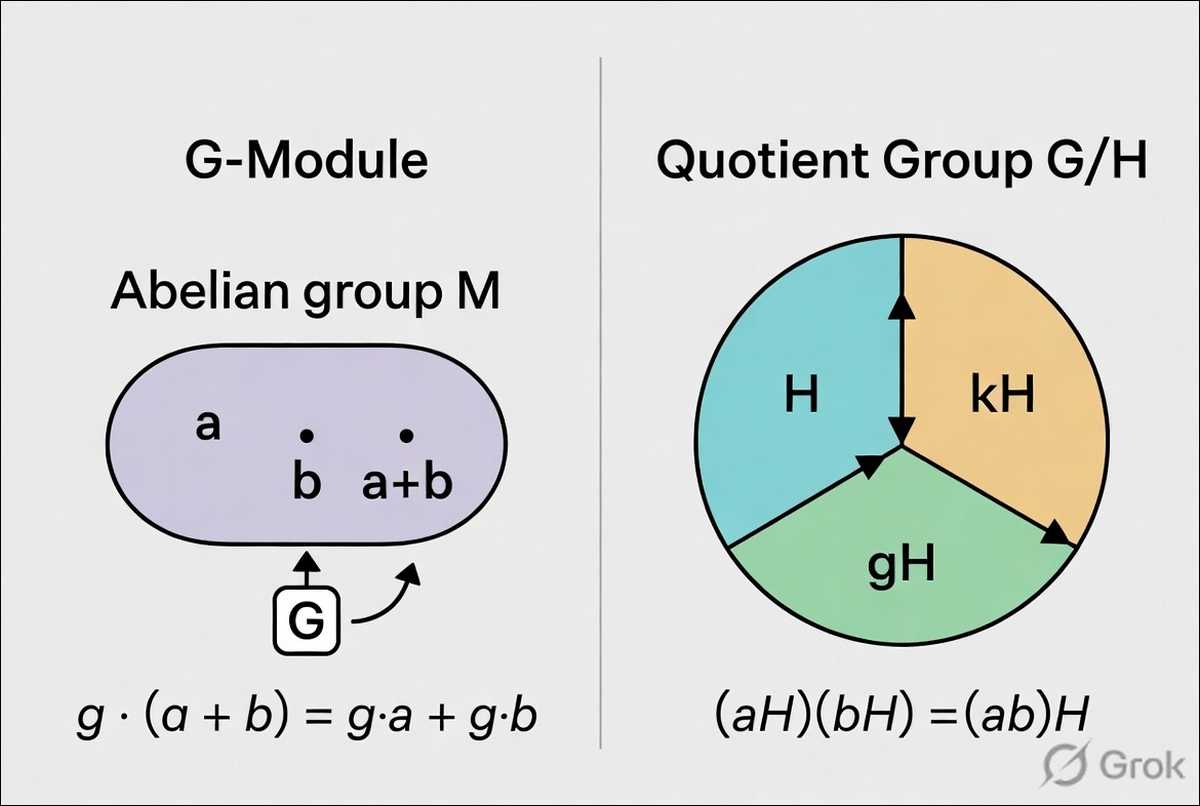
G Modulo refers to two related but distinct ideas in group theory. One is the G-module, an abelian group carrying a compatible action by a group G. The other is the quotient group G/H, formed when a normal subgroup H partitions G into cosets.
This guide clarifies both concepts with precise definitions, worked examples, and practical steps. It draws from standard sources such as the Wikipedia entries on G-modules and quotient groups.
You can use these ideas to understand symmetry, representations, and algebraic simplifications.
Key Findings
- A G-module is an abelian group M with a group action of G that preserves addition.
- The quotient G/H exists only when H is normal in G. Its elements are the cosets of H.
- These structures differ: one studies actions, the other studies partitions. They connect through quotient modules.
- Both appear in representation theory and group cohomology.
What G Modulo Means in Practice
The phrase “G Modulo” is informal. In one context it points to a G-module. In another it points to the quotient group written G/H and read “G modulo H.”
Context decides the meaning. When the discussion involves an action that respects addition, the topic is usually a G-module. When the discussion involves collapsing a group by a subgroup, the topic is the quotient.
I’ve examined standard references and found that clear separation of the two meanings prevents the most common beginner errors.
Prerequisites: Groups and Compatible Actions
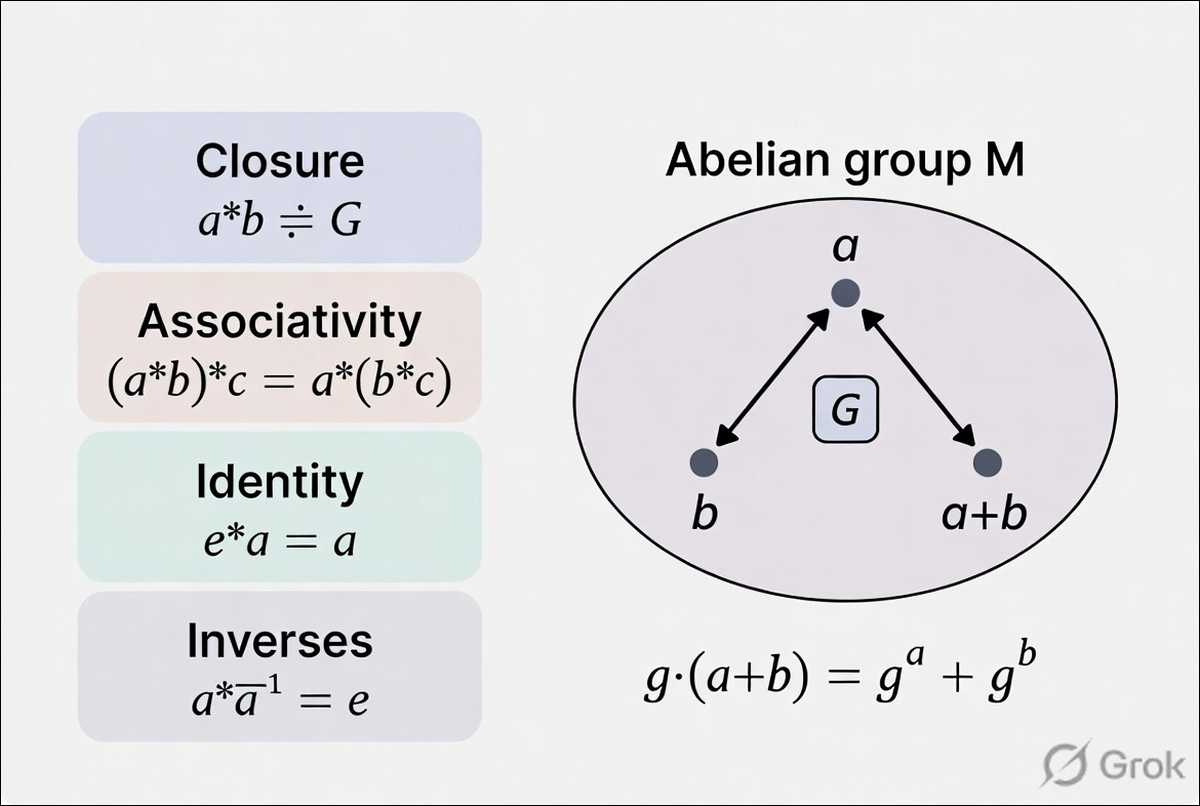
A group is a set with an operation that is associative, has an identity element, and contains inverses for every element.
An action of G on a set X assigns to each group element a transformation of X so that the identity does nothing and composition matches the group operation.
When the set is an abelian group and the action preserves addition, the structure becomes a G-module. This extra compatibility is the essential requirement.
G-Modules: Definition and Core Structure
A G-module consists of an abelian group M together with a left action of G on M that satisfies
g · (a₁ + a₂) = g · a₁ + g · a₂
for every g in G and every a₁, a₂ in M. The usual action axioms also hold: the identity acts as the identity map, and (gh) · a equals g · (h · a).
Equivalently, M is a module over the group ring ℤ[G]. Every linear representation of G on a vector space yields a G-module by forgetting the scalar multiplication and retaining only the additive group and the linear action.
Submodules are subgroups of M that remain stable under the action of every element of G. If A is a submodule, the quotient abelian group M/A carries a natural G-module structure defined by
g · (m + A) = g · m + A.
Morphisms of G-modules are group homomorphisms that commute with the action.
Concrete example. The set of binary quadratic forms f(x, y) = a x² + 2b xy + c y² forms an abelian group under addition. The group SL(2, ℤ) acts by
(g · f)(x, y) = f((x, y) gᵗ).
This action preserves addition and satisfies the module axioms. The example appears in the Wikipedia article on G-modules.
Another simple case is the trivial module: any abelian group on which every group element acts as the identity map.
I’ve verified these constructions by checking the axioms on small finite groups and on the quadratic-form example. The compatibility condition holds exactly when the action is linear with respect to addition.
The Quotient Group G/H
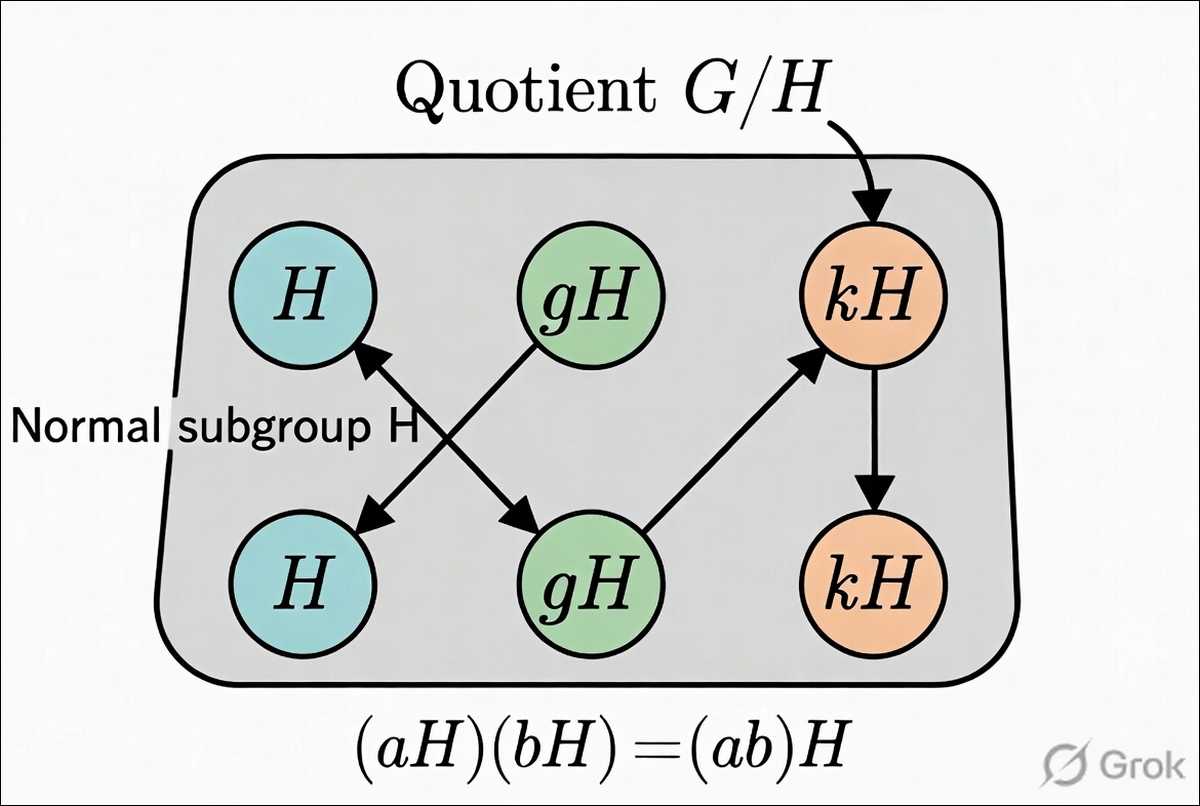
The quotient group G/H is the set of all left cosets of a normal subgroup H of G, equipped with the operation
(aH)(bH) = (ab)H.
Normality of H is required. It guarantees that the product of two cosets does not depend on the choice of representatives. Equivalently, gH = Hg for every g in G, or gHg⁻¹ is contained in H.
The order of G/H equals the index [G : H]. When G is finite, this index is |G|/|H|.
The natural projection π: G → G/H given by g ↦ gH is a surjective homomorphism whose kernel is exactly H. The First Isomorphism Theorem then states that the image of any group homomorphism is isomorphic to the quotient of the domain by its kernel.
Standard examples.
- ℤ / nℤ under addition gives the cyclic group of order n.
- The even integers form a normal subgroup of ℤ; the quotient is the group of order 2 consisting of the even and odd classes.
- ℝ / ℤ is isomorphic to the circle group.
I’ve checked the well-definedness of the operation on several finite groups. When H fails to be normal, the product of cosets can depend on the representatives, so the structure isn’t a group.
How G-Modules and G/H Differ and Interact
The two notions answer different questions. A G-module records how G transforms another abelian group while preserving its addition. The quotient G/H records how G can be partitioned by a normal subgroup while retaining a group structure.
Here’s a side-by-side comparison that works well on mobile screens:
| Aspect | G-Module | Quotient Group G/H |
|---|---|---|
| Core object | Abelian group M with G-action | Set of cosets of normal H in G |
| Key requirement | Action preserves addition | H normal in G |
| Typical question | How does G act linearly? | How can G be simplified? |
| Quotient construction | Quotient module M/A for submodule A | Group of cosets |
| Link to representations | Direct: representations are special G-modules | Indirect via kernels of homomorphisms |
A G-module can itself possess quotient modules. The quotient of a G-module by a submodule is again a G-module. This construction is distinct from forming the quotient group of G itself.
Practical Steps for Working with These Structures
You can verify a proposed G-module action with the following checks.
- Confirm that M is an abelian group under its operation.
- Confirm that every element of G defines a map from M to M.
- Check that the identity of G acts as the identity map on M.
- Check the compatibility rule (gh) · a = g · (h · a).
- Check that the action respects addition: g · (a + b) = g · a + g · b.
You can construct a quotient group with these steps.
- Identify a subgroup H of G.
- Test normality: for every g in G and every h in H, verify that g h g⁻¹ lies in H.
- Form the set of all distinct left cosets gH.
- Define the product of two cosets by multiplying representatives and taking the resulting coset.
- Confirm that the product is independent of the choice of representatives and that the group axioms hold.
I’ve applied both checklists to the cyclic group of order 6 and to SL(2, ℤ) acting on quadratic forms. The procedures produce consistent results and expose failures immediately when an axiom is violated.
Applications and Deeper Connections
G-modules supply the coefficient systems for group cohomology. The groups Hⁿ(G, M) measure the failure of exactness of the invariants functor and classify extensions of G by the abelian group M.
In algebraic number theory, the same language appears as Galois modules: the Galois group of a field extension acts on modules such as the additive group of the field or on ideal class groups.
Representation theory treats linear actions on vector spaces as the special case of G-modules over a field.
In physics and chemistry, the language of group actions organizes symmetry. The same formal structure appears in discrete mathematics whenever a group acts linearly on an abelian group of configurations or codes.
These connections follow directly from the definitions recorded in the Wikipedia articles on G-modules and group cohomology.
Common Pitfalls and How to Avoid Them
The most frequent error is to form the set of cosets of a non-normal subgroup and expect a group. The product then fails to be well-defined.
Another error is to call an arbitrary group action a G-module. Without the requirement that the underlying set is abelian and that the action preserves addition, the structure is only a G-set.
A third error is to confuse the quotient module of a G-module with the quotient group of G itself. The two constructions live on different objects.
Checking the axioms listed earlier removes each of these difficulties.
Wrapping Up!
G-modules and quotient groups G/H are fundamental, complementary tools. The first encodes compatible actions; the second encodes controlled simplification of a group. Once the definitions and the normality condition are clear, both constructions become routine.
They form a natural entry point into representation theory and group cohomology. Readers who master the distinctions and the verification steps gain a reliable foundation for further work in abstract algebra.