test.com Pricing & Enterprise Plans Explained (2026)
TL;DR
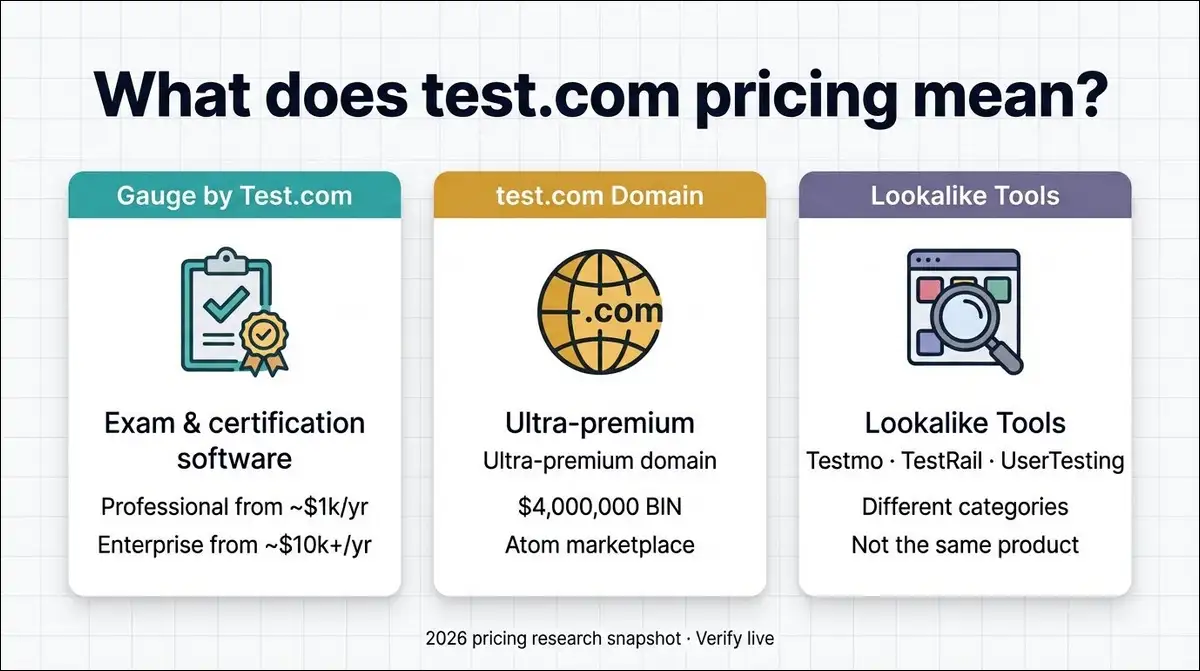
- Gauge by Test.com (Professional): from about $750/yr software + $250/yr hosting + $500 setup.
- Gauge Enterprise: from about $10,000/yr + $1,000/yr hosting + $2,000 setup, aimed at >10,000 tests/year.
- test.com the domain: listed at $4,000,000 one-time on Atom (verify live).
- Not the same as Testmo, TestRail, or UserTesting pricing.
What does “test.com pricing enterprise plans” actually mean?
It usually means one of three things: Gauge by Test.com software pricing, the test.com domain sale price, or a mix-up with other “test” products.
Searchers rarely share the same intent. Some want certification exam software costs. Others want the premium domain. And a third group lands here after confusing Testmo or TestRail with test.com.
That’s why this guide separates those intents with verified 2026 figures. You’ll get plan floors, volume math, module costs, and competitor ranges. You’ll also get decision rules you can use on a budget call.
One more thing up front: we treat vendor pages as claims, not gospel. Prices change, so it’s worth re-checking the live calculator before you sign.
Which “test.com” are you researching?
You’re almost always looking at Gauge software, the $4M domain, or a lookalike brand. Pick the row that matches your goal.
| If you need… | You mean… | Primary page to verify |
|---|---|---|
| Exam delivery, certificates, badges | Gauge by Test.com | gaugeonline.com/pricing |
| A one-word brand domain | test.com domain (Atom) | atom.com/name/Test |
| QA test case management | Testmo or TestRail (not test.com) | testmo.com / testrail.com |
| UX research panels | UserTesting (not test.com) | usertesting.com |
In short: Gauge is a certification and exam platform. The domain is a marketplace asset. The lookalikes sit in different categories.
So why does this mix-up happen? “Test” is a crowded root word. Product names, domains, and SEO pages collide in the same results.
If you only care about software, you can skip the domain section. If you only care about brand assets, you can skip the exam modules. Either way, the rest of this article is built so you can jump cleanly.
How much does Gauge by Test.com cost in 2026?
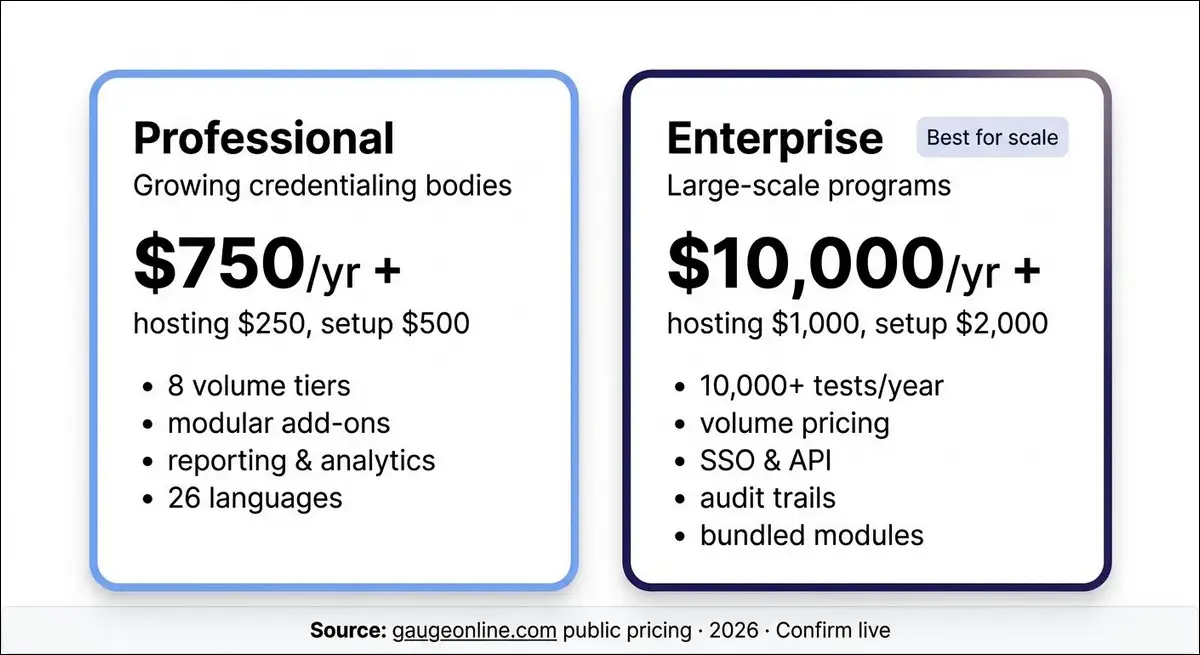
Gauge publishes two plan families: Professional for growing programs and Enterprise for large-scale certification volume.
Their website pages describe Professional as starting at $750 per year for core software. Hosting is listed at $250 per year. A one-time setup fee is listed at $500.
Enterprise is listed as starting at $10,000 per year. Hosting is listed at $1,000 per year. Setup is listed at $2,000.
That’s sticker framing, though, not always your all-in bill. Volume tiers and optional modules can change the total.
What is included in the Professional plan?
Professional is Gauge’s modular plan for growing credentialing bodies. You may pay a volume-based base fee, then add only the modules you need.
They Claims for the Professional plan include:
- Eight usage-based pricing levels by annual exam volume
- Advanced testing and user management features you can use as your program grows
- Security and customization options
- Reporting and analytics
- Availability in 26 languages
- White-glove support on every plan
In short: Professional isn’t “unlimited everything.” It’s core testing plus optional paid modules you can turn on when you’re ready.
What is included in the Enterprise plan?
Enterprise targets organizations running more than 10,000 tests per year. On this tier, the vendor may bundle features that stay modular on Professional.
Vendor claims for Enterprise include:
- Certification and badging
- Proctoring integration
- Lessons
- eCommerce capability
- Developer tools and integrations
- Custom volume pricing above the 10,000-test threshold
In short: Enterprise is less about a bigger feature menu and more about scale, integrations, and negotiated unit economics.
What are Gauge’s volume tiers and cost per exam?
Gauge prices for the Professional plan mainly by annual exams taken, not by seats. As volume rises, the base cost per exam can fall.
Below is the volume ladder as shown on Gauge’s public pricing calculator content in 2026 research snapshots. Before you budget, it’s worth re-opening the live page.
| Tier | Annual exam volume | Listed base $/year | Implied base $/exam |
|---|---|---|---|
| Tier 1 | Up to 500 | $1,000 | $2.00 |
| Tier 2 | Up to 1,000 | $1,750 | $1.75 |
| Tier 3 | Up to 2,000 | $3,300 | $1.65 |
| Tier 4 | Up to 3,000 | $4,550 | ~$1.52 |
| Tier 5 | Up to 4,000 | $6,000 | $1.50 |
| Tier 6 | Up to 5,000 | $7,500 | $1.50 |
| Tier 7 | Up to 7,500 | $9,500 | ~$1.27 |
| Tier 8 | Up to 10,000 | $11,500 | $1.15 |
How to read “$1,000/yr base” at Tier 1
Gauge’s calculator frames Tier 1 at about $1,000 per year all-in for core testing and hosting. That matches the $750 software + $250 hosting split on the plan cards.
From there, modules sit on top of that base. Your real cost per exam rises when you add certification, proctoring, or eCommerce.
Important Insight: the “$2.00 per exam” claim
Gauge’s calculator can show $2.00 cost per exam at the 500-exam tier.
“Cost per exam” here is base platform spend divided by the tier ceiling, not your actual count. If you run 200 exams inside the 500 tier, your true unit cost is higher. If you run 500 exactly, you hit the posted $2.00 base figure before modules.
Next action: You may want to model unit cost on expected exams, not the tier maximum. Then add modules.
How much do Gauge modules cost?
Modules are annual add-ons on Professional. Enterprise marketing copy treats several of them as included in the large-scale package.
| Module | Listed annual price | What it is for |
|---|---|---|
| Certification & Badging | $750 | Certificates, digital badges, micro-credentials |
| Lessons | $250 | Structured learning and prerequisites |
| eCommerce | $500 | Sell exams and programs; payments; coupons |
| Developer Tools & Integrations | $500 | API, webhooks, SSO-oriented enterprise hooks |
| Proctoring integration | $750 | Connect Honorlock, ProctorFree, ProctorU, MonitorEDU |
In short: Proctoring session fees from third-party vendors are separate. The $750 line is integration access, not per-session invigilation.
When do modules matter most?
You may want Certification & Badging if credentials are the product. You can skip it if you only need internal quizzes.
You may want eCommerce if candidates pay you online. You can skip it if another system already handles checkout.
You may want Developer Tools if SSO, LMS sync, or CRM sync is required. You can skip it for a standalone admin-run program.
And you may want Proctoring when exam integrity is non-negotiable. If you go that route, budget session fees in a second line item.
What does Gauge Enterprise really cost at scale?
Enterprise starts around $11,000 per year before volume math, if you use the published floors. That’s $10,000 software + $1,000 hosting, plus $2,000 setup in year one.
For programs above 10,000 tests per year, Gauge says customers may move to volume pricing.
Important: The “starts at $3 per test” claim
On its Enterprise materials, Gauge states volume pricing starts at $3 per test and decreases as volume rises. The pricing page also states highest-volume customers can pay well under $1 per test.
These figures are vendor self-reported. They benefit sales conversations that need a simple unit story. Independent public contracts for Gauge unit rates are scarce, so triangulation is weak. “Per test” likely means tests taken, not seats, questions, or certificates issued. That definition matters. A retake can be another billable test.
There’s another wrinkle too. The two pages don’t use identical wording for the floor. One stresses “under $3,” another “under $1” at the top end. That spread isn’t a contradiction by itself. It’s a reminder that volume curves are negotiated.
Next action: You may want to ask sales for a written quote with included tests, overage rate, which modules are bundled, and whether retakes count.
Enterprise features buyers usually care about
Vendor enterprise materials emphasize that you may get:
- Full REST API and webhooks you can use to sync systems
- SSO support
- IP and referral-based access controls
- A full audit trail on sessions and admin actions
- Custom CSS/JS branding options
- Multi-session scale without claimed performance collapse
- A 99.9% uptime claim
Important Insight: the “99.9% uptime” claim
Gauge states 99.9% uptime with “essentially zero downtime reported by enterprise customers.”
99.9% annual uptime allows roughly 8.8 hours of downtime per year if measured continuously. The vendor doesn’t publish a public status methodology in the research snapshot. “Reported by enterprise customers” is anecdotal framing, not a third-party audit.
Next action: You may want to put SLA credits, maintenance windows, and status-page access into the contract, not the brochure.
What is a realistic year-1 vs year-2 TCO for Gauge?
Year one is almost always higher because of setup. Year two drops that one-time fee and may change only if volume or modules change.
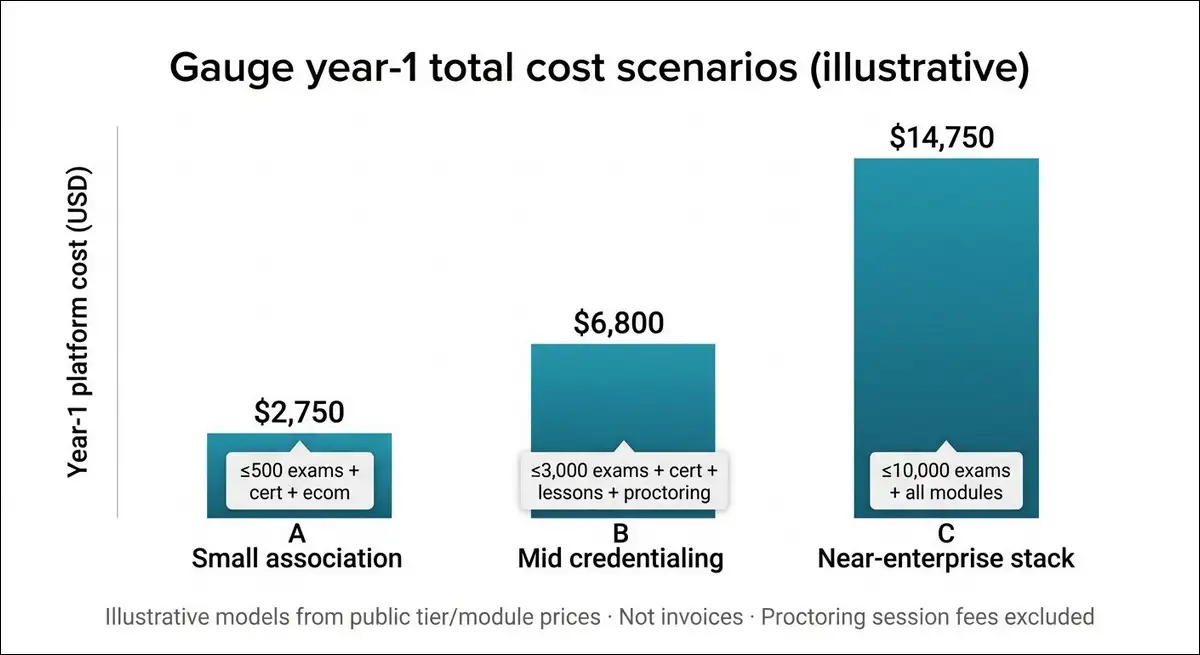
With that in mind, these scenarios use published module and tier figures. They’re illustrative models, not invoices.
Scenario A: Small trade association
Need: ≤500 exams/year, paid certificates, online checkout.
| Line item | Year 1 | Year 2 |
|---|---|---|
| Base (Tier 1) | $1,000 | $1,000 |
| Certification & Badging | $750 | $750 |
| eCommerce | $500 | $500 |
| Setup | $500 | $0 |
| Total | $2,750 | $2,250 |
| Base+modules $/exam at 500 | $5.50 | $4.50 |
Takeaway: Modules can more than double the base. That’s normal when certificates are the product.
Scenario B: Mid-size credentialing body
Need: ≤3,000 exams/year, certificates, lessons, proctoring integration.
| Line item | Year 1 | Year 2 |
|---|---|---|
| Base (Tier 4) | $4,550 | $4,550 |
| Certification & Badging | $750 | $750 |
| Lessons | $250 | $250 |
| Proctoring integration | $750 | $750 |
| Setup | $500 | $0 |
| Total (platform) | $6,800 | $6,300 |
| Platform $/exam at 3,000 | ~$2.27 | $2.10 |
Still missing, though: third-party proctoring session fees. Those can dominate high-stakes programs.
Scenario C: Near-enterprise Professional stack
Need: ≤10,000 exams/year, all modules on Professional.
| Line item | Year 1 | Year 2 |
|---|---|---|
| Base (Tier 8) | $11,500 | $11,500 |
| All five modules | $2,750 | $2,750 |
| Setup | $500 | $0 |
| Total | $14,750 | $14,250 |
| Platform $/exam at 10,000 | $1.48 | $1.43 |
Decision question: At this height, does Enterprise volume pricing beat Professional + modules? You may want to run both quotes.
Scenario D: Enterprise volume illustration (hypothetical)
Need: 25,000 tests/year, full stack.
If a negotiated rate landed at $2.00 per test all-in for platform services, that’s $50,000/year before any external proctoring. At $1.00 per test, it’s $25,000/year.
Those are illustrative rates only. They sit inside the vendor’s stated “starts near $3, falls with volume” story. They aren’t a published price list.
Professional Plus modules or Enterprise: which should you choose?
You may want Professional when volume is under 10,000, and you prefer modular spend. You may want Enterprise when volume, security, or integration needs outgrow that model.
Choose Professional if most of these are true
- Annual tests are clearly under 10,000
- You can live without every module on day one
- Procurement wants transparent calculator pricing
- A small admin team runs the program without heavy SSO needs
- You’re still validating demand for paid credentials
Choose Enterprise if most of these are true
- You’re already over 10,000 tests/year, or will be soon
- Security, SSO, IP controls, and audit exports are mandatory
- Multiple systems need to sync through API and webhooks
- You need a single negotiated rate, not a module stack
- Compliance teams own the buying decision
Simple decision tree
Once you’ve narrowed the fit, you can walk this sequence:
- Count annual tests taken (include retakes if they’re billable).
- List non-negotiables: SSO, eCommerce, badges, proctoring, API.
- Price Professional as base tier + required modules + setup.
- Request an Enterprise quote if volume is over 10k or security is heavy.
- Compare 3-year TCO, not month-one optics.
- Add proctoring session fees outside Gauge’s platform line.
In short: The wrong reason to buy Enterprise is “it sounds bigger.” The right reason is unit economics or control requirements.
How does Gauge pricing compare with other exam platforms?
Gauge sits in the transparent mid-to-enterprise certification band. Some tools are cheaper for light quizzes. High-stakes platforms are often quote-only.
| Platform | Pricing style | Public / reported range | Best fit |
|---|---|---|---|
| Gauge by Test.com | Volume + modules; Enterprise floor published | Professional from ~$1k/yr base; Enterprise from ~$10k+/yr | Credentialing bodies, associations, training providers |
| ClassMarker | Monthly tiers by volume | Roughly $19.95–$39.95/mo entry; higher tiers into hundreds/mo | Educators and lighter business testing |
| Questionmark | Enterprise quote | Third-party roundups often cite $10,000+/yr | High-stakes, psychometric-heavy programs |
| ExamSoft | Institutional quote | Often framed as per-student/year or $10k+ programs | Medical, law, and other high-stakes education |
| ProProfs Quiz Maker | Freemium + paid | Paid plans often from about $20/mo | Mid-market quizzes and training |
| Regional per-test tools | Per attempt | Sometimes ~$0.20–$5 per test equivalent | High-volume, price-sensitive markets |
Important Insight: “enterprise starts at $10,000+”
Many roundups say enterprise assessment software “starts at $10,000+.”
That number is a category cliché, not a regulated floor. It usually means “annual contract for a serious institution,” not a single SKU. Some tools are cheaper. Some multi-campus deals are six figures. Recency matters too, because 2024 brochure prices may not match 2026 quotes.
Next action: You may want to compare cost per completed credential, not logo prestige.
What does Gauge do differently on the pricing page?
Compared with quote-only vendors, Gauge publishes a calculator with volume tiers and module toggles. That means you can budget earlier without a sales call.
That transparency helps early budgeting. It still doesn’t remove negotiation at true enterprise volume.
What hidden costs should enterprise buyers budget for?
Platform fees are only part of the bill. Setup, proctoring sessions, content migration labor, and change management can move the real total.
Hidden or easy-to-miss cost lines
Beyond the headline plan, you may also need to budget for:
- One-time setup ($500 Professional / $2,000 Enterprise on published cards)
- Hosting line items called out separately from software
- Module creep as the program matures
- Proctoring per session from Honorlock, ProctorU, and peers
- Internal admin time for item writing and form design
- Integration engineering, even when API access is licensed
- Accessibility remediation if content isn’t designed well
- Payment fees on eCommerce (Stripe/PayPal processing)
- Retake policy costs if retakes consume volume tiers
- Training time for proctors, graders, and support staff
Cost of delay (vendor framing)
On top of those line items, Gauge’s marketing argues that waiting 6–12 months to switch has a real cost. It cites recovered admin hours after migration.
That argument sells switching. The “avg. 8 hrs/week recovered” style claim is vendor-authored. Treat it as a hypothesis you can validate in a pilot, not as your ROI model.
Next action: You may want to time-study your current reset, scoring, and certificate workflow for two weeks. Use your numbers.
How do you migrate to Gauge without a multi-month project?
Gauge claims most content can move through a CSV import. The vendor also says onboarding often takes days, not months.
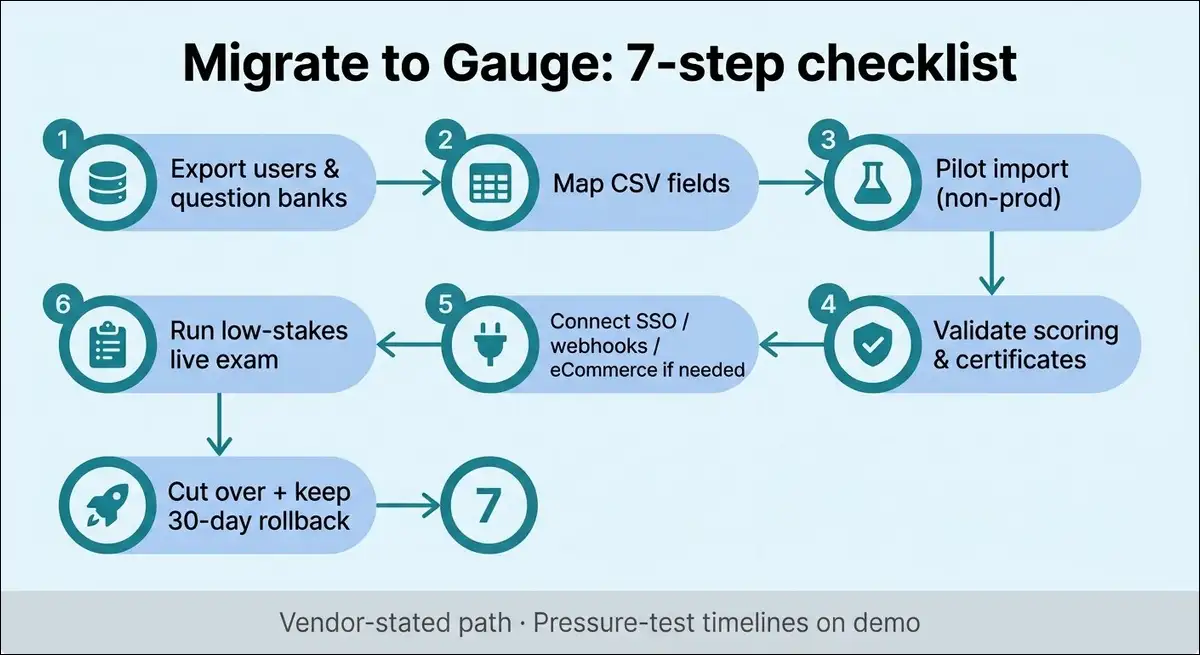
Vendor-stated migration path
If you go that route, the path they describe looks like this:
- Export users, history, and question banks from the old system.
- Map fields into Gauge’s import format.
- Run a pilot import in a non-production window.
- Validate scoring rules, certificates, and permissions.
- Connect SSO, webhooks, or eCommerce if you need them.
- Run a low-stakes live exam before the flagship event.
- Cut over and keep a rollback export for 30 days.
Claims to pressure-test on a demo
Even so, it’s worth pressure-testing these claims on a demo:
- “Single CSV” completeness for your question types
- “1 to 2 days” timeline for complex item banks
- “Live within a week” for enterprises with SSO
- “Never lost a client’s data in 25 years” (vendor trust claim)
In short: Migration risk is usually process risk, not file risk. Scoring rules and credential templates break more often than CSV rows.
How does Gauge handle security, SSO, and audit needs?
Enterprise buyers should evaluate controls, not adjectives. Gauge lists SSO, IP rules, audit trails, and encrypted certificate delivery you may be able to use depending on the plan and setup.
Control checklist (map to your RFP)
| Control | Why it matters | What to ask on a demo |
|---|---|---|
| SSO | Reduces shadow accounts | Which IdPs? SCIM or manual provisioning? |
| MFA / custom auth | Helps stop shared passwords | Can you enforce MFA by group? |
| IP / referral rules | Limits where exams are open | Group-level rules or global only? |
| Audit trail | Proves who changed what | Export format? Retention period? |
| Certificate encryption / tamper evidence | Protects credential trust | Public verification page? |
| Role permissions | Separates authors and admins | Custom roles or fixed templates? |
| API / webhooks | Helps keep LMS/CRM as source of truth | Rate limits? Event catalog? |
| Data processing terms | Legal and privacy review | DPA, subprocessors, regions? |
In short: If your compliance team can’t export an audit package, the feature isn’t complete enough for enterprise use.
What is the test.com domain price in 2026?
The test.com domain is listed for sale at $4,000,000 one-time on Atom. It isn’t a SaaS subscription.
So this is a brand acquisition, not software procurement. Finance, legal, and brand teams should own the decision.
Domain facts from the public listing
Here’s what the public listing shows:
- BIN price: $4,000,000 USD (verify live; ultra-premium prices move)
- Type: four-letter, one-word .com
- Marketplace: Atom Ultra Premium listing
- Transfer: typically initiated within about one business day after payment
- Ongoing cost: about $10/year .com renewal at a normal registrar
- Trademark: not included with the domain
- Protection: marketplace purchase-protection language if transfer fails
Important Insight: the $4,000,000 price tag
Atom lists test.com at $4,000,000.
Marketplace BIN prices are asking prices set by sellers and marketplaces that earn on completed sales. A list price isn’t a closed comparable. Liquidity at this tier is thin. The right buyer may pay near BIN. Another may never appear. Conditions that change value include trademark risk in your class, existing brand equity, and whether you can actually execute on the name.
Next action: You may want to run trademark counsel review before any deposit. Price the domain against customer acquisition savings only with hard funnel data.
Buy Now vs Lease-to-Own vs Rental
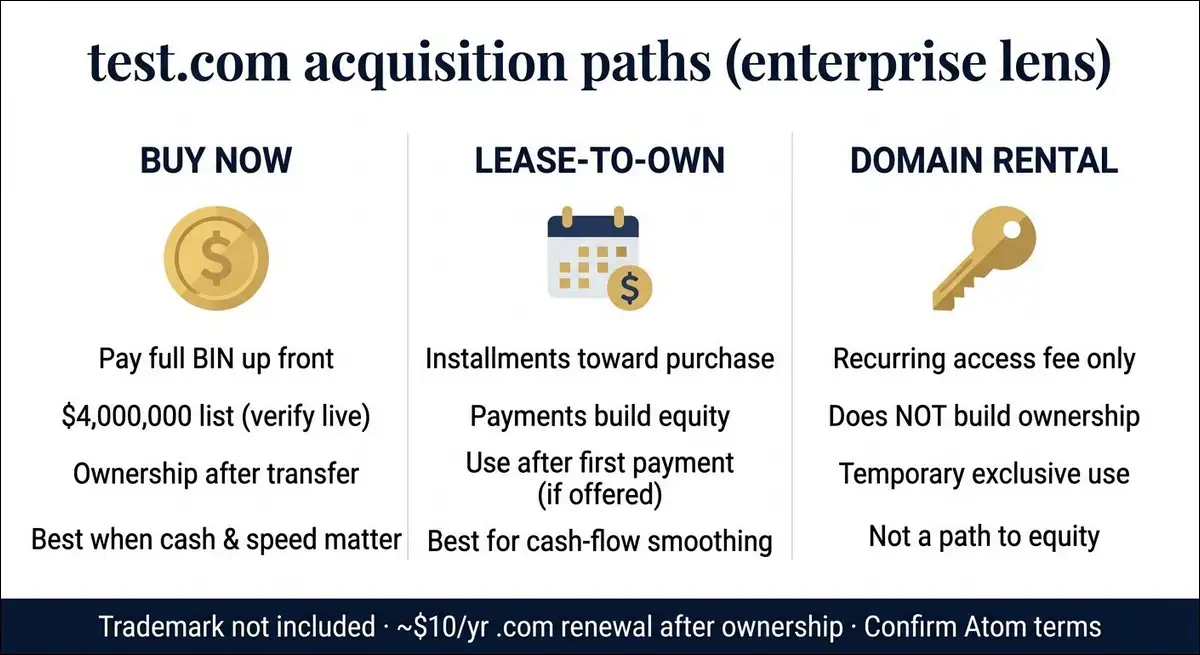
If you’re exploring a payment structure, these are the common paths:
| Option | What you pay | Builds ownership? | Best when |
|---|---|---|---|
| Buy Now | Full BIN up front | Yes, immediately after transfer | Cash is available; speed matters |
| Lease-to-Own (if offered) | Installments toward purchase | Yes, payments build equity | You want the name and need cash flow smoothing |
| Domain Rental (if offered) | Recurring access fee | No | You need temporary exclusive use only |
Atom’s help materials distinguish rental from LTO clearly. Rental fees are access costs. They don’t reduce a future purchase price. LTO payments do.
Ultra-premium names may also use longer installment schedules than standard listings. Confirm terms in writing.
When does a $4M domain make enterprise sense?
It makes sense only if brand leverage beats the capital cost. That’s rare and board-level.
Possible strategic cases include:
- You sell testing infrastructure at global scale and want category ownership
- Offline and direct traffic value is measurable and large
- Sales conversion lifts are proven in controlled tests on lesser domains
- Investors or acquirers price brand assets into valuation
For most credentialing bodies, though, software ROI is the real project. The domain is a separate bet.
Are Testmo, TestRail, and UserTesting the same as test.com?
No. They’re different products that steal attention in search results. Don’t use their price lists as Gauge or domain pricing.
Quick disambiguation table
| Product | Category | Rough 2026 pricing signal | Use if you need |
|---|---|---|---|
| Gauge by Test.com | Certification/exam delivery | From ~$1k/yr base; Enterprise from ~$10k+/yr | Credentials, proctored exams, badges |
| test.com domain | Digital asset | $4,000,000 BIN | Brand domain ownership |
| Testmo | QA test management | Team ~$99/mo; Business/Enterprise in hundreds/mo per seat blocks | Manual + automation test case management |
| TestRail | QA test management | Professional ~$36–$38/user/mo; Enterprise ~$69–$76/user/mo (third-party 2026 reports) | Structured QA workflows |
| UserTesting | UX research | Enterprise contracts often tens to hundreds of thousands per year | Customer video research panels |
Why lookalikes rank
They share the word “test.” Their content engines publish aggressive pricing posts. Google and AI systems sometimes blur entities as a result.
So if your RFP says “enterprise testing platform,” define the noun. Testing software can mean QA, UX, assessments, or load testing. Those budgets don’t transfer.
How should you evaluate enterprise assessment vendors beyond price?
Price without fit is a waste. You’ll also want to score vendors on integrity, operations, and exit risk.
Weighted scorecard you can copy
| Criterion | Weight | What “good” looks like |
|---|---|---|
| Unit economics at your volume | 20% | Clear $/exam or $/credential at year 3 |
| Exam integrity controls | 15% | Proctoring options, randomization, access rules |
| Credential trust | 10% | Verifiable certificates, badge standards |
| Integration depth | 15% | SSO, API events, LMS/CRM sync that your team can run |
| Admin usability | 10% | Non-engineers can launch forms without tickets |
| Reporting/psychometrics | 10% | Exports that satisfy auditors and educators |
| Support model | 10% | Named contacts, response times, onboarding help |
| Exit / data portability | 10% | Full export, documented offboarding |
From there, you may want to run a paid pilot when the contract is material. A demo script isn’t a pilot.
How to run a fair pilot
A fair pilot uses production-like rules on a limited cohort. Soft demos hide failure modes.
Suggested pilot design:
- Duration: 2–4 weeks inside the free trial or a paid sandbox
- Cohort: 30–100 real candidates, not staff only
- Forms: one high-stakes form and one low-stakes practice form
- Integrations: at least one SSO path or one webhook if those are must-haves
- Success metrics: time-to-launch, support tickets, scoring disputes, certificate errors
- Exit test: full data export before you continue
If the vendor resists export testing, treat that as a signal.
RFP questions that surface real pricing
Once the pilot scope is clear, these questions can surface real pricing:
- What counts as a billable test?
- Do retakes bill again?
- Are sandbox users free?
- What’s overage pricing after the tier?
- Which modules are mandatory for SSO?
- What are proctoring session fees at our concurrency?
- What’s the year-1 professional services estimate?
- What SLA and credit schedule apply?
- Where is data stored, and can we restrict regions?
- How do we export all items, results, and credentials at contract end?
Contract terms worth negotiating
List price isn’t the only lever. Enterprise deals often move on structure, and you may have the option to negotiate:
- Multi-year discount in exchange for a clear exit clause
- Price-hold on overage rates for 12–24 months
- Included onboarding hours in writing
- Named support channel for exam-day incidents
- Cap on non-renewal price increases
- Data return format and timeline at termination
In short: If it isn’t in the order form, it isn’t part of the deal.
What older Gauge prices still appear online, and why ignore them?
Older pages still mention Standard at $500/year and Enterprise at $3,000/year. Those figures look active in search snippets even when they’re superseded.
Historical support-style copy described:
- Standard: $500/yr for up to 500 tests
- Enterprise: $3,000/yr for up to 3,000 tests
- Overage: about $1 per extra test
Important Insight: stale pricing in SERPs
Those older numbers still surface in indexes and secondary sites.
They describe a simpler prepaid model. Gauge’s 2026 public site presents modular Professional pricing and a higher Enterprise floor. If a blog still leads with $500/$3,000 as current, it’s likely recycling stale sources.
Next action: Prefer the live calculator on gaugeonline.com over any article, including this one, on the day you buy.
Practical budgeting playbook (step by step)
You can build a defensible budget in one working session. Here’s a sequence you may want to follow.
- Define the product. Certification program, internal exam, or paid course final?
- Count volume. Last 12 months of tests taken, plus 20–30% growth if relevant.
- Mark retake policy. Decide if retakes are free or billable.
- List must-have modules. Badges, lessons, checkout, API, proctoring.
- Price Professional with the public tier table.
- Add year-1 setup and hosting exactly as quoted.
- Get an Enterprise quote if volume or controls demand it.
- Add external proctoring at expected peak concurrency.
- Add internal labor for content and support.
- Compare 36-month TCO across two finalist vendors.
- Negotiate written overage and SLA terms.
- Pilot with a real cohort before full cutover.
In short: If you can’t explain cost per successful credential, you’re not done pricing.
Worked example: cost per successful credential
Platform cost only matters relative to outcomes. Here’s a simple model.
Assume:
- 3,000 exams/year
- 80% pass rate → 2,400 credentials
- Platform year-2 cost $6,300 (Scenario B without proctoring sessions)
Platform cost per successful credential ≈ $6,300 / 2,400 = $2.63.
Now add proctoring at a hypothetical $12 per session for all 3,000 exams: $36,000.
Total variable stack ≈ $42,300.
Cost per successful credential ≈ $17.63.
That second number is what finance will remember. It also shows why proctoring policy design matters as much as SaaS list price.
And your pass rate, no-show rate, and retake rate will move this more than a $250 module.
Content and program design choices that change your bill
How you design the program can change consumption. Pricing pages rarely say that clearly.
Design levers
A few levers you can pull:
- Shorter forms can reduce fatigue and retakes
- Prerequisites via Lessons may cut unqualified attempts
- Clear candidate prep can raise first-time pass rates
- Grouped testing windows may improve proctoring volume discounts
- Badge pathways may increase total attempts if you monetize micro-credentials
- Practice exams may be cheaper in a lower-security mode
In short: Growth in badges can be revenue. It can also be volume that pushes you into the next tier.
So model both the revenue and the tier jump before launch.
Example: micro-credential expansion math
Suppose you add three micro-badges under a main certification. Each badge is a short exam.
If 1,000 people take the main exam once, that’s 1,000 tests. If half also take three micro-exams, you add 1,500 attempts. Your volume jumps to 2,500 before retakes.
On Gauge’s public ladder, you can move across tiers. Revenue may still win. You just need the tier change in the forecast.
Ask finance one blunt question: what’s our target contribution margin per credential after platform and proctoring costs?
Who is Gauge a poor fit for?
Not every testing need belongs on a certification platform. Saying no early can save budget.
Gauge is likely a weak fit if:
- You only need informal course quizzes inside an LMS
- Your “testing” problem is a software QA case management
- You need heavy item-response theory tooling and a psychometrics team already on another stack
- Your volume is tiny, and a low-cost quiz tool covers integrity needs
- You require an on-prem only deployment and won’t consider SaaS
In short: Buying enterprise certification software to solve a quiz problem is overspending. Buying a quiz tool to solve licensure risk is under-protecting.
Match the severity of the credential to the severity of the stack.
Final recommendation matrix
Match the purchase to the job. Don’t force one budget to answer three different problems.
| Your job-to-be-done | Best focus | Budget posture |
|---|---|---|
| Launch or modernize certifications | Gauge Professional + needed modules | Model $/credential; pilot in 30 days |
| Run >10k high-stakes exams with SSO | Gauge Enterprise quote | Demand volume curve + SLA in writing |
| Own the literal test.com brand | Atom domain acquisition process | Board-level capital + trademark counsel |
| Manage QA test cases for software teams | Testmo / TestRail / peers | Per-seat math, not exam volume |
| Run UX research studies | UserTesting or lighter research tools | Panel credits + seats, not certificates |
What to do this week
If you want a simple next step, start here:
- Write one sentence that defines your “test” problem.
- Count last year’s tests taken.
- Price Professional on the public calculator.
- Request one Enterprise quote if you’re near 10k tests.
- Ignore lookalike SaaS prices that don’t match your category.
- Re-verify every number on vendor sites before procurement sign-off.
Method note and source hygiene
This article is a research synthesis. Primary anchors are Gauge’s pricing and enterprise pages plus Atom’s test.com listing.
Secondary ranges for ClassMarker, Questionmark, ExamSoft, Testmo, TestRail, and UserTesting come from recent public pages and 2026 analyses. They’re for orientation only.
We don’t claim private contract access. Where vendors self-report unit economics or uptime, we label the claim and show what to verify.
If a figure is material to your purchase, treat this page as a map. Treat the vendor quote as the terrain.
Key takeaways
- Gauge Professional is modular and volume-tiered; base pricing can start near $1,000/year before modules.
- Gauge Enterprise is framed from about $10k+/year and targets >10,000 tests/year with negotiated $/test.
- Modules and proctoring sessions often matter more than the headline plan name.
- test.com the domain is a $4M-class brand asset, not software.
- Testmo, TestRail, and UserTesting are different categories that confuse search results.
- Unit economics per successful credential beat sticker price arguments.
- Re-check live vendor pages on the day you buy. Prices move.
Sources to re-verify before you buy
Primary
Context only (different products or secondary ranges)
- Testmo support price list and pricing page
- Recent 2026 TestRail and UserTesting pricing analyses
- Independent exam-software roundups for ClassMarker, Questionmark, and ExamSoft ranges
When a primary page and a secondary blog disagree, trust the primary page. When two primary pages use soft wording on unit rates, ask for a quote.