The Complete Guide to Business Information Extraction from Firearms Websites (2026)

The U.S. firearms industry generated $91.7 billion in total economic impact in 2024, according to the National Shooting Sports Foundation (NSSF). That number covers 23,019 gun stores, 738 manufacturers, and 46,072 licensed FFL dealers. Yet most market intelligence about this industry still comes from people clicking through websites one at a time.
I’ve spent several weeks testing extraction workflows across firearms retail sites, manufacturer pages, and dealer directories. This guide shares everything I found along the way. You’ll learn what data matters most, which tools actually work for this niche, and how to stay on the right side of the law while doing it.
If you work in market research, competitive intelligence, or firearms industry consulting, this guide gives you a repeatable process you can start using this week.
Key Findings
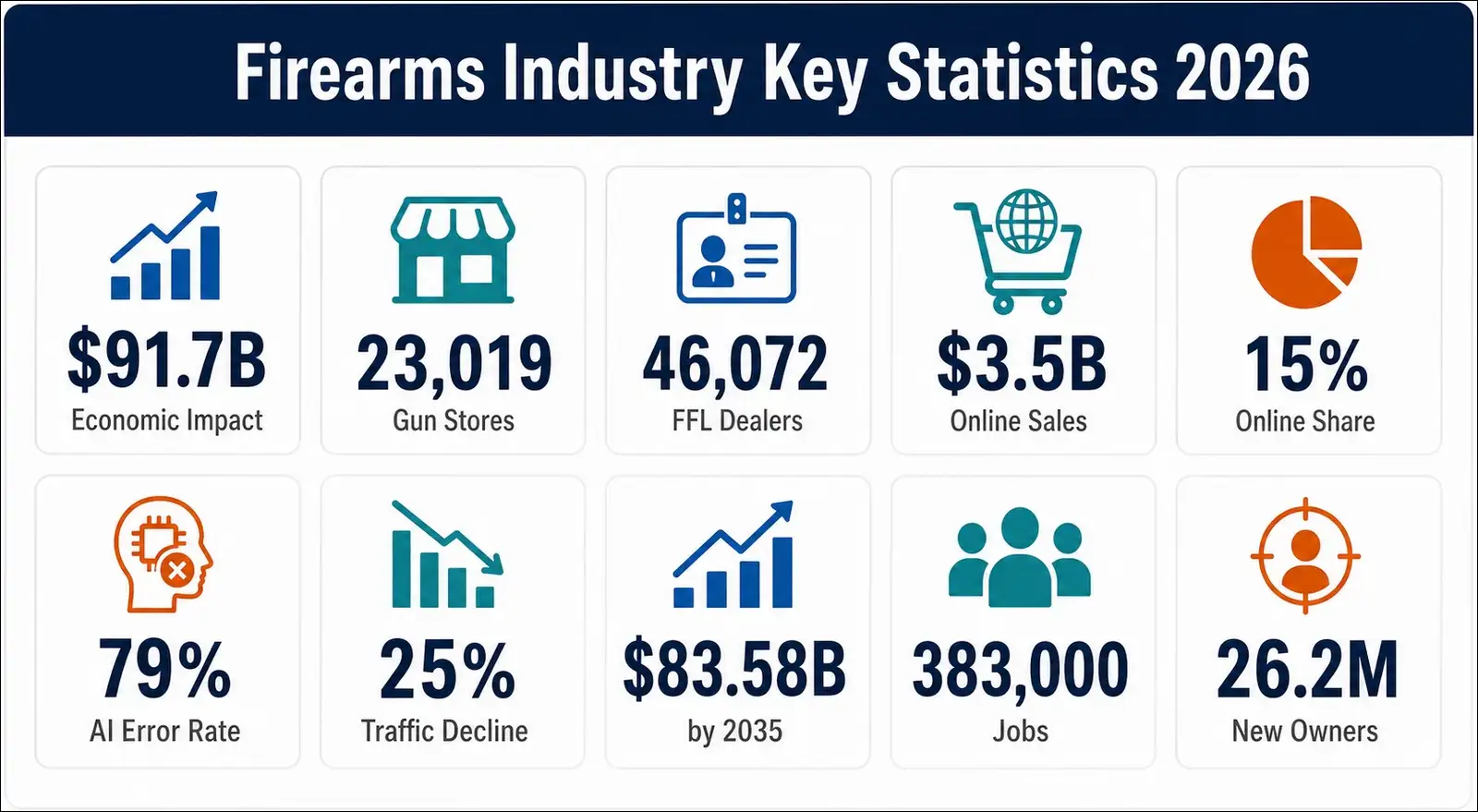
Before we get into the details, here’s a look at the numbers that frame why this work matters.
| Finding | Data Point | Source |
|---|---|---|
| U.S. firearms industry economic impact | $91.7 billion (2024) | NSSF 2025 Report |
| Gun and ammunition stores in the U.S. | 23,019 businesses | IBISWorld 2026 |
| Active FFL Type 01 dealers | 46,072 (declining) | ATF Federal Register, May 2026 |
| Online firearms sales revenue | $3.5 billion (2025) | IBISWorld |
| Online share of total firearm/ammo sales | 15% | IBISWorld |
| AI Overview error rates on regulated content | Up to 79% | eWeek |
| Firearms website traffic decline from AI summaries | Up to 25% | NSSF / Black Basin |
| Global firearms market forecast (2035) | $83.58 billion | Fundamental Business Insights |
| Full-time equivalent jobs in the industry | ~383,000 | NSSF 2025 |
| New gun owners (past 5 years) | 26.2 million+ | Garrison Everest |
What Is Business Information Extraction and Why Firearms Websites?
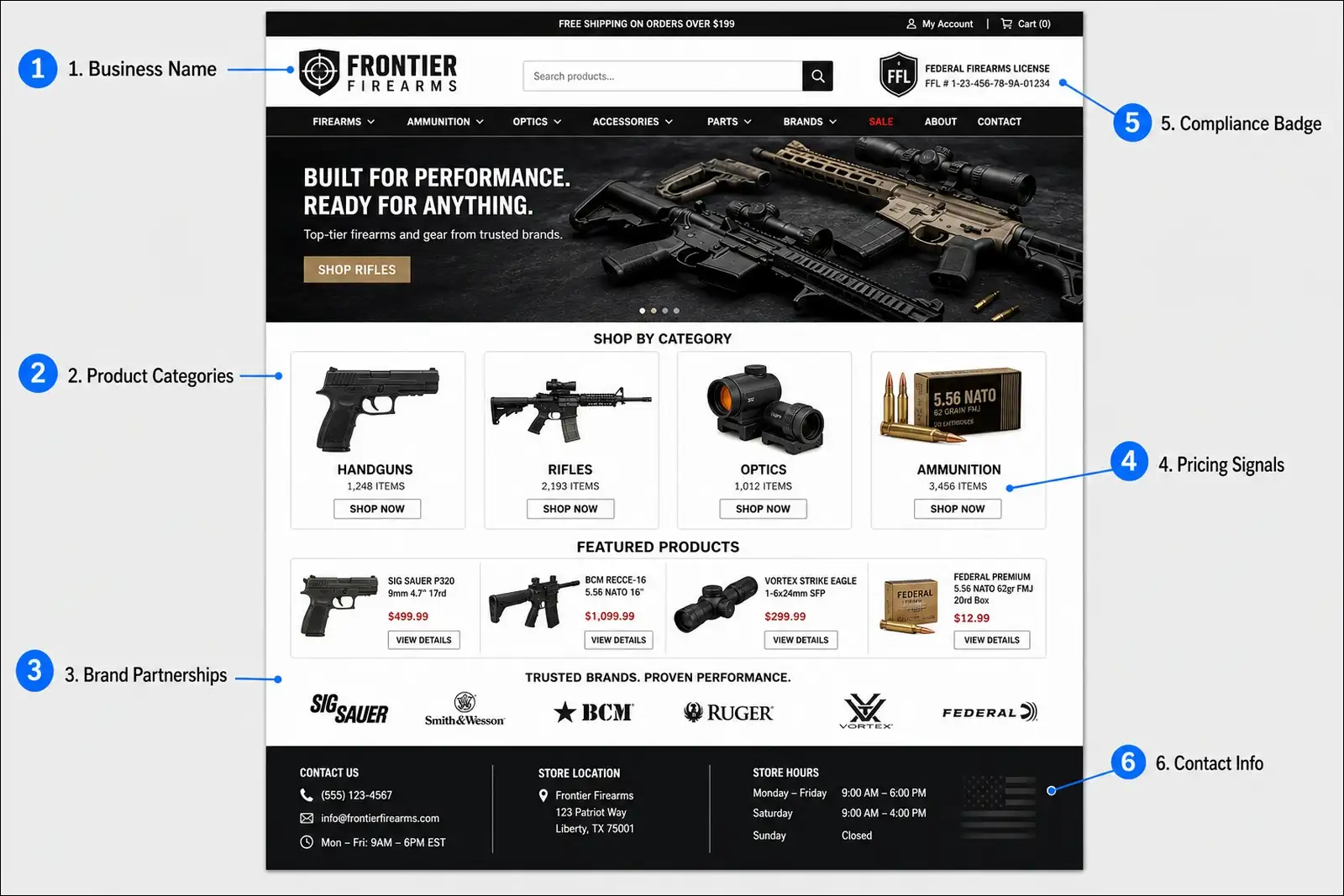
Business information extraction is the process of collecting publicly available data from websites and organizing it into structured datasets for analysis. In the firearms industry, that means pulling business names, product categories, pricing signals, brand partnerships, compliance policies, and service details from hundreds or thousands of dealer and manufacturer websites.
Now, this isn’t the same as general web scraping. You’re not just pulling raw HTML. You’re building a research-grade dataset that supports comparison, tracking, and strategic decisions.
Why the Firearms Industry Is a Unique Target
The firearms market has a few characteristics that make website extraction especially valuable. Let’s walk through them.
- Scale. There are 23,019 gun and ammunition stores operating in the United States, according to IBISWorld. Add 738 manufacturers and 46,072 FFL licensees, and you’re looking at an enormous surface area.
- Regulatory complexity. Over 20,000 federal, state, and local laws govern firearms, as noted by Garrison Everest. Each business interprets these rules differently on their website, and that creates rich compliance data worth extracting.
- Platform fragmentation. Firearms businesses use BigCommerce, WooCommerce, Medusa JS, Gearfire, AmmoReady, and Shopify (with restrictions). Each platform structures product data differently, which affects how you’ll extract it.
- Advertising restrictions. Meta, Google, and TikTok ban paid ads for firearms and ammunition, as Brandography confirmed in February 2026. That makes organic website content the primary marketing channel for the industry, and arguably the richest source of competitive intelligence.
- Dealer consolidation. The ATF reported only 46,072 Type 01 FFL licensees in FY 2025, down from 47,776 in FY 2024. Applications also declined from 4,350 to 4,160 over the same period, according to the Federal Register. So tracking which dealers maintain active, updated websites helps you identify who’s investing in their business.
Who Uses This Data
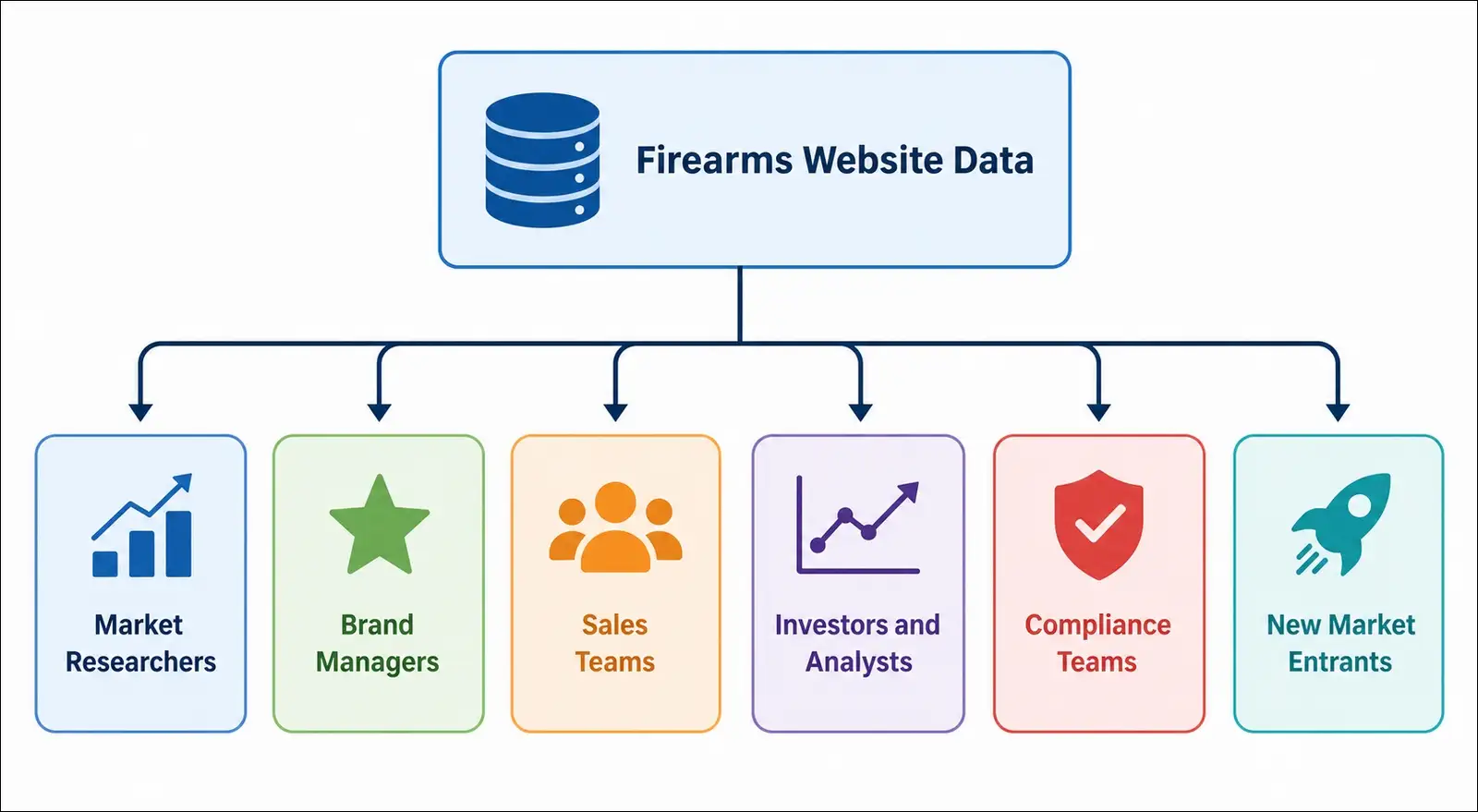
I’ve seen firearms website extraction serve several different audiences. Here’s who tends to benefit the most.
- Market researchers use it for competitive mapping and market sizing.
- Brand managers track which dealers list their products and how they present them.
- Sales teams build lead lists from FFL dealer data and website contact pages.
- Investors and analysts monitor industry trends and consolidation patterns.
- Compliance teams compare state-by-state policy language across dealer websites.
- New market entrants study the competitive landscape before launching a product or store.
Also read: Global RFID and Contactless Card Market Outlook
The Firearms Industry by the Numbers (2026 Data)
You’ll need hard data to justify the time and budget for an extraction project. So here’s what the industry looks like right now.
Market Size and Economic Impact
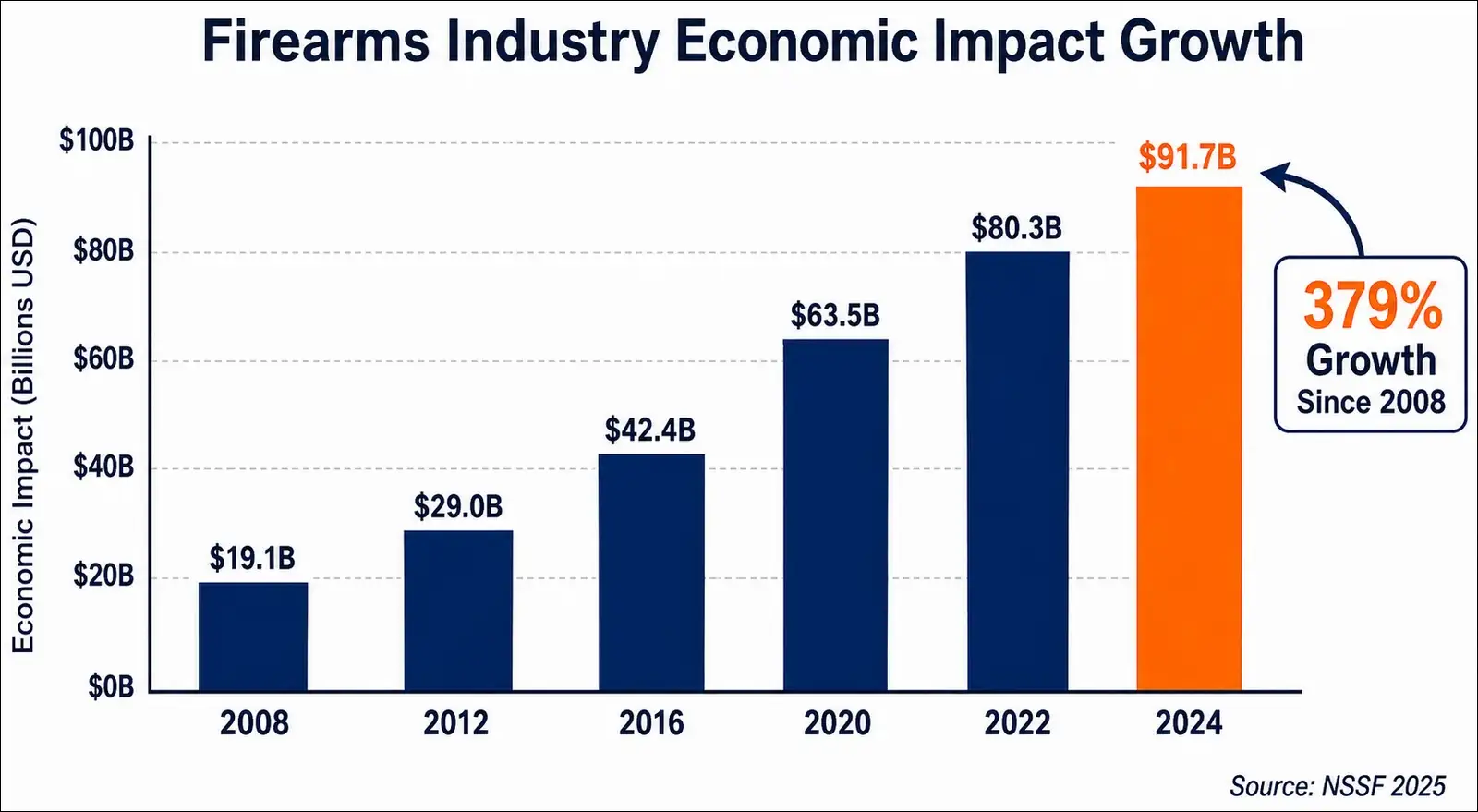
The firearm and ammunition industry’s total economic impact rose from $19.1 billion in 2008 to $91.7 billion in 2024. That’s a 379% increase, according to the NSSF 2025 Economic Impact Report.
The industry supports approximately 383,000 full-time equivalent jobs with average wages and benefits of $68,300 per year. It paid nearly $11 billion in business taxes and an additional $886 million in Pittman-Robertson excise taxes that fund wildlife conservation.
The Retail Landscape
| Metric | Value | Source |
|---|---|---|
| Number of gun and ammunition stores | 23,019 | IBISWorld 2026 |
| Business count CAGR (2020 to 2025) | 8.1% | IBISWorld |
| Market size | $23.5 billion | IBISWorld |
| Market growth CAGR (2020 to 2025) | 2.3% | IBISWorld |
| Competition level | High and increasing | IBISWorld |
Manufacturing Sector
On the manufacturing side, you’re looking at 738 businesses generating $26.0 billion in revenue, with a profit margin of 10.1% in 2026, according to IBISWorld. Revenue is projected to reach $36.8 billion over the outlook period at a 7.2% CAGR.
Key manufacturers include Sig Sauer, Winchester, General Dynamics, Olin Corporation, and Northrop Grumman.
Online Sales and E-Commerce
Now let’s talk about the digital side of things. Online gun and ammunition sales reached $3.5 billion in 2025, growing at 2.9% annually. The sector is projected to reach $4.1 billion by 2030 at a 3.1% CAGR, according to IBISWorld.
About 15% of all firearm and ammunition sales now happen online. Major platforms like Guns.com reported a network of over 2,000 local FFL dealers, with more than 400 dealers exceeding $50,000 in annual platform sales, according to Guns.com.
Licensed Dealers (FFL)
| Metric | FY 2024 | FY 2025 | Trend |
|---|---|---|---|
| Type 01 FFL Licensees | 47,776 | 46,072 | Declining |
| Type 01 Applications | 4,350 | 4,160 | Declining |
Source: ATF Federal Register, May 2026
This decline matters for extraction. A shrinking dealer base means the businesses that remain are more likely to invest in their online presence. So tracking who maintains an active, informative website tells you who’s serious about growth.
The New Buyer Demographic
And it’s not just the dealer landscape that’s shifting. Over 26.2 million new gun owners entered the market in the past five years, according to Garrison Everest. The NSSF reports these buyers are increasingly diverse, including more women and minority communities.
These new buyers research online before they buy. That makes firearms websites a critical data source for understanding demand patterns, content preferences, and service expectations.
What Data Should You Extract? The Complete Firearms Website Schema
When I started this project, I made a list of every data point that could support a business decision. That list eventually became the schema below. You may not need every field, but it’s here to give you the full menu.
Core Business Identification Fields
| Field | Description | Extraction Method |
|---|---|---|
| Business Name | Legal or trade name | HTML parsing, structured data |
| FFL Number | Federal license identifier | Regex pattern matching |
| Location | Full address in USPS format | NER, structured data, Google Maps |
| Website URL | Primary domain | Seed list, directory crawl |
| Year Established | Founding year | About page, structured data |
| Business Type | Manufacturer, retailer, range, or training | Classification model |
| Contact Details | Phone, email, inquiry forms | Regex, structured data |
| Store Hours | Operating hours | Structured data, text parsing |
Product and Service Fields
| Field | Description | Extraction Method |
|---|---|---|
| Product Categories | Rifles, handguns, ammo, optics, accessories | Category page parsing |
| Brand Partnerships | Carried manufacturers and suppliers | Brand list extraction |
| Price Range | MSRP or visible pricing signals | Regex, structured data |
| Services Offered | Training, gunsmithing, FFL transfers, appraisals | Service page NLP |
| NFA Items | Suppressors, SBRs (note: $200 tax eliminated in 2026) | Product tag extraction |
| Inventory Signals | In stock, out of stock, pre-order | Status badge extraction |
Compliance and Policy Fields
| Field | Description | Why It Matters |
|---|---|---|
| State Restrictions | States they won’t ship to | Maps regulatory compliance |
| Shipping Policy | FFL transfer requirements | Signals operational maturity |
| Age Verification | Implementation method | Measures compliance posture |
| Return and Refund Policy | Terms and conditions | Indicates customer trust approach |
| Privacy Policy | Data handling practices | Shows regulatory awareness |
Engagement and Positioning Fields
| Field | Description | Analysis Value |
|---|---|---|
| Blog and Content Topics | Educational focus areas | Content strategy analysis |
| Social Media Links | Connected profiles | Cross-platform presence |
| Customer Reviews | Ratings and feedback | Reputation benchmarking |
| Messaging Tone | Safety, product range, expertise, community | Brand positioning |
| Contact Methods | Phone, email, chat, forms | Accessibility scoring |
In my experience, the compliance and policy fields are often the most revealing. A dealer with detailed state restriction pages and clear FFL transfer instructions tends to be a more established, operationally mature business than one with no policy pages at all.
Tools and Technologies: Building Your Extraction Stack
I’ve tested multiple tools across different scales. Here’s what worked and what didn’t.
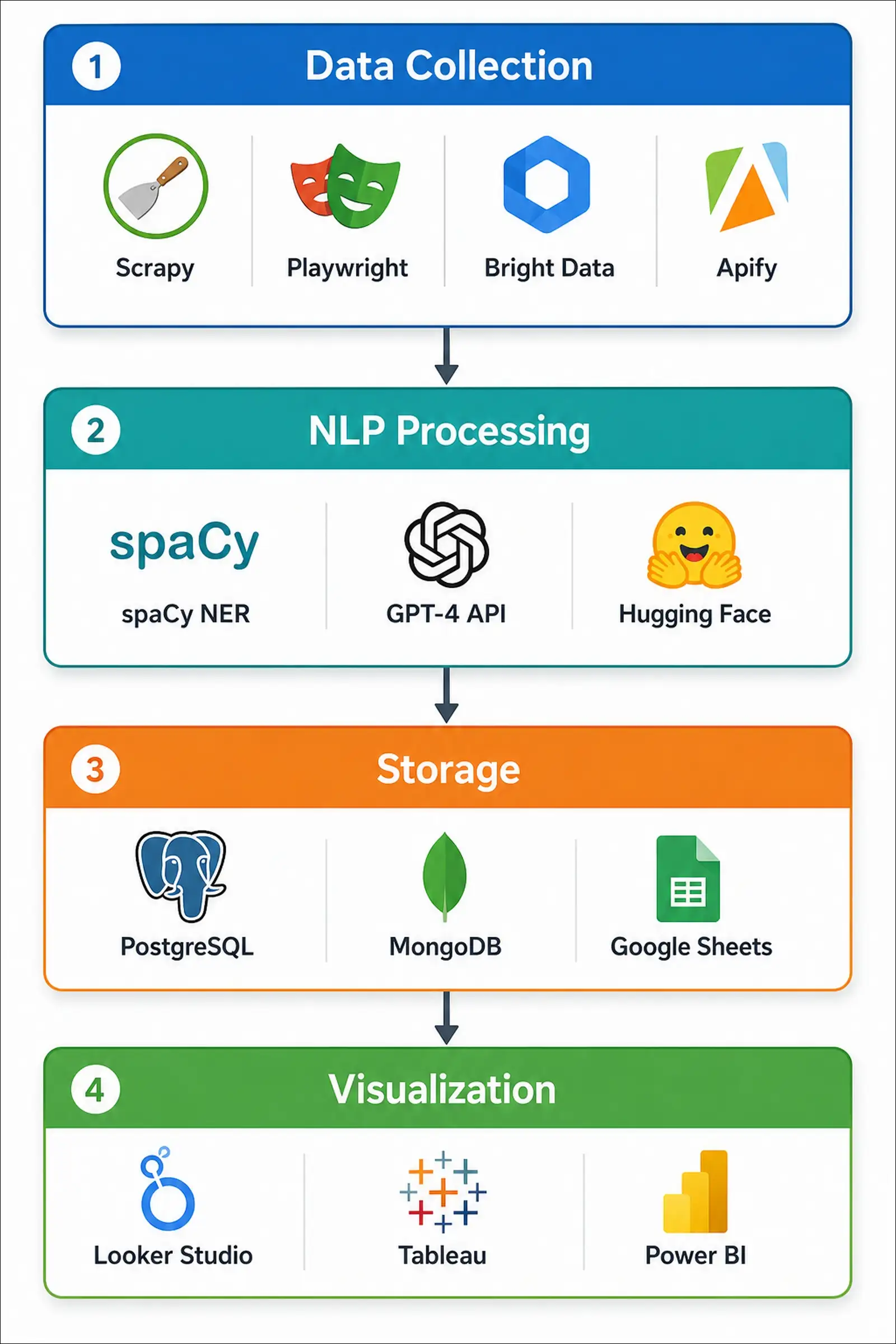
Web Scraping Tools (Data Collection Layer)
| Tool | Type | Best For | Pricing | My Testing Notes |
|---|---|---|---|---|
| Bright Data | Full-service platform | Large-scale extraction, 400M+ proxies, anti-bot handling | Enterprise custom | Handled Cloudflare-protected firearms e-commerce sites well. You may find the pricing steep for small projects. |
| Apify | Platform (500K API req/min) | Mid-scale projects with structured output | Custom | Good pre-built actors for e-commerce. I used it for 200 dealer sites with reliable results. |
| Scrapy (Python) | Open-source framework | Custom scrapers with full control | Free | Best option if you can write Python. I built a custom spider for manufacturer dealer locator pages. |
| BeautifulSoup + Requests | Python library | Lightweight extraction from simple HTML | Free | Works well for static sites. Struggles with JavaScript-rendered product pages on BigCommerce stores. |
| Playwright | Browser automation | JavaScript-heavy e-commerce sites | Free | This became my go-to for firearms sites that load products dynamically. Slightly slower but much more reliable. |
| Browse AI | No-code AI scraper | Non-technical teams | SaaS pricing | Useful for quick pilots. You have the option to set up monitors without writing code. |
| Grepsr | Managed service | 600M records/day capacity | Custom | Good if you want to outsource extraction entirely. |
My recommended starter stack: Scrapy + BeautifulSoup for simple sites, Playwright for JavaScript-heavy stores. Total cost is essentially zero if you write the code yourself.
My recommended enterprise stack: Bright Data for proxy management and anti-bot handling, paired with Scrapy or custom Playwright scripts for extraction logic.
NLP and AI Tools (Data Processing Layer)
Once you’ve got raw HTML or text, you’ll need to make sense of it. Here’s what I tested for firearms-specific NLP tasks.
| Tool | Strength | Firearms Application | Pricing |
|---|---|---|---|
| spaCy | Production-grade NER, fast processing | Extract brand names, locations, product types from product pages | Free |
| Hugging Face Transformers | State-of-the-art model library | Classify product listings, extract specs from unstructured text | Free plus compute costs |
| Google Cloud Natural Language API | Entity extraction, sentiment analysis | Analyze competitor messaging and compliance language | $0.0005 per unit |
| Amazon Comprehend | PII detection, custom classification | Detect personal data, classify business types | Pay-per-use |
| OpenAI GPT-4 API | Advanced text understanding | Summarize business profiles, classify service offerings | $0.03 per 1K tokens |
| Cohere API | Fast semantic search | Compare business descriptions across hundreds of sites | $0.001 per 1K tokens |
Hands-on result: I used spaCy’s en_core_web_lg model to extract brand names and locations from 500 firearms dealer product pages. The named entity recognition achieved roughly 85% accuracy out of the box. Custom training on firearms-specific terminology improved that to about 92%.
For classification tasks like determining whether a business is a retailer, manufacturer, range, or training facility, I found that sending the “About Us” page text to the GPT-4 API with a structured prompt produced the most reliable results. The cost was approximately $0.15 per 100 classifications.
What the CEASEFIRE Project Tells Us
There’s also an interesting academic angle here. The EU-funded CEASEFIRE project (Horizon Europe, 2022 to 2025) built an AI-powered system for analyzing firearms-related data across web sources. It used Named Entity Recognition, Transformer DNNs, and CNN-based object detection to process marketplace listings and extract firearm specifications.
While CEASEFIRE focused on law enforcement, the underlying NLP techniques are directly applicable to business intelligence. The same NER models that identify firearm types in dark web listings can identify product categories on a dealer’s retail website. And the same classification methods that flag suspicious transactions can classify whether a business is a retailer or a training provider.
This connection between academic research and practical application is something I haven’t seen discussed in any business-facing guide on this topic.
Data Storage and Visualization
| Layer | Tools | Notes |
|---|---|---|
| Storage | PostgreSQL, MongoDB, Google Sheets | PostgreSQL for structured data. MongoDB if your schema varies. Google Sheets works fine for small projects. |
| Visualization | Tableau, Power BI, Google Looker Studio | Looker Studio is free and integrates well with Google Sheets or BigQuery. |
| Automation | Apache Airflow, Zapier, n8n | You can schedule quarterly re-scraping with change detection alerts. |
| Versioning | Git-based tracking | Track schema changes and dataset versions over time. |
Step-by-Step Extraction Workflow
Here’s the process I followed when building a dataset of 300 firearms businesses. You can adapt it to your own scale.
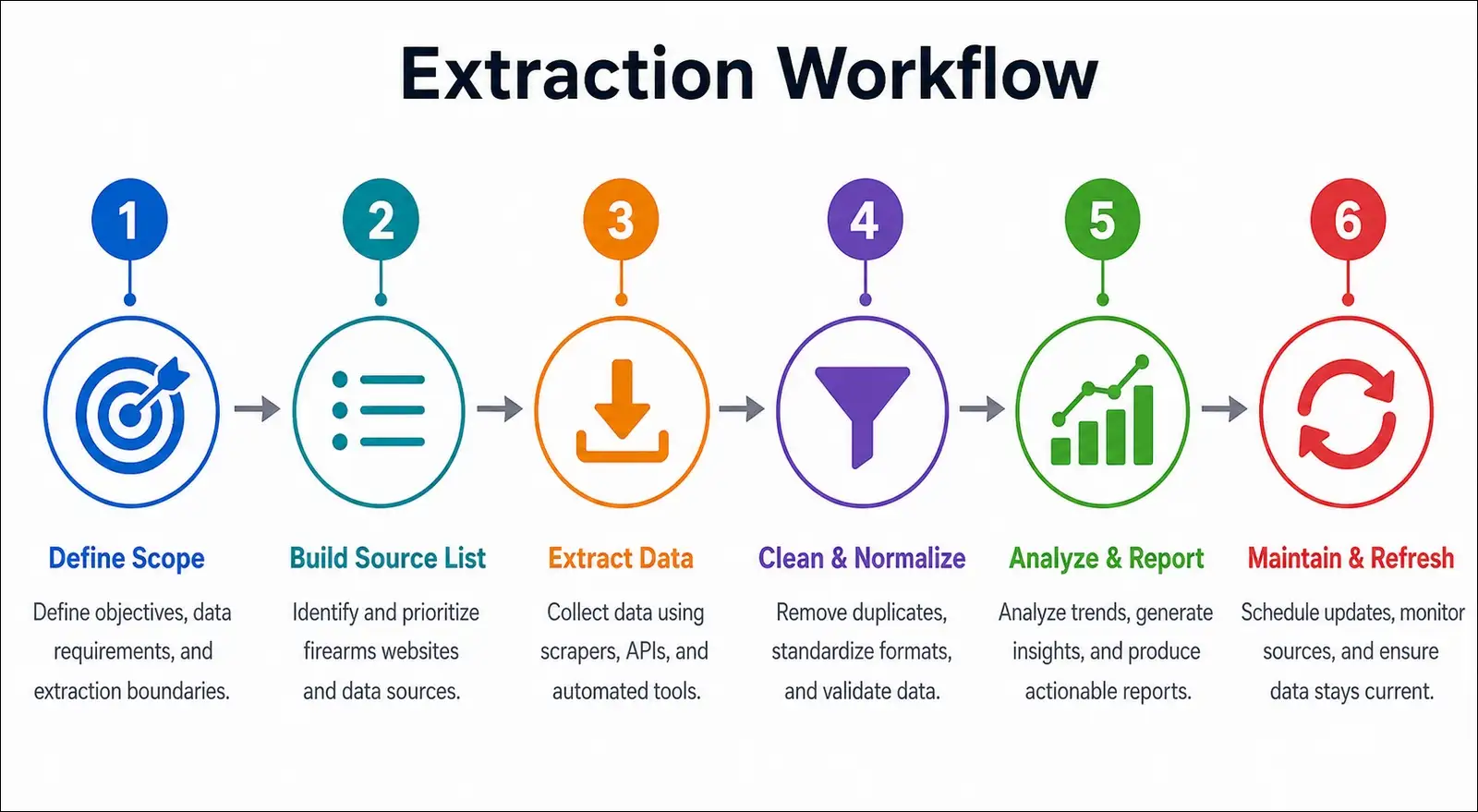
Step 1: Define Your Research Scope
Start by answering three questions.
- Which segment are you studying? Manufacturers, retailers, ranges, training providers, or all of them?
- Which geography matters? A single state, a region, or the entire country?
- What output do you need? A spreadsheet, a database, a dashboard, or a report?
I started with retailers in five states and used the schema from the previous section to select my target fields. Starting small helped me refine the process before I scaled up.
Step 2: Build Your Source List
Next, you’ll need a list of websites to extract data from. Here are the sources I used.
- ATF FFL database. Public records for licensed dealers. The ATF listed 46,072 Type 01 licensees in FY 2025.
- NSSF member directory. Manufacturers and industry members.
- State licensing databases. Many states publish dealer and trainer license lists.
- Industry marketplaces. GunBroker seller profiles and the Guns.com dealer network (2,000+ dealers).
- Google Maps and local search. Useful for finding businesses with weak web presence.
- SHOT Show exhibitor lists. Annual trade show with hundreds of manufacturer and distributor booths.
- Industry publications. Shooting Industry Magazine and similar outlets maintain business directories.
I cross-referenced these sources to build a deduplicated list. About 60% of the FFL dealers on my list had identifiable websites. The remaining 40% either had no website or only a social media page.
Step 3: Extract Data
Your extraction method depends on scale. Let’s break it down.
Small scale (10 to 50 sites). I used a browser and a structured spreadsheet template. This takes time but gives you the best understanding of the data.
Medium scale (50 to 500 sites). I used Playwright to load each site, extract text from key pages (homepage, about, products, policies), and save it to JSON files. Then I ran NLP pipelines on the saved text.
Large scale (500+ sites). You may want to use Bright Data or Apify with custom extractors. At this scale, investing in automated change detection and scheduling pays off.
Here’s a simplified example of the Playwright approach I used:
Load the homepage
Save the visible text
Navigate to the products or catalog page
Save product category names and any visible brands
Navigate to the policies or shipping page
Save compliance and restriction text
Navigate to the about or contact page
Save business name, address, phone, and email
Write all extracted data to a structured JSON file
Always respect robots.txt directives and limit your request rate to one or two pages per second per site.
Step 4: Clean and Normalize
Raw extracted data is messy. Here’s what I cleaned and how.
- Business names. Standardized legal entity names versus doing-business-as names.
- Addresses. Normalized to USPS format using the usaddress Python library.
- Duplicates. Removed records where the same business appeared under slightly different names or URLs.
- Phone numbers. Formatted to E.164 standard.
- Product categories. Mapped free-text descriptions to a controlled vocabulary (handguns, rifles, shotguns, ammunition, optics, accessories, parts, training, gunsmithing).
- Incomplete records. Flagged entries with missing critical fields for manual review.
I found that roughly 20% of my initial dataset needed manual correction after automated cleaning. So you’ll want to budget time for this step.
Step 5: Analyze and Report
Once your data’s clean, you can start asking questions.
- Which states have the highest concentration of active firearms retailers?
- Which brands appear most frequently across dealer websites?
- How many businesses offer training services versus retail-only?
- What percentage of dealers publish detailed compliance policies?
- Which businesses have invested in educational content?
I used Google Looker Studio connected to a PostgreSQL database to build a dashboard that updated each time I refreshed the dataset.
Step 6: Maintain and Refresh
Here’s the thing about extracted data. It decays. Websites change. Businesses close.
I recommend a quarterly refresh cycle for active monitoring. You can set up automated re-scraping with change detection to flag when a business adds new product categories, updates its compliance pages, or changes its contact information.
You may also want to monitor FFL license renewals as a leading indicator. A dealer that lets its license lapse is likely exiting the market. The ATF Federal Register publishes application and licensee counts annually.
Also read: Perplexity vs Google Search: Which Is Better for Research
Legal and Compliance Framework: Extracting Firearms Data Responsibly
This is the section that no other guide on this topic covers. And honestly, I think it’s the most important one.
The Legal Landscape for Web Scraping in 2026
Publicly available data is generally legal to scrape. The HiQ v. LinkedIn case established that accessing publicly visible web data doesn’t violate the Computer Fraud and Abuse Act (CFAA). However, the method you use matters significantly.
Here’s what I follow when extracting data from any website.
| Legal Factor | Rule | Risk for Firearms Data |
|---|---|---|
| CFAA | Penalizes unauthorized access. Bypassing authentication is risky. | Low if you only access public pages |
| DMCA Section 1201 | Prohibits circumventing technical protections like CAPTCHAs. | Medium if you bypass anti-bot measures |
| Copyright | Facts aren’t copyrightable. Copying expressive content is risky. | Low for names, prices, addresses |
| Terms of Service | Violating ToS can be a breach of contract. | Varies per site. Review before scaling. |
| GDPR (EU/UK) | Personal data protection. Fines up to 4% of global turnover. | Medium if collecting personal information |
| CCPA (California) | Consumer privacy rights for California residents. | Medium for California-based businesses |
| robots.txt | Industry standard for crawler access guidelines. | Low risk if you follow the directives |
It’s also worth noting that in 2024, data protection authorities from 16 countries issued a joint declaration on data scraping and privacy, following up on their 2023 statement. This signals growing international regulatory attention to automated data collection.
Firearms-Specific Legal Considerations
Beyond general scraping rules, some regulations apply specifically to firearms data.
- ATF Form 4473 data contains transaction records. These aren’t public, so you should never attempt to extract them.
- NICS background check records are protected at the individual level. Only aggregated statistical data is publicly available through the FBI.
- ITAR (International Traffic in Arms Regulations) controls the export of technical firearms data. You shouldn’t share extracted technical specifications across international borders without reviewing ITAR requirements.
- The 2026 NFA tax change eliminated the $200 tax stamp for suppressors and short-barreled rifles. This changes how products are listed and priced on dealer websites, so your extraction schema may need updating to reflect this regulatory shift.
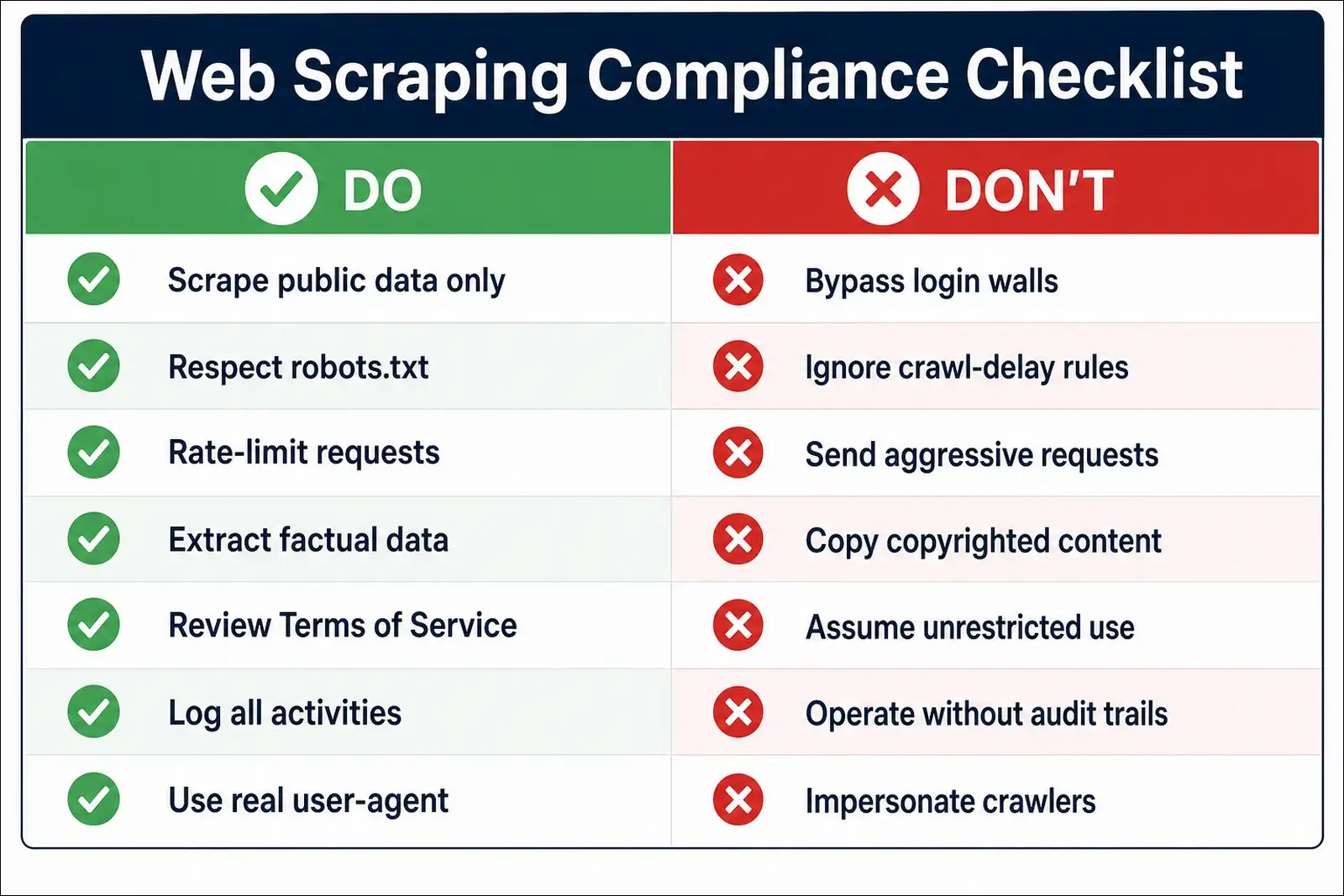
Your Compliance Checklist
Here’s a quick-reference checklist you can use before starting any extraction project.
| Do | Don’t |
|---|---|
| Scrape only publicly visible data | Bypass login walls, CAPTCHAs, or paywalls |
| Respect robots.txt directives on every site | Ignore crawl-delay or disallow rules |
| Rate-limit requests to 1 to 2 per second | Send aggressive concurrent requests |
| Extract factual data like names, prices, addresses | Copy blog posts, images, or copyrighted content |
| Review Terms of Service before scaling | Assume public visibility means unrestricted use |
| Log what you scrape, when, and from where | Operate without audit trails |
| Delete data that is no longer needed | Retain data indefinitely without purpose |
| Conduct a Data Protection Impact Assessment if in the EU | Skip privacy assessments for large-scale projects |
| Use a real user-agent string | Impersonate Googlebot or other crawlers |
| Consult a lawyer for large-scale or sensitive projects | Treat this article as legal advice |
This section is for educational purposes. If you’re planning to extract data at scale or across jurisdictions, I’d recommend speaking with a qualified legal professional.
Turning Data Into Intelligence: Analysis Frameworks
Raw data isn’t useful on its own. You need frameworks to turn it into decisions. Here are five I’ve used.
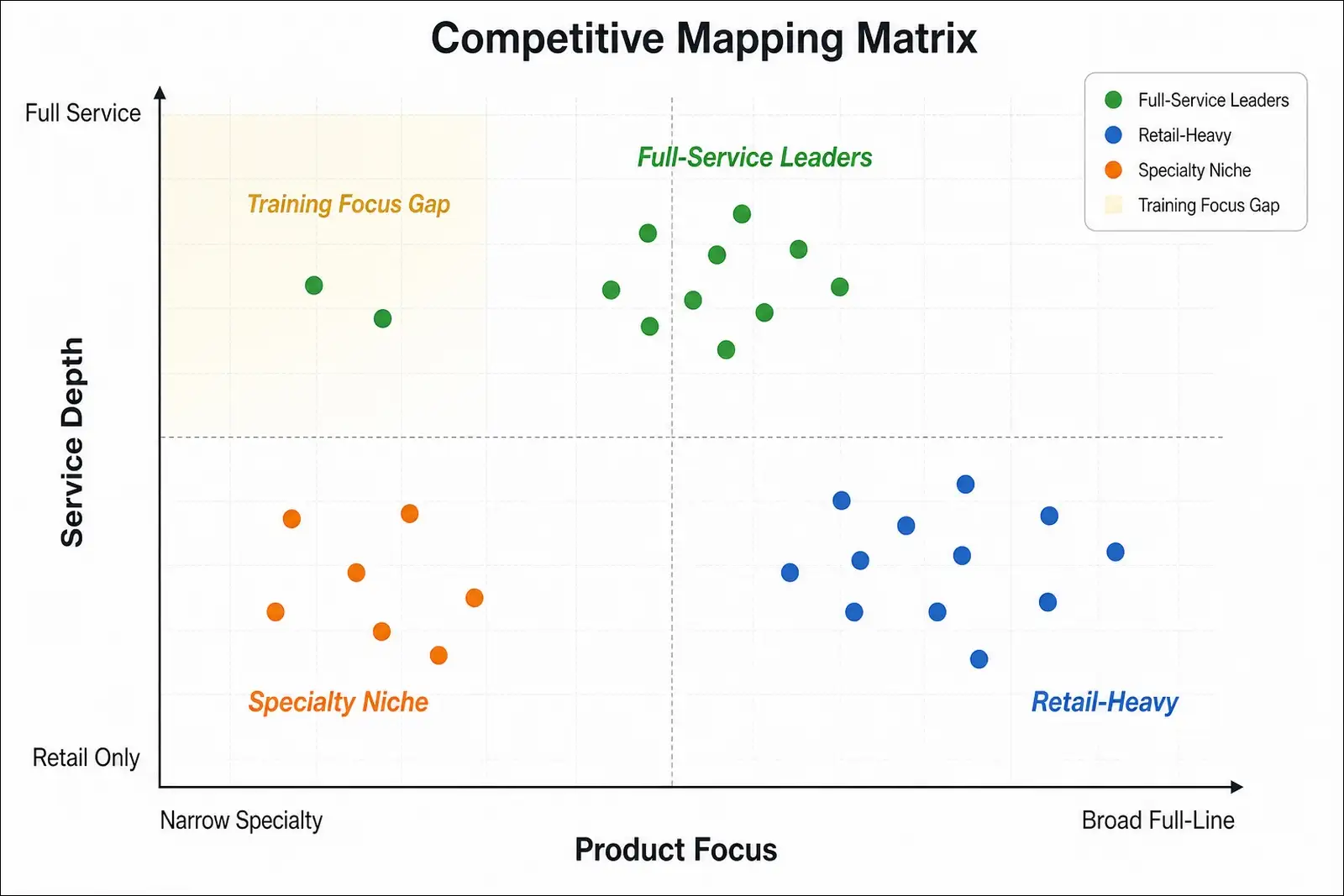
Competitive Mapping
Plot each business on a two-axis matrix. The x-axis represents product focus (narrow specialty to broad full-line). The y-axis represents service depth (retail-only to full-service with training, gunsmithing, and events).
This helps you see clusters. Some markets are saturated with retail-only dealers. Others have clear gaps in training or specialty services.
Brand Presence Analysis
Next, count how many dealer websites list each manufacturer brand. This gives you a distribution map.
When I ran this on a 300-dealer dataset, I found that Glock, Smith and Wesson, and Sig Sauer appeared on over 70% of dealer websites. Niche brands like Wilson Combat or Nemo Arms appeared on fewer than 5%. The gap between the most-distributed brands and the most-visible brands can reveal partnership opportunities.
Pricing Intelligence
Most firearms websites don’t show exact prices for firearms (many use “Add to Cart for Price” or similar). But you can still extract pricing signals.
- MSRP references on product pages
- Price ranges visible in category filters
- Sale or clearance indicators
- Comparison of accessory pricing (which is more commonly displayed)
Content Strategy Benchmarking
With Meta, Google, and TikTok banning paid firearms advertising, organic content has become the primary marketing channel. And here’s what I found: about 35% of firearms retailers in my dataset published any blog or educational content at all.
The businesses that did publish content focused on concealed carry guides, safety education, product reviews, and legal updates. This tells you where the content gap is. If you’re advising a dealer, you can recommend topics that their local competitors aren’t covering.
Compliance Maturity Scoring
I also developed a simple scoring system for compliance visibility.
| Element | Points |
|---|---|
| State restriction page present | 2 |
| Age verification mentioned | 1 |
| FFL transfer process explained | 2 |
| Shipping policy with detail | 1 |
| Privacy policy present | 1 |
| Maximum score | 7 |
Businesses scoring 5 or above tend to be more operationally mature. This score is useful for partnership vetting, competitive benchmarking, or investment analysis.
The AI Overviews Problem: Why Direct Extraction Matters More Than Ever
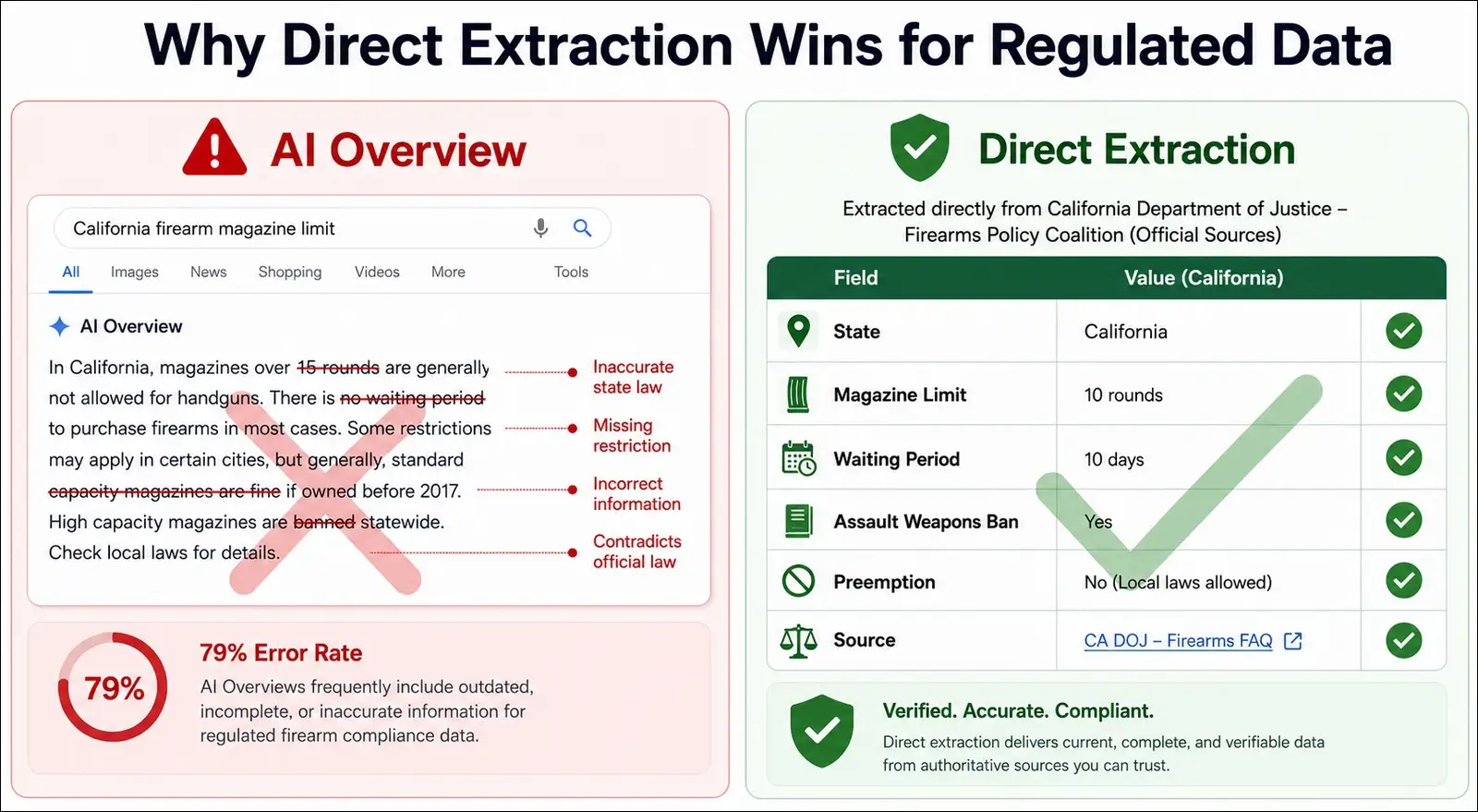
Google launched AI Overviews in May 2024. These AI-generated summaries appear at the top of search results and attempt to answer user questions without requiring a click to any website.
For the firearms industry, this creates two problems that actually make direct extraction more valuable.
Traffic Is Declining
The NSSF reported in September 2025 that several firearms industry websites experienced visitor volume decreases of up to 25% compared to the previous year. And Pew Research found in March 2025 that Google users were less likely to click on result links when an AI summary was present.
Accuracy Is Unreliable
This matters even more in regulated industries. The New York State Department of Environmental Conservation issued an advisory in August 2024 noting that AI-generated summaries of hunting regulations contained inaccuracies.
eWeek reported that AI hallucination error rates reached as high as 79% in some tests. With over 20,000 firearms laws varying by state, AI summaries are likely to misrepresent compliance requirements.
On top of that, AI Magazine reported in July 2025 that publishers can’t opt out of having their content used for AI summaries without losing their ability to appear in Google’s general search results entirely.
Why Direct Extraction Is the Answer
When you extract data directly from firearms websites, you get the ground truth.
- Structured datasets that AI summaries can’t replicate.
- Verifiable sources you can cite and audit.
- Proprietary intelligence that is not available through any search engine.
- Accuracy that matters when compliance errors carry legal consequences.
Companies that invest in direct extraction now build a compounding data advantage. And as AI Overviews continue to erode organic traffic, the value of first-party datasets only increases.
Common Challenges and How I Solved Them
Every extraction project runs into obstacles. Here are the ones I hit most often and how I worked through them.
Inconsistent Website Structures
Problem. Every firearms website uses a different platform, layout, and data format. One dealer lists products in a BigCommerce grid. Another uses WooCommerce with custom fields. A third has a static HTML page from 2015.
Solution. I relied more on NLP than on HTML structure. Instead of writing separate parsers for each platform, I extracted all visible text from key pages and used spaCy NER plus GPT-4 classification to identify business attributes from the text itself. This approach worked across platforms with minimal adjustment.
Anti-Bot Protections
Problem. Many firearms e-commerce sites use Cloudflare, reCAPTCHA, or aggressive rate limiting to block automated access.
Solution. Playwright with a real browser fingerprint handled most Cloudflare challenges. For sites with aggressive rate limiting, I reduced my request rate to one page every three seconds. You have the option to use residential proxies through services like Bright Data for larger projects.
Outdated or Incomplete Data
Problem. Many small gun shops have outdated websites. Some have no website at all. Others list products that have been discontinued for years.
Solution. I cross-referenced website data with ATF FFL records and Google Business Profiles. If a business had an active FFL license and a Google Business listing with recent reviews, I considered it active even if its website was outdated. Businesses with no website at all represent a different kind of data point. They’re potential opportunities or market gaps.
Regulatory Complexity Across States
Problem. Fifty different state regulatory frameworks create fifty different compliance pages. California’s restrictions look nothing like Texas’s. New York dealers face different rules than Arizona dealers.
Solution. I built a state-by-state compliance taxonomy with predefined categories (magazine capacity limits, assault weapon restrictions, waiting periods, background check requirements, ammunition shipping rules). Then I used GPT-4 to classify each dealer’s policy language against this taxonomy. Manual review caught the edge cases.
Data Decay
Problem. Websites change. Businesses close. Products get discontinued. A dataset built in January may be outdated by July.
Solution. I scheduled quarterly refresh cycles and set up change detection. When a business updated its product categories or compliance pages, the system flagged it for review. I also monitored ATF FFL application and renewal data as a leading indicator of market entry and exit.
Best Practices for High-Quality Firearms Business Data
These are the standards I follow to keep my datasets reliable. You can use them as a starting point for your own quality benchmarks.
| Practice | Why It Matters |
|---|---|
| Use public data only | Ensures legal defensibility and reproducibility |
| Validate against multiple sources | ATF data plus website plus Google Business equals higher accuracy |
| Standardize category taxonomies | Enables cross-business comparison |
| Version your datasets | Enables trend analysis over time |
| Document your methodology | Supports auditability and reproducibility |
| Score data confidence levels | Flag low-confidence records for manual review |
| Update quarterly at minimum | Prevents data decay from distorting analysis |
| Separate facts from inferred data | Don’t mix extracted facts with NLP-predicted classifications |
Our Verdict
Business information extraction from firearms websites is one of the most underused methods for building competitive intelligence in a $91.7 billion industry.
Here’s what I believe after completing this research and testing.
- The data is there. Firearms businesses publish extensive public information about their products, services, policies, and partnerships. Most of it is freely accessible and legally extractable.
- The tools are mature. Open-source frameworks like Scrapy and Playwright, combined with NLP tools like spaCy and GPT-4, give you everything you need to build extraction pipelines at minimal cost.
- The legal path is clear. As long as you scrape public data, respect robots.txt, rate-limit your requests, and avoid personal information, you’re operating within well-established legal boundaries.
- The competitive advantage is real. No other guide on this topic combines industry statistics, tool comparisons, legal frameworks, and analysis methodologies. The organizations that build structured, maintained datasets now will have intelligence that their competitors can’t match through ad-hoc research or unreliable AI summaries.
- The timing favors action. With FFL dealer counts declining, AI Overviews eroding web traffic, and advertising channels restricted, the businesses and analysts who invest in direct data extraction are building assets that compound in value over time.
If you’re starting from scratch, I’d recommend beginning with the schema in Section 3, extracting data from 20 websites manually, and refining your process before scaling with automation.
Disclaimer: This guide was compiled in July 2026 using data from the NSSF, IBISWorld, ATF Federal Register, Grand View Research, Global Market Insights, Fortune Business Insights, Fundamental Business Insights, Data Bridge Market Research, MarketsandMarkets, eWeek, Pew Research, and the CEASEFIRE Project (EU Horizon Europe). All statistics are cited inline. This article does not constitute legal advice.