SpyDialer vs. Enterprise Intelligence: Why Free Lookups Are Costing Your Business
Free phone lookups are the most expensive lookup option your business has, though not because the tool costs money. It doesn’t. The bill arrives in agent hours, wrong decisions, and legal exposure, and it shows up whether you notice it or not.
And you’d be surprised to know that the numbers back that up. According to YouMail’s Robocall Index, Americans took 52.5 billion robocalls in 2025, and 29.6 billion of them were telemarketing or scam calls, up 15.4% year over year.
The FTC reported people lost $16 billion to fraud in 2025, with business impersonators alone taking about $1 billion of it. Gartner’s research, cited by ZoomInfo, puts the average cost of poor data quality at $12.9 million to $15 million per organization per year.
If you’re the business owner, the sales lead, the ops manager, or the compliance person who sees “free” in a search result and assumes it’s good enough, this guide is just for you!
In this guide, I’ll discuss what free really costs, what paid phone data actually costs (the price list may surprise you), and when each one is the right call.
So, let’s get started and see the real cost behind the free curtain!

Key findings
Her are some important findings that you can read quickly:
- “Free” has a price. At Gartner’s estimate of 27% of selling time spent on bad data, one sales rep with a free-tool habit can burn thousands of dollars a year in labor alone.
- Free is not enterprise-grade. SpyDialer is U.S.-only, capped at 50 lookups a day, has no API, no SLA, and no audit trail.
- Compliance is the line item nobody prices. Consumer lookup data cannot legally feed employment, housing, credit, or eligibility decisions. Free tools say so themselves.
- Paid data is cheap at scale. Commercial lookups run from about $0.008 per request (Twilio) to $1.95 (Searchbug). Bulk rates drop below a penny.
- Free tools cannot catch modern fraud. Spoofed VoIP numbers, burners, and “snowshoeing” campaigns defeat static public-record lookups.
Also read: How Brands Can Replicate “Baby Alien Fan Bus” Virality
Why the free tool wins the first 30 seconds
It’s not hard to see why teams reach such tools.
Juts open spydialer.com and the homepage sells itself. “SNEAKY… BUT LEGAL… FREE!” No account. No credit card. No signup. Up to 50 lookups a day at zero cost. I checked the site, and that’s exactly what it promises, along with “billions of records” and “no hidden fees, no bait-and-switch.”
The origin story adds trust, too. SpyDialer was created by Robert Scott, a Los Angeles private investigator, and launched on September 1, 2011. It landed press on the Today Show, Fox News, and PC Magazine.
So for a team that just needs to know who called, it feels perfect.
And you know what that’s the trap. The first 30 seconds are free, while the next 30 minutes aren’t.
The loop that eats the day
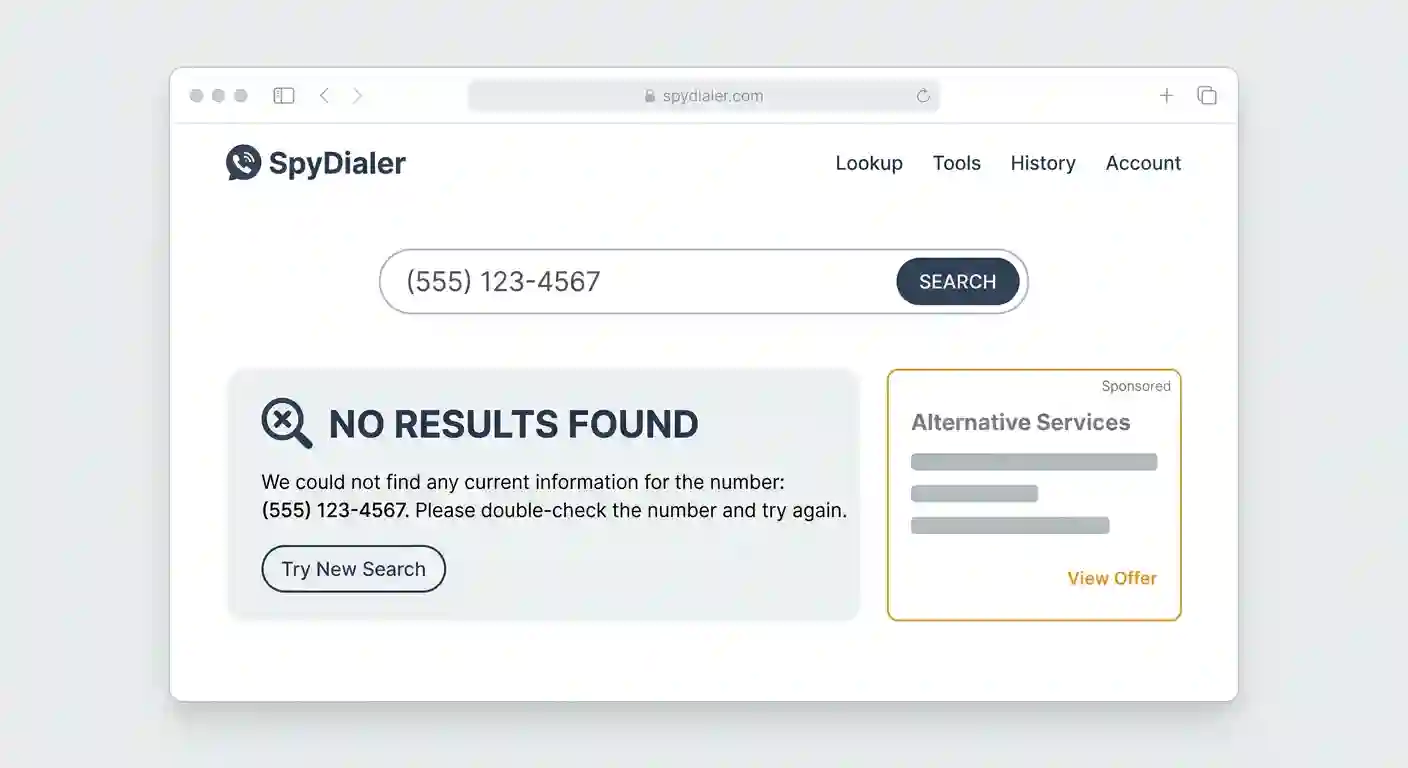
In practice, the pattern remains the same across years of user reports: you enter a number, you get “NO RESULTS FOUND,” and then you get an ad or a redirect to a paid partner like Spokeo, Intelius, or BeenVerified.
One verified review from December 2025 on Slashdot put it bluntly: “The only function that currently works on this site is the paid advertisements.”
Now price that loop. Say each failed attempt costs 3 to 5 minutes, including ad loading and retries. Ten lookups a day at four minutes each for 230 work days comes to about 153 hours a year per person. At a loaded cost of $40 an hour, that’s roughly $6,000 a year in labor to get nothing.
Free tools monetize your time, while paid tools sell you theirs. That’s the whole trade.
Free data can be wrong, and wrong costs more than missing
A wrong answer is worse than no answer, because you act on wrong answers, and you don’t always know you’re acting on them.
You don’t have to god far for real examples. One person’s number was still mapped to an ex-spouse’s name nine years after divorce. Another wrote that the tool was “100% inaccurate for every search I did.” Even SpyDialer’s own disclaimer admits results “may be wrong” and includes “false ‘no hits'” as a known outcome.
For a business, a wrong owner name means calling the wrong person, pitching the wrong decision-maker, or flagging the wrong account.
Each of those has a dollar figure, though none of them shows up on the tool’s invoice, because there isn’t one.
The business-grade ceiling
Here’s what the free tier can’t do. This isn’t opinion, it’s the product’s own design:
- U.S.-only coverage. Numbers outside the United States return nothing, so a global sales or collections team gets zero value from it.
- A 50-per-day cap. That is fine for one curious person, though it is nothing for an outbound operation.
- No API, no bulk, no SLA. You can’t integrate it, can’t automate it, and nothing guarantees it stays up.
- No FCRA standing. Its own terms state it is not a consumer reporting agency and its data is not for FCRA-regulated decisions.
A free consumer tool and an enterprise data product are different products that just happen to share an input box.
Five hidden taxes make “free” the most expensive option on the menu
Free tools don’t bill you, but they still charge you. These five taxes are where the money leaks out.
| Tax | What it costs you | The number to remember |
|---|---|---|
| Time | Agent hours on ads, no-results pages, retries | ~27% of selling time on bad data (Gartner) |
| Accuracy | Wrong outreach, dead deals, bad verdicts | 15-25% of revenue lost (MIT Sloan) |
| Coverage | No VoIP, burner, spoofed, or international data | 29.6B telemarketing and scam calls in 2025 (YouMail) |
| Compliance | FCRA, TCPA, and wiretap exposure | 258M+ numbers on the Do Not Call registry (FTC) |
| Opportunity | Errors compound through your pipeline | The 1-10-100 rule of data fixes |
The time tax
Gartner reports that sales development reps spend roughly 27% of selling time working with bad data. That’s more than a quarter of a person’s week, spent re-checking, re-dialing, and cleaning up after incorrect contact info.
The accuracy tax
MIT Sloan research, conducted with Cork University Business School and summarized by Integrate.io, found companies lose 15-25% of revenue annually because of the poor data quality.
Harvard Business Review, picked up by Forbes, estimates bad data drains about $3 trillion a year from the U.S. economy.
The same Gartner research found that 60% of organizations don’t measure this cost at all. You can’t fix what you don’t count, and most teams never count it.
The coverage tax
Static public records miss the categories that matter most right now: VoIP numbers, burner phones, and spoofed caller IDs. YouMail’s tracking also flagged “snowshoeing” campaigns that spread identical messages across tens of thousands of numbers.
A per-number lookup can’t see that pattern; it only sees one number, one miss.
The compliance tax
This one is detailed in its own section below, but the short version is this: the cheapest lookup becomes the most expensive one the day a regulator asks where your data came from.
The opportunity tax
The 1-10-100 rule says catching an error early costs $1, fixing it later costs $10, and letting it drive a decision costs $100. You’ll notice a theme across all five taxes: they’re invisible at the start and obvious at the end. That’s why the 2×2 test below matters more than any price comparison.
Enterprise phone data costs pennies per lookup, while free costs hours per day.
The market sorts into three tiers, and they’re not interchangeable.
The three tiers of phone data
- Free web tools (SpyDialer, NumLookup, USPhoneBook): public records, ad-monetized, consumer terms only.
- Consumer subscriptions (Spokeo, BeenVerified, Intelius): deeper reports for about $25 to $37 a month, still consumer terms, trial auto-renewals to watch.
- Commercial APIs (Twilio Lookup, Telesign, Searchbug, Whitepages Pro): real-time signals, global coverage, bulk processing, SLAs, and licenses that allow business use.
What the money buys
You’re not paying for “a name,” you’re paying for recency, identity signals, and the legal right to use the data in decisions. That includes line status (is the number live right now), caller name (CNAM), identity match, SIM swap detection, reassigned number risk, bulk CSV uploads, audit trails, and uptime SLAs in the 99.95% range.
The price list, verified August 2026
| Tier | Tool | Price | Notes |
|---|---|---|---|
| Free web | SpyDialer | $0 | U.S.-only, 50/day, ads, not FCRA-safe |
| Free web | NumLookup / USPhoneBook | $0 | Same public-record ceiling |
| Consumer sub | Spokeo | ~$24.95/month | Trials from $0.95 |
| Consumer sub | BeenVerified | ~$36.89/month | All-in-one reports |
| Consumer sub | Intelius | ~$35.30/month | After a $0.95 trial |
| API | Twilio Lookup | $0.008 per line-type request, ~$0.01 caller name, ~$0.10 identity match, volume tiers down to $0.0015+ | Pay as you go |
| API | Searchbug | $1.95 per successful lookup, from ~$0.30 high volume | No subscription |
| API | NumLookup API | $89.99 per 300,000 requests | 248 countries covered |
| API | Veriphone Enterprise | $199 per 1 million validations | Global, bulk |
The math that flips the argument
Take 10,000 lookups a month on a commercial API at a blended $0.01 each, and you get $100 a month, which at $40 an hour of loaded labor is about 2.5 hours of one person’s time.
The free loop above consumes more than that in a single week.
Paid data isn’t a premium; it’s the discount, while free is the luxury you pay for in labor.
What I verified firsthand, and what I will not fake
Let me be direct about how this article was built, because that honesty is the whole point of writing it this way.
The checks I did myself
- I opened spydialer.com and read the company’s own claims: “billions of records,” up to 50 free lookups a day, “no hidden fees, no bait-and-switch,” and U.S.-only coverage across all 50 states plus D.C.
- I checked the company record. Spy Dialer, Inc. was incorporated in California on June 13, 2011, with Robert Scott as agent, and its status is active.
- I read the original 2011 launch announcement, including the founder’s quotes and the Today Show mention.
- I verified the app removal on AppBrain: the Spy Dialer Android app (org.rifluxyss.androiddev.SPYDialer) was unpublished from Google Play on March 29, 2016, after roughly 900 ratings.
- I read the current price cards for Twilio Lookup, Searchbug, NumLookup API, and Veriphone before writing the table above.
- I checked the impostor domains too, and none of them are the company. spy-dialer.net, spy-dialer.org, and spydialer.site all pose as the real thing.
Also read our Opt Out Guide if you’re looking to remove your personal dteails from such websites.
Documented tests I can point you to
- Incogni tested the voicemail feature and reported they “weren’t able to hear any recording,” getting a “no answer” notice instead.
- A Vocal.Media writer tested a VoIP burner number and got a no-results page covered in ads, then a push toward Intelius at $34.95 a month.
- Reddit’s r/OSINT community reported in January 2025 that owner names were being blocked from results.
Every documented test in the last 18 months points one direction: free results are getting thinner while the ad walls get taller.
The test I recommend you run
I’m not going to invent a 50-number test I didn’t run. What I can give you is the protocol, plus the documented evidence above. If you run it, you’ll have your own numbers, which are worth more than any review.
- Collect 50 numbers in five buckets of ten: listed landlines, published mobile numbers, VoIP numbers (like Google Voice), numbers reported as spam, and business lines.
- Run each through the free tool. Record a name returned (yes or no), line type correct (yes or no), time per lookup, and any ads or redirects you hit.
- Run the same 50 through one paid tool of your choice.
- Compare hit rates and total time.
- Keep the sheet and re-run it monthly, because both the tools and the data change.
When we run the full batch on this site, we’ll publish the sheet with dates and screenshots. Until then, the protocol is yours to use.
Compliance is the line item nobody prices, until a regulator asks.
Compliance is the one cost you can’t negotiate away, and it’s the reason “just use the free tool” falls apart in a business setting.
FCRA sets the hard line
The Fair Credit Reporting Act governs data used for employment, housing, credit, insurance, and other eligibility decisions. If your lookup feeds any of those, the provider must be FCRA-compliant, with full-file disclosure and an adverse-action process.
A free lookup tool is not that, and it says so. SpyDialer’s terms explicitly state it is not a consumer reporting agency. That’s not a loophole, that’s a warning.
The FTC has been enforcing this harder. Its Impersonation Rule took effect in April 2024, and the agency has since brought a dozen enforcement actions that secured more than $70 million in consumer redress.
TCPA makes callbacks risky
Calling back based on a wrong lookup means calling the wrong person, and possibly a number that has been reassigned to someone new. Reassigned number risk is a paid-API signal for a reason: it’s a real, expensive failure mode.
The context matters too: there are now more than 258 million numbers on the National Do Not Call Registry, and the FTC received 2.6 million DNC complaints in fiscal year 2025, according to the FTC’s biennial report to Congress. Outbound calling has less room for error every year.
The voicemail feature is a gray zone
A voicemail greeting meant for the public is generally treated as public, not as an intercepted conversation. That is the argument for why “spy dialing” is legal, though state recording laws vary. Using captured audio as a business workflow is a different question than using it out of curiosity.
My advice: don’t build a process on the voicemail feature. If a vendor pitches you “call the number and listen to the greeting,” run it past your legal team first.
What enterprise providers offer that free tools cannot
Licensed use terms, audit trails, SOC 2-type attestations, data processing agreements, and contractual limits on what the data can be used for. Those are the things procurement asks for, and they’re what holds up when a regulator or a customer starts asking questions.
Free lookup quality is trending down. The timeline is public.
Free lookup quality is going down, and you can trace exactly when it started.
Here’s what public records say about it:
| Date | What happened | Where it shows |
|---|---|---|
| Sep 1, 2011 | SpyDialer launches, created by L.A. private investigator Robert Scott | Company press release |
| Nov 2011 | “Eavesdrop on voicemail” press coverage; Today Show segment | 24-7 PressRelease |
| 2011-2015 | Android app live; press in PC Magazine, Fox News, Kim Komando | spydialer.com media page |
| Mar 29, 2016 | Android app unpublished from Google Play | AppBrain archive |
| ~2024 | CCPA-era tightening and carrier restrictions; users report blank results | Vocal.Media, Reddit |
| Jan 2025 | r/OSINT users report owner names now blocked | Reddit thread |
| Late 2025 | “Advertisement honey pot” reviews; search button reported broken | Slashdot, December 2025 |
| 2026 | Review aggregates at 2.5 to 3.0 out of 5; organic traffic down roughly 56% month over month | Slashdot, Sitejabber, Semrush snapshot |
Why the decline matters for your business
Well the threat environment is moving in the opposite direction from free data quality: scam calls jumped 40% month over month in January 2025, according to YouMail’s tracking. Fraudsters now have cheap AI voice-cloning, per FTC analysis of 2025 losses.
Whatever you build on a shrinking data source shrinks with it.
The impostor problem nobody writes about
The look-alike domains are real, and they’re dangerous in a business context. spy-dialer.net embeds a fabricated rating of 4.5 stars from 1,250 reviews in its page markup. spy-dialer.org claims worldwide coverage, which the real tool never offered. spydialer.cc has appeared in referral traffic to the real site.
An employee who types “spy dialer” into a search box can land on one of these instead of the real thing, so teach your team one line: the official domain is spydialer.com, and nothing else. Bookmark it once, verify it once.

When free is fine, and when it is quietly costing you
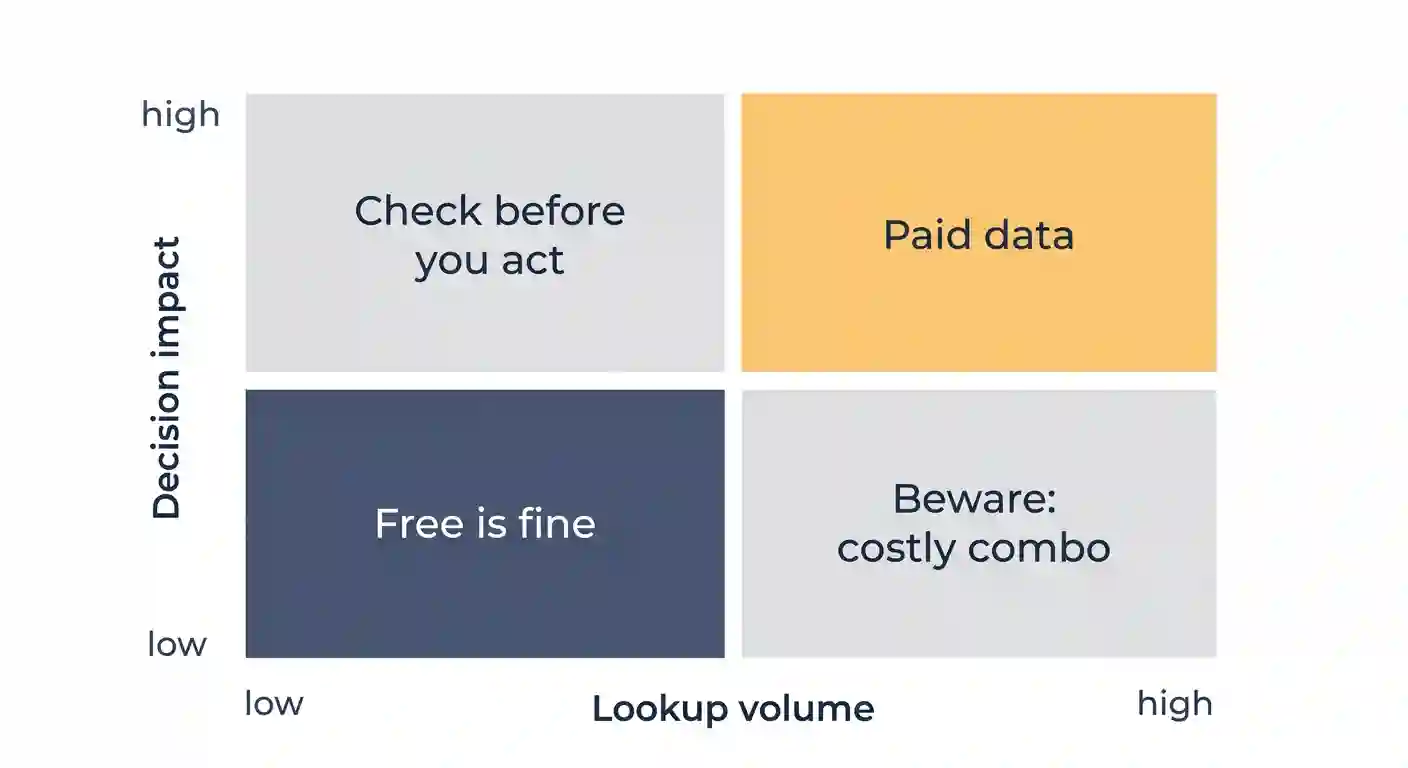
The two-by-two test
Here’s a simple way to think about it. Put volume on one axis and decision impact on the other. High volume with high stakes means paid data, while low volume with low stakes means free is fine.
The only dangerous combination is high volume treated as low stakes, which is exactly where most teams start.
| Scenario | What to use | Why |
|---|---|---|
| “Who called me?” personal check | Free tool | Zero stakes |
| Verify an inbound lead before a callback | Paid API or subscription | Accuracy and TCPA safety |
| Outbound dialing campaigns | Paid API with line status | Reassigned number risk |
| Collections priority scoring | Paid intelligence | Stale data targets the wrong debt |
| Fraud and chargeback review | Paid identity signals | Spoofed and VoIP detection |
| Employment, housing, credit | FCRA-compliant provider | It is the law |
A 60-second cost calculator
- Count your average lookups per day. Call that D.
- Time one lookup on the free tool, including ad loading and retries. Call that M, in minutes.
- Multiply D by M, then by 230 work days, then divide by 60. That is hours per year.
- Multiply hours by your loaded hourly cost. That is the hidden labor cost.
- Compare it to a paid API: lookups per month times $0.01 (a reasonable blended rate), times 12.
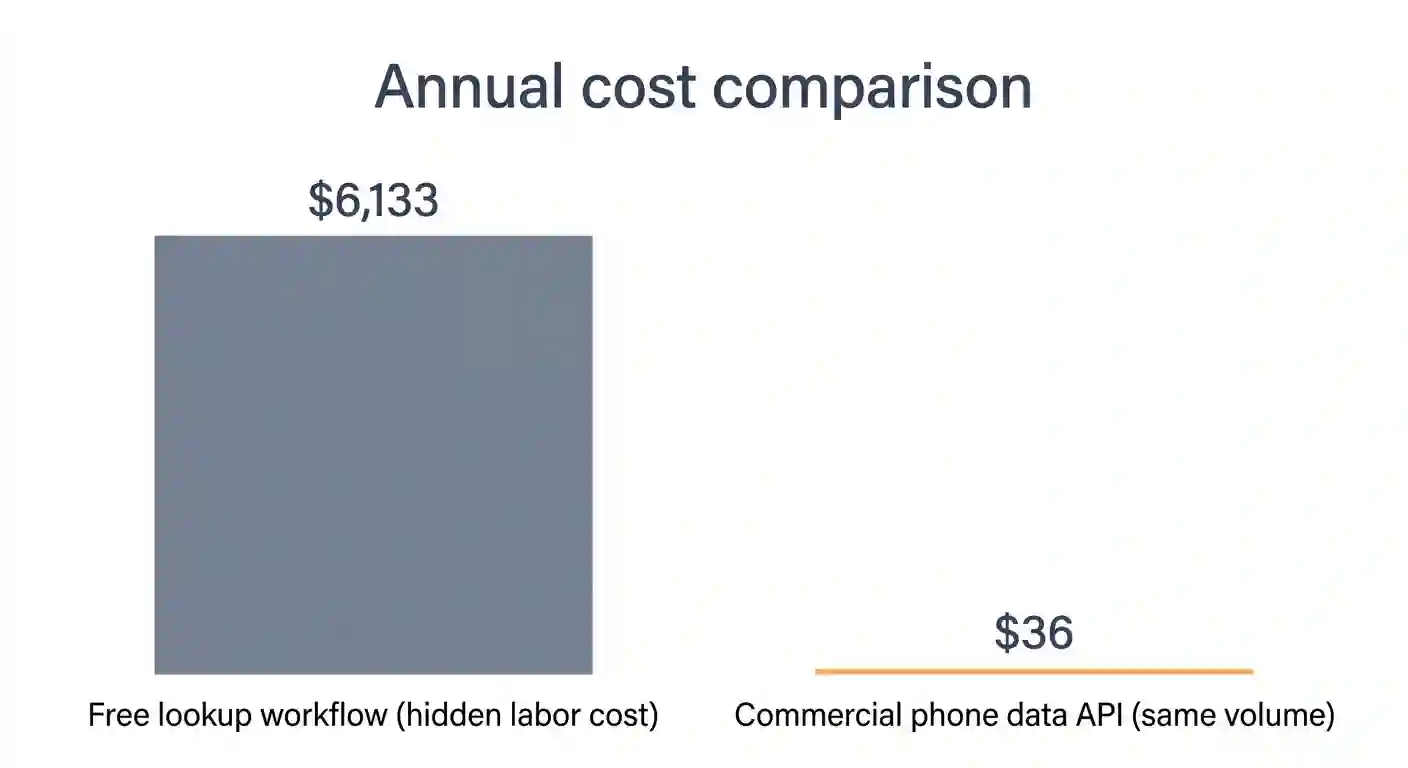
Worked example: 10 lookups a day at 4 minutes each with $40 an hour loaded comes to $6,133 a year hidden, while a paid API at 300 lookups a month times $0.01 is $36 a year, with better answers.
In that example, paid data is more than 100 times cheaper than the free loop.
The hybrid play
You have the option to keep the free tool for low-stakes triage, then route anything with money or compliance attached through a paid layer.
The stronger version is to bake verification into your CRM or dialer, so no one’s copy-pasting numbers into a browser tab at all.
The alternatives, priced and scored for business use
Here’s the short version before the tables: free tools triage, consumer subscriptions dig deeper, and APIs handle volume. On a phone, wide tables are painful to read, so I split this one into two.
Free and consumer tools
| Tool | Price | Notes |
|---|---|---|
| SpyDialer | $0 | U.S.-only, 50/day, ads, not FCRA-safe |
| NumLookup | $0; API $89.99/300K | Same public-record ceiling |
| USPhoneBook | $0 | Same public-record ceiling |
| Spokeo | ~$24.95/mo | Trials from $0.95 |
| BeenVerified | ~$36.89/mo | All-in-one reports |
| TruthFinder | $4.99-$29.73/mo | Trial-based |
| Intelius | ~$35.30/mo | After a $0.95 trial |
Commercial APIs
| Tool | Price | What you get |
|---|---|---|
| Twilio Lookup | $0.008+ per request | Global, real-time line status, identity signals |
| Searchbug | $1.95 per hit, from $0.30 bulk | Global, no subscription |
| Telesign | Custom quote | Global, enterprise-grade, licensed |
How to read this table without overthinking it
Match the columns to your use case, not the brand. Watch trial auto-renewals on consumer plans. Check the terms for commercial use before you build anything on it. And if you’re in a regulated industry, ask for SOC 2-type attestation and a data processing agreement before you sign.
My Verdict
Free lookups feel free, but they aren’t. You pay in agent hours, wrong decisions, and legal risk, and the bill arrives without an invoice.
The counterintuitive part is the pricing: paid phone data at a penny per lookup is the cheap option, while free is the expensive one, because its price is paid in the most costly currency a business has: people’s time and the decisions built on their work.
Here’s what I’d do, if this were my team: keep a free tool for personal curiosity, put a commercial API behind any decision with money or compliance attached, and re-test quarterly, because the tools, the data, and the laws all keep moving.
The verdict: free lookups are acceptable for a question you would not bet money on, though for anything else, they are the most expensive option on the menu.
Quick answers, for the questions people usually ask
Yes, for basic use: up to 50 U.S.-only lookups a day with no account required, and it’s monetized through ads and redirects to paid partners.
Mixed. It is strongest on landlines and listed businesses, though weakest on mobiles, VoIP, and spoofed numbers. Its own disclaimer admits errors and “false ‘no hits.'”
For casual checks, generally yes, though for employment, housing, credit, or eligibility decisions, no. That is FCRA territory, and free tools are not FCRA-compliant.
From about $0.008 per lookup (Twilio line type) to $1.95 per successful lookup (Searchbug). Bulk rates drop below a penny.
Free tools can triage low-stakes checks, while a commercial API is the practical option for outbound volume, compliance, or international numbers. To be fair, plenty of teams run on free tools for months before the costs show up in the workflow.