AI Transformation Is a Governance Problem | 90-Day Guide
Do you know that most companies don’t lack AI tools? Actually, they lack someone with authority to say yes, no, and stop.
Most AI pilots don’t fail during the first demonstration. They fail later, when the system reaches real customers, real data, and real money.
That’s when someone asks who approved it. Who owns the result? Who can shut it down? What happens when the vendor changes the model?
We’ll here’s the truth: AI transformation isn’t just a technology project. It’s a management test that happens to involve software.
The model may work perfectly. But the organization around it may still be a mess.
The model usually isn’t the problem. The blank space around it is.
Most AI pilots fail after the demo because nobody has settled ownership, permissions, monitoring, or value measurement.
AI adoption is already widespread but enterprise AI transformation isn’t.
McKinsey’s 2025 State of AI report found that 88% of respondents used AI in at least one business function. Yet nearly two-thirds hadn’t started scaling AI across the enterprise. Only 39% reported enterprise-level EBIT impact.
Those figures don’t prove AI is a fraud. Instead they prove something less comfortable:
Buying AI is easier than running it.
Deloitte found that only 21% of surveyed organizations had mature governance for agentic AI. Meanwhile, 74% expected moderate agent use by 2027, according to its 2026 agentic AI research.
That’s a serious timing problem. Companies are preparing to give software more authority before they’ve decided how to control it.
A 2025 MIT report, summarized by MIT IDE, found that 95% of organizations in its research saw no measurable return from generative AI.
That doesn’t mean 95% of all AI projects fail worldwide. It means the companies in that research struggled to turn spending into measurable business outcomes.
And that distinction matters a lot. Search results are full of dramatic failure statistics. Many don’t show their sample, definition, or original study.
A serious article shouldn’t repeat those figures blindly.
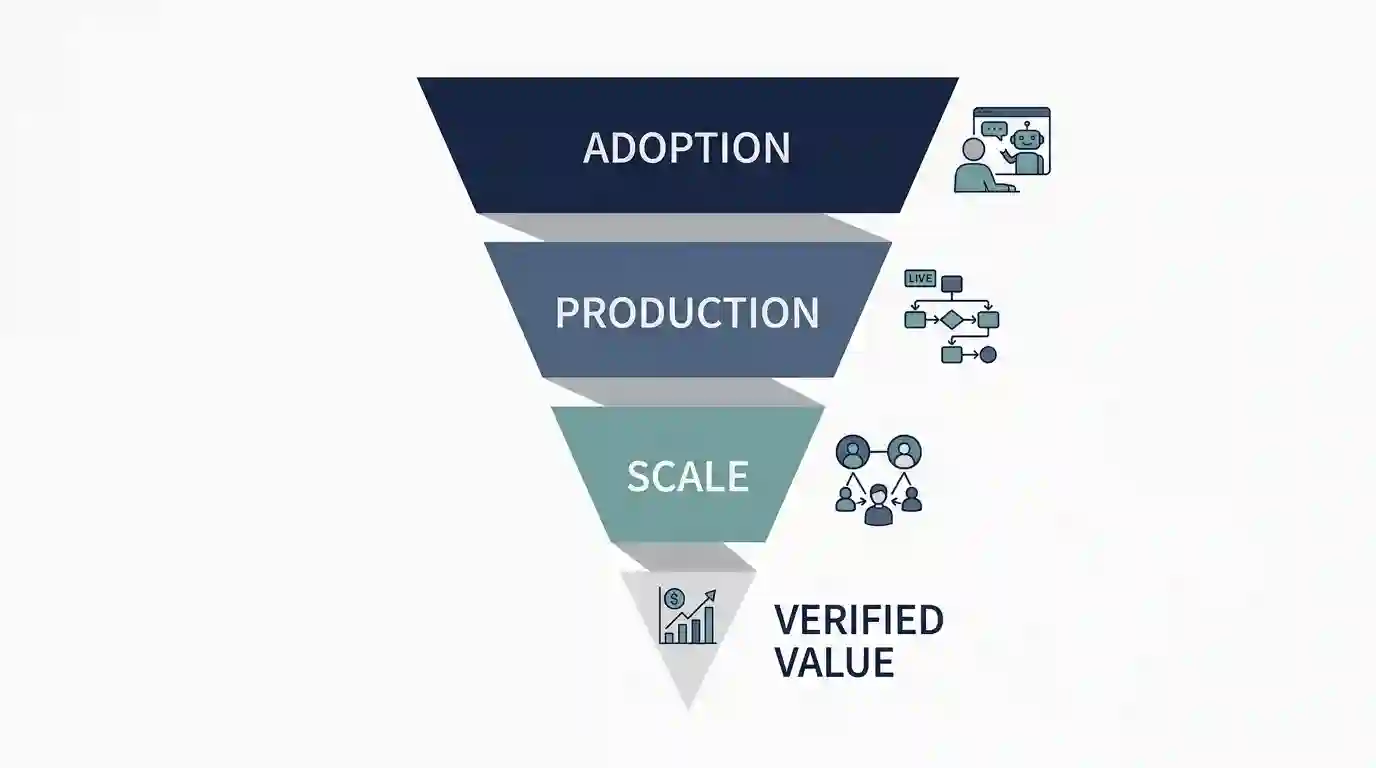
AI adoption isn’t AI transformation
Using ChatGPT to draft a report is adoption.
But putting an AI system inside customer service, pricing, recruitment, lending, or procurement is something else. It changes workflows, authority, controls, skills, and accountability.
| Stage | What happens | Main question |
|---|---|---|
| Adoption | People use AI tools | Is the tool useful? |
| Production | A use case runs live | Can it operate safely? |
| Scale | Multiple teams use it | Can controls keep up? |
| Transformation | Work and decisions change | Does the business perform better? |
Most companies mix these stages together. And they report tool usage as progress, even when the underlying process hasn’t changed.
That’s how pilot theatre begins.
Governance is the part everyone tries to turn into a PDF
AI governance means deciding how AI gets approved, used, monitored, changed, and stopped.
It isn’t an ethics page on a company website. It isn’t a committee that meets once each quarter. And it isn’t a policy nobody reads.
A useful governance system answers five simple questions:
- Who decides?
- What may the system do?
- What evidence is needed?
- How will failure be detected?
- Who can stop the system?
NIST’s AI Risk Management Framework organizes risk work around four functions: Govern, Map, Measure, and Manage. NIST describes the framework as voluntary unless another rule, contract, or policy makes it applicable.
ISO/IEC 42001 provides a management-system structure for organizations that develop, provide, or use AI systems. ISO says the standard can help organizations establish policies, responsibilities, processes, and continual improvement.
ISO/IEC 42005 focuses on impact assessments. Its public description covers how AI systems may affect people, groups, and society across their lifecycle.
These frameworks are useful because they turn vague principles into repeatable work.
They also expose a common weakness.
Many organizations have principles. Few have evidence.
Principles versus controls
| Principle | Control that makes it real |
|---|---|
| AI should be fair | Test outcomes against defined thresholds |
| Humans remain accountable | Name a business owner with override authority |
| AI should be transparent | Disclose AI use and retain decision evidence |
| AI should be secure | Apply access limits and monitor tool use |
| AI should create value | Track cost, revenue, quality, and cycle time |
A policy says what the organization believes.
A control shows what the organization actually does.
That difference separates governance from corporate decoration.
The first question isn’t “which model?” It’s “who can say yes?”
The biggest governance failure is shared responsibility without clear ownership.
IT may own infrastructure. Data teams may own models. Legal may own compliance review. Operations may own the workflow.
When the system fails, each team can point somewhere else.
The business owner should own the outcome. Not the algorithm, vendor. or technical team.
Business owners and model owners are different
The business owner decides whether the use case is worth pursuing. They define the desired result and accept responsibility for the operational consequences.
The model owner manages technical performance, version changes, testing, and monitoring. That role matters, but it doesn’t replace business accountability.
A technically excellent model can still support a terrible business decision.
What boards should ask
Deloitte’s 2025 board governance survey found that 31% of respondents said AI was absent from their board agenda. Sixty-six percent reported limited or no board AI knowledge. Forty percent said AI had changed how they thought about board composition.
Board education is useful. But education without authority isn’t oversight.
A board can ask management:
- Which AI systems affect customers or employees?
- Who owns each system’s business outcome?
- Which systems can act without approval?
- What data can each system access?
- What incidents occurred last quarter?
- How quickly can the company disable a risky system?
- Which projects have verified financial results?
- Which roles will change because of AI?
The board doesn’t need to approve every prompt. It does need visibility into authority, exposure, and results.
AI agents turn governance into a spending problem
An AI agent with system access isn’t just a smarter chatbot.
Suppose a procurement agent can read vendor quotes, rank suppliers, draft orders, and submit purchases. If it can spend ₹5 lakh without approval, the company hasn’t deployed a simple assistant.
It’s given a software system a company credit card.
That calls for a different control model.
A practical autonomy ladder
| Level | AI capability | Suitable control |
|---|---|---|
| Level 0 | Drafts or summarizes | Human reviews every external result |
| Level 1 | Recommends an action | Human approves before execution |
| Level 2 | Performs reversible actions | Limited tools and spending caps |
| Level 3 | Runs multi-step workflows | Threshold approvals and action logs |
| Level 4 | Influences high-impact decisions | Human decision-maker and appeal process |
| Level 5 | Prohibited or unacceptable use | Don’t deploy |
The higher the authority, the stronger the evidence and review should be.
An agent that drafts an internal meeting note doesn’t need the same process as an agent that changes a customer’s credit limit.
My tabletop test
I tested this model with a hypothetical purchase-order agent. This was a desk exercise, not a live production deployment.

The agent could read vendor quotes, rank suppliers, draft orders, and submit low-value purchases. The design failed immediately unless five questions had clear answers.
First, a procurement leader had to own the result. Second, the agent needed restricted data access. Third, spending limits had to be explicit. Fourth, every action needed a traceable record. Fifth, someone needed authority to pause the agent.
The model itself wasn’t the difficult part. The permissions were.
That’s the point most AI strategy documents skip.
Minimum controls for agents
An agent can have a unique identity, separate credentials, a restricted tool list, data-access boundaries, transaction limits, rate limits, approval thresholds, full action logs, pause controls, and a fallback process.
Deloitte’s research specifically identifies autonomy boundaries, real-time monitoring, and action audit trails as missing governance capabilities.
The AI inventory is boring. It’s also where the truth starts.
You simply can’t govern systems you can’t identify.
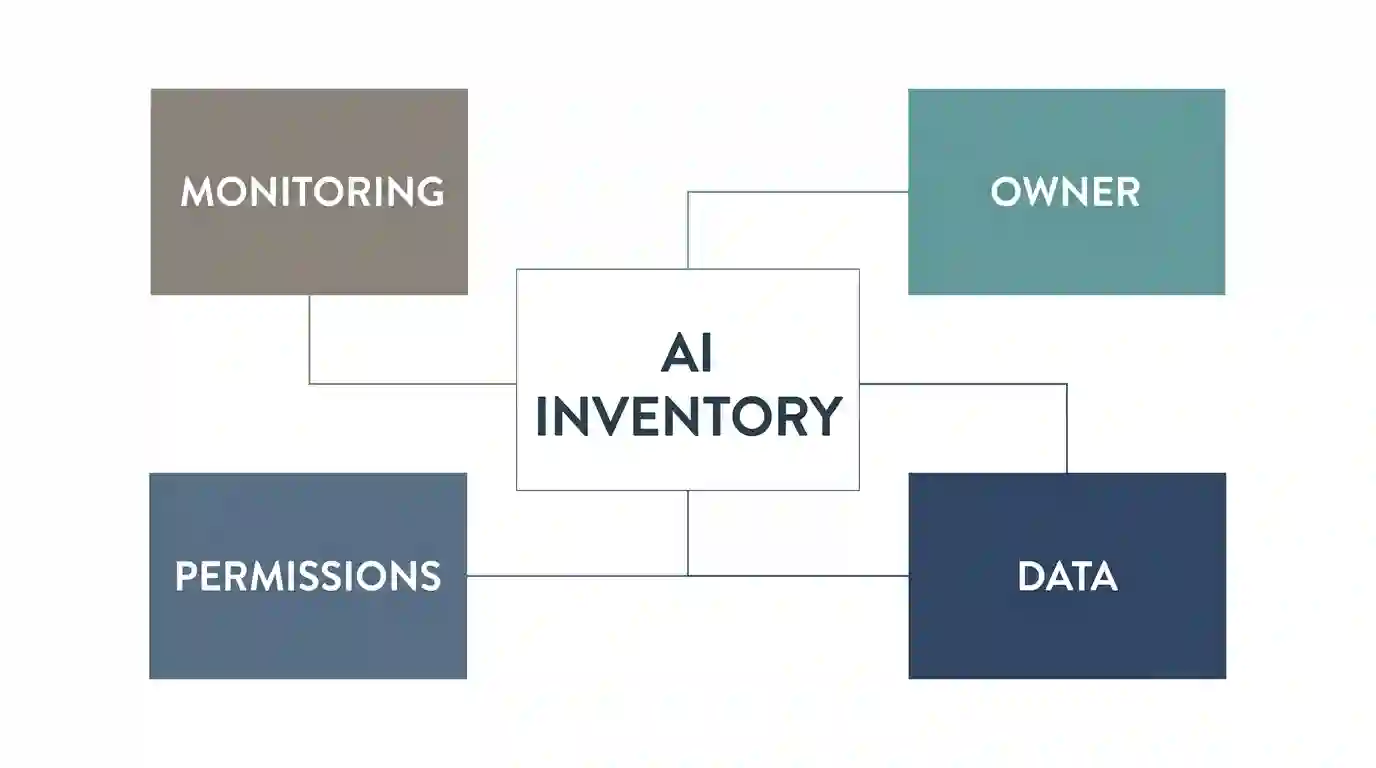
The inventory should cover internal models, public tools, AI features inside SaaS products, vendor APIs, agents, and automated decision systems.
IBM’s 2026 technology executive study reported that 70% of surveyed technology executives said business teams deployed technology faster than IT could track. Seventy-seven percent said AI adoption was outpacing governance capabilities.
That isn’t a minor reporting problem. It means a company may be accountable for systems it can’t see.
What the inventory should record
For every AI system, record the business owner, model provider, purpose, data categories, affected people, connected tools, autonomy level, jurisdiction, version history, review requirement, monitoring owner, and shutdown process.
The first inventory may reveal duplicate tools and unauthorized use. That’s not bad news. It gives leadership a real list instead of a comforting guess.
How you can build the inventory
- Review procurement and software records.
- Inspect cloud, API, and identity logs.
- Ask business teams about unofficial tools.
- Review AI features inside existing SaaS products.
- Match every system to a business owner.
- Classify impact, autonomy, and data sensitivity.
- Assign monitoring and shutdown authority.
- Review the inventory each quarter.
The inventory shouldn’t become a static spreadsheet. It needs an owner, update process, and escalation path.
A stale inventory creates the same problem as no inventory.
A policy without a kill switch is corporate fiction
AI systems can change after deployment.
Data changes, vendors update models, users find new ways to prompt systems, and connected tools gain new permissions over the time. A system that worked in March may behave differently in October because of many factors.
Stanford HAI’s 2026 AI Index recorded 362 documented AI incidents in 2025, compared with 233 in 2024.
That doesn’t establish one cause for every incident. It does show why organizations need clear reporting and response processes.
A live AI system needs more than launch approval. It needs operating controls.
Those controls can cover performance drift, unexpected outputs, unauthorized access, harmful decisions, repeated overrides, data leakage, and customer complaints.
The shutdown process matters just as much.
Someone should know who can pause the system, what triggers a pause, how the business continues manually, who reviews the incident, what evidence must be kept, and who approves a restart.
If nobody can answer those questions, the organization isn’t governing the system.
It’s hoping.
Also read: Workday HCM Implementation
The 2026 rulebook isn’t one rulebook
AI regulation is split by country, sector, system type, and business role.
That makes source discipline essential.
The EU AI Act
On 2 August 2026, new EU transparency rules took effect for certain AI interactions and synthetic content.
Users may need to know when they’re interacting with AI. Certain generated or manipulated content may need visible labels and machine-readable marks.
The European Commission’s transparency announcement explains the new requirements for chatbots, AI agents, avatars, deepfakes, biometric systems, and certain public-interest content.
The Commission also lists penalties of up to €35 million or 7% of worldwide annual turnover for prohibited AI practices. Other GPAI breaches may reach €15 million or 3%, according to its AI Act enforcement guidance.
Here’s the part many articles get wrong. Not every AI Act obligation began on the same day.
The Commission’s current AI Act framework lists high-risk rules for Annex III systems from 2 December 2027. It lists 2 August 2028 for high-risk AI embedded in regulated products.
An article that says “the AI Act is fully active now” is too vague to help a compliance team.
NIST, ISO, and OECD
NIST provides a voluntary risk-management process. ISO/IEC 42001 provides an AI management-system structure. ISO/IEC 42005 provides impact-assessment guidance.
The OECD AI Principles cover human-centred values, transparency, safety, privacy, and accountability.
These frameworks can work together. NIST helps organize risk work. ISO helps structure management processes. OECD provides principles. The EU AI Act creates binding obligations within its scope.
They aren’t the same thing.
India’s policy picture
IndiaAI published its AI Governance Guidelines on 5 November 2025.
The guidelines address risk classification, accountability, safety testing, transparency, human oversight, and institutional mechanisms.
India’s amended IT Rules concerning synthetically generated information took effect on 20 February 2026. The official Gazette notification includes obligations around labelling and provenance for certain synthetic content.
For Indian companies, AI governance can’t stop at the EU AI Act. Data protection, sector rules, advertising standards, financial regulation, and customer disclosure may all matter.
The money is in the boring work nobody wants to fund
Companies spend heavily on models and infrastructure. They often underfund process redesign, training, monitoring, and data cleanup.
That’s backwards.
BCG’s 10-20-70 analysis estimates that roughly 10% of AI value comes from algorithms, 20% from technology and data infrastructure, and 70% from people, processes, and organizational change.
The exact percentages are a rule of thumb, not a universal formula.
BCG’s July 2026 CEO research found that more than half of surveyed CEOs saw P&L linkage as a barrier. Only 14% had defined P&L impact for every AI initiative, while only 30% included HR in AI governance.
That’s a management failure, not a model failure.
Measure outcomes, not excitement
A company can track the number of AI pilots. That number says almost nothing.
Better measures include cost per transaction, cycle time, error rate, rework, customer complaints, revenue contribution, override rates, control coverage, and time to disable.
| Activity metric | Better business metric |
|---|---|
| Number of pilots | Verified savings or revenue |
| Number of prompts | Cycle-time improvement |
| Number of licenses | Approved workflow usage |
| Number of trained employees | Error reduction after training |
| Number of agents | Completed tasks within control limits |
| Number of approvals | Time to approve safe use cases |
McKinsey’s governance and value analysis found that workflow redesign had the strongest effect among tested attributes on enterprise EBIT impact from generative AI.
The lesson is simple. If the workflow stays the same, the business result may stay the same too.
Shadow AI needs a safe path, not just a ban
Employees use unofficial AI tools because they want faster answers and less repetitive work.
A blanket ban may look firm. It often creates less visibility.
A better approach gives employees approved tools, clear data rules, a safe testing environment, training, and a way to report mistakes. It also asks why people bypassed the official process.
If the approved tool takes three weeks to access, while the unofficial tool takes three minutes, people will make their own decision.
That doesn’t excuse misuse. It explains why enforcement alone rarely works.
Vendor governance questions
Before approving a vendor, ask where it processes data, whether it retains prompts, how it handles subprocessors, how it reports model changes, and what audit rights the contract provides.
Also ask what happens after an incident. Can the company retrieve logs? Can it switch providers? Can it remove data? Can it continue operating if the vendor retires the model?
A vendor contract is part of the governance system.
Workforce governance decides whether AI sticks
AI changes job design, performance measures, training needs, and management responsibilities.
BCG’s research found that only 30% of surveyed organizations included HR in AI governance, compared with 82% including technology.
That gap is hard to defend. AI changes work. HR should be in the room when work changes.
A serious workforce plan covers AI literacy, role redesign, review responsibilities, employee consultation, incentives, reskilling, and career paths.
Human oversight also needs substance. A reviewer must have enough time, authority, and information to reject an AI result.
Otherwise, “human in the loop” simply means “human nearby.”
Also read: Sage HRMS Implementation Guide
The first 90 days should create control, not bureaucracy
A company doesn’t need a five-year governance program before it can start acting.
It needs a visible inventory, named owners, sensible risk tiers, and a way to stop harmful systems.
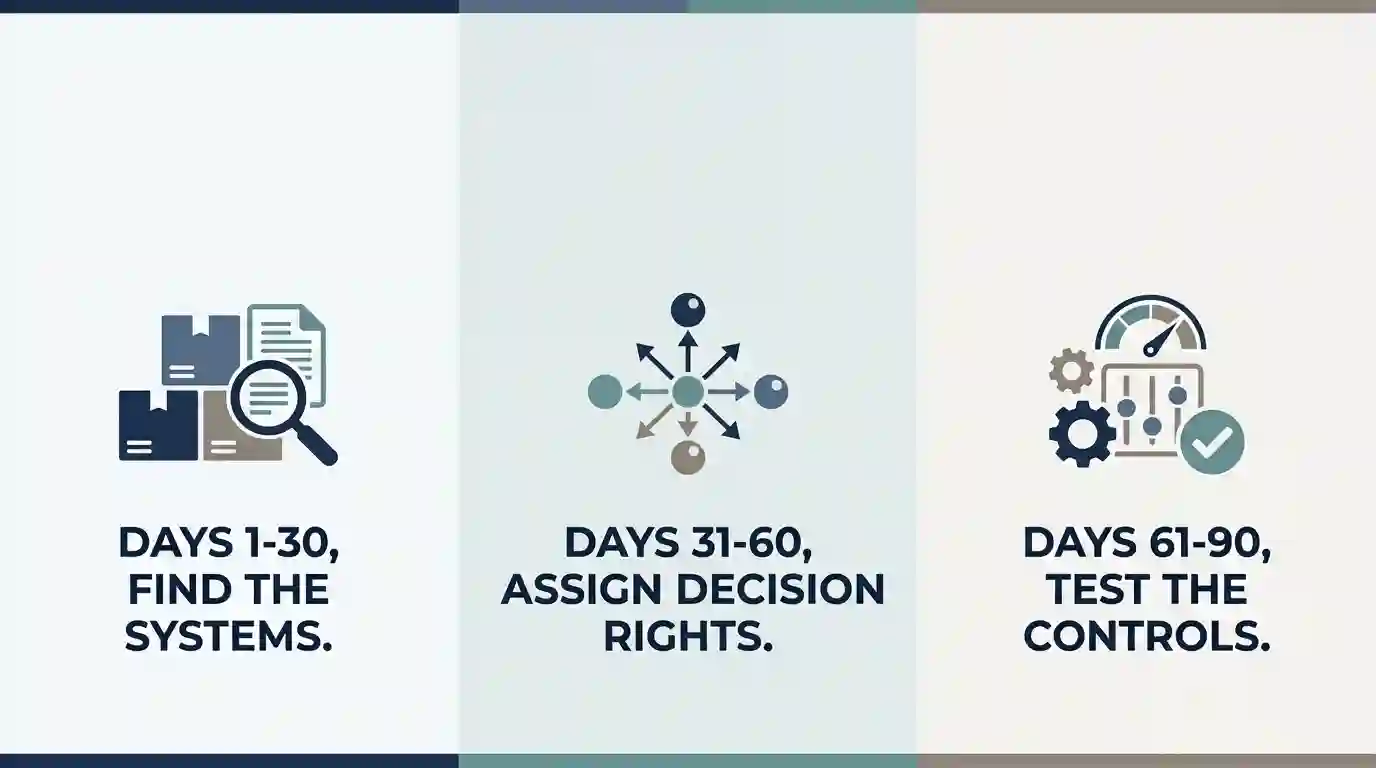
Days 1 to 30: find the systems
You can start by naming one executive owner. Then review procurement records, cloud logs, API usage, SaaS features, and business-team tools.
Create an initial inventory. Identify systems that affect customers, employees, money, or regulated decisions.
You may also want temporary rules for sensitive data. Temporary limits can reduce risk while the full process develops.
By day 30, leadership should have an inventory, named owners, a risk register, and a board briefing.
Days 31 to 60: assign decision rights
You can create a cross-functional governance group with business operations, technology, data, security, legal, compliance, risk, procurement, and HR.
Write down who approves use cases, who owns data access, who accepts risk, who monitors performance, and who can stop deployment.
You may also create a short vendor questionnaire. Define human-review thresholds and decide what evidence every production system must retain.
By day 60, the organization should have a governance charter, RACI matrix, intake form, and incident process.
Days 61 to 90: test the controls
You can add approval gates to the development process. Configure agent permissions and start monitoring live performance.
Then run a tabletop incident exercise. Pretend an agent sent confidential data to the wrong recipient or approved an unauthorized purchase.
Ask whether anyone can stop it within minutes.
By day 90, each major pilot should have a scale, pause, or retirement decision. It should also have a business KPI, monitoring owner, evidence record, and fallback process.
That’s enough to replace guesswork with management.
The simplest test is also the most revealing
Ask ten questions.
Can the company identify every AI system in use? Does every system have a business owner? Can anyone explain what data it uses and which actions it can take?
Does someone monitor the system after launch? Can a person override a consequential result? Can the organization disable the system quickly?
Can the board see both value and incidents? Can management explain why each system remains active?
If the answer is no, the organization doesn’t have a model problem first.
It has an ownership problem.
Frequently Asked Questions
AI transformation is a governance problem because it changes who makes decisions, who owns outcomes, and how organizations control risk.
What does “AI transformation is a governance problem” mean?
It means AI transformation depends on clear decision rights, accountable owners, risk controls, data permissions, monitoring, and measurable business outcomes. Technology alone cannot decide who may approve, change, or stop an AI system.
Why do AI transformation projects often fail to scale?
AI projects often stall because teams lack clear ownership, reliable data, workflow redesign, value metrics, human-review rules, and post-launch monitoring. A successful pilot does not prove that an organization can operate the system safely.
Who should own AI governance in a company?
The board and CEO should own strategic accountability. A cross-functional governance group can manage operating decisions, while every AI system should have a named business owner responsible for its outcomes.
How should companies govern AI agents?
Companies can govern AI agents through unique identities, limited permissions, approved tools, spending caps, approval thresholds, action logs, monitoring, escalation paths, and shutdown controls.
What is the first step in an AI governance program?
The first step is creating an AI inventory. The inventory can record each system’s owner, provider, purpose, data access, connected tools, autonomy level, risk, monitoring plan, and shutdown process.
Is the NIST AI Risk Management Framework mandatory?
NIST describes its AI Risk Management Framework as voluntary. It may become mandatory when a law, contract, procurement rule, or internal company policy requires its use.
What should a board ask about AI transformation?
The board can ask which AI systems affect customers or employees, who owns each outcome, what actions agents may take, what incidents occurred, how quickly systems can be disabled, and which initiatives have verified financial results.
Our Verdict: The best AI strategy may be a management strategy
AI transformation is a governance problem because AI changes who decides, who acts, and who answers for the result.
The hardest AI decision isn’t which model to buy. It’s naming the person who can stop the system, then giving them enough authority to do it.