Beyond Smartphones: Big Tech’s AI Glasses Race In 2026
AI glasses won’t replace smartphones in 2026, though they can absorb quick tasks. These tasks include capture, translation, navigation, captions, and short AI requests.
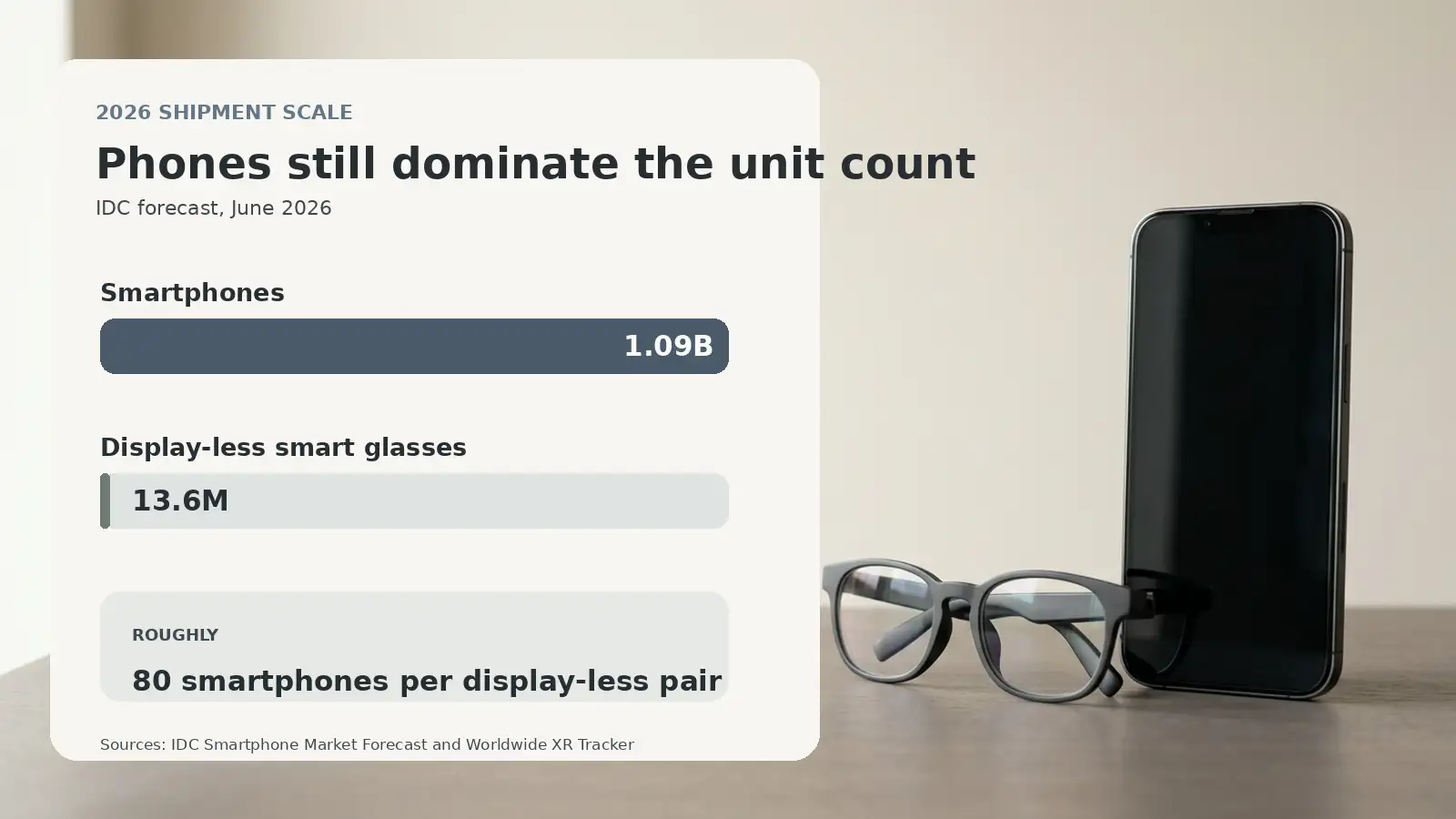
The current scale gap remains extremely wide. According to IDC’s June 2026 forecast, vendors may ship 1.09 billion smartphones this year. Its XR tracker expects 13.6 million display-less smart glasses.
That equals roughly 80 smartphones per display-less pair, while glasses grow much faster. This tension explains Big Tech’s current hardware race.
Research and testing note: I checked filings, product pages, availability, and market trackers. The workflow tests compare required steps across current device types. I didn’t physically wear every product listed. Comfort judgments therefore use disclosed weight and battery data.
AI glasses will complement phones before they replace them
You’re more likely to handle your phone less, not abandon it. Glasses can simplify short, context-based tasks, while phones still handle complex work better.
For example, IDC’s XR tracker values 2026 display-less glasses near $5.1 billion. First-quarter shipments reached 2.25 million units, up 167% yearly. Meta held 69.2% of that market.
That’s because smartphones still offer several practical advantages:
- Larger screens support editing, browsing, and detailed comparisons.
- Touch keyboards remain useful for precise text entry.
- Bigger batteries support longer, heavier workloads.
- Mature apps cover banking, work, travel, and commerce.
- Private screens expose less information to nearby people.
- Broad accessories make repairs and charging easier.
Still, glasses have a useful advantage because their sensors face your surroundings. You can request help without changing your posture.
A workflow comparison shows where glasses save steps
I’ve compared three common workflows using current product capabilities. This workflow test wasn’t a laboratory benchmark. I’ve checked official specifications, availability, and companion devices.
For a quick visual question, a phone often requires:
- First, you remove the phone from your pocket.
- Next, you authenticate and open your preferred assistant.
- Then, you frame the object using its camera.
- After that, you ask the question and read results.
- Finally, you return the phone to your pocket.
Camera-equipped AI glasses can shorten that flow:
- First, you can look toward the relevant object.
- Next, you can ask the assistant your question.
- Then, you can hear its answer through open-ear speakers.
That advantage helps during cooking, repairs, walking, or fieldwork. It matters less, though, during research, shopping, or editing.
Meta leads because ordinary-looking AI glasses already sell
Meta has the strongest commercial evidence among current AI-glasses vendors. EssilorLuxottica’s 2025 results report over 7 million Meta-partnered glasses sold. That total includes Ray-Ban Meta and Oakley Meta products.
That’s where Meta’s advantage goes beyond software. EssilorLuxottica supplies brands, manufacturing, fitting, lenses, and optical retail. Those services can solve problems electronics stores rarely handle.
In practice, you’ll need frames that fit your face. You may also need prescription lenses. Style, comfort, adjustments, and repairs can influence daily use.
Meta now covers three distinct product levels
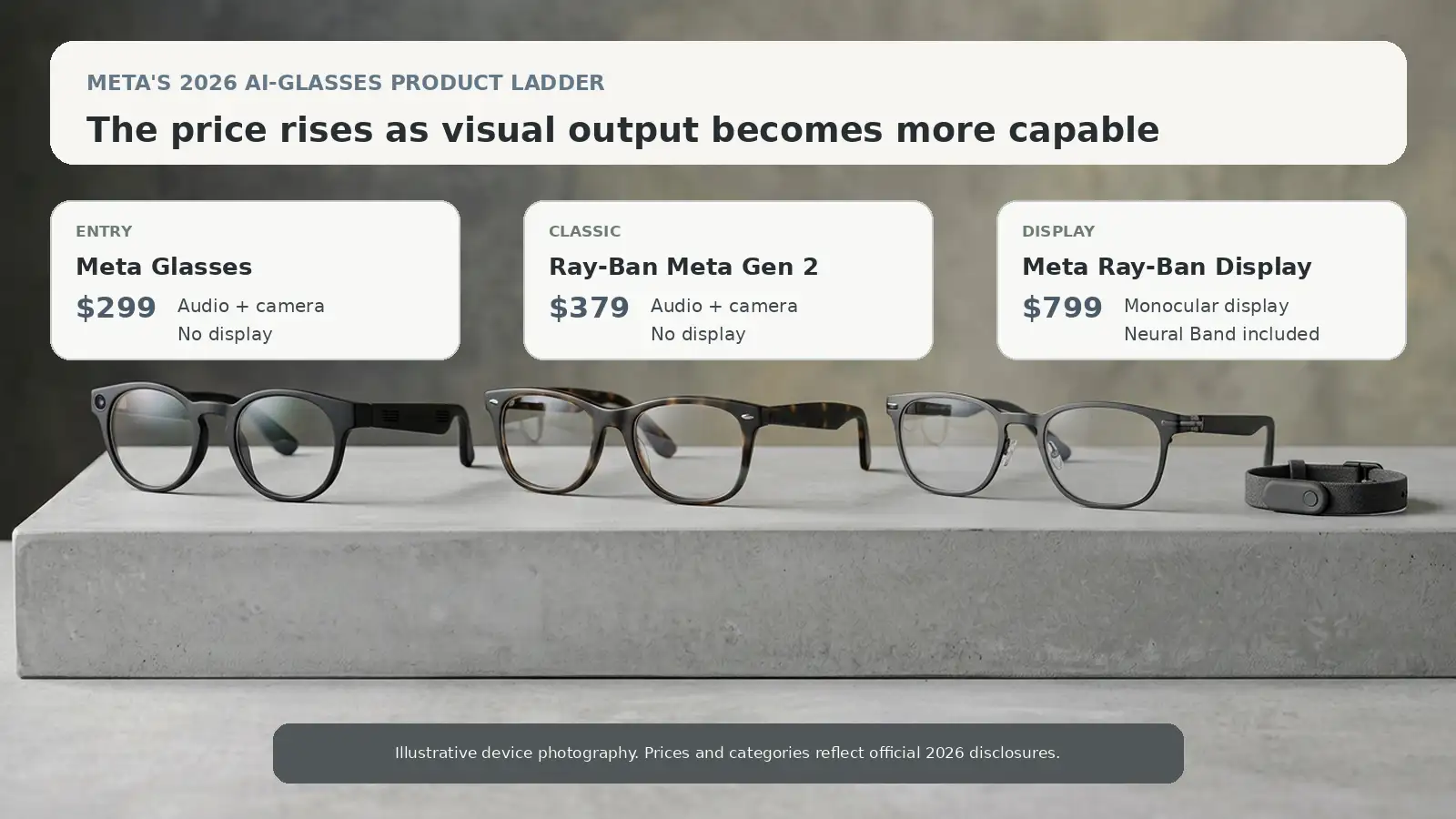
| Product | Price and display | Best fit, plus trade-off |
|---|---|---|
| Meta Glasses | $299<br>No display | Audio, capture, calls, and AI requests.<br>Results are mainly audio-based. |
| Ray-Ban Meta Gen 2 | $379<br>No display | Familiar eyewear with stronger capture.<br>It still needs Meta’s ecosystem. |
| Meta Ray-Ban Display | $799<br>Monocular color display | Messages, captions, navigation, and previews.<br>It costs more and lasts about six hours. |
More recently, Meta’s June launch announcement introduced Meta Glasses at $299. You can choose among 26 styles, including prescription-compatible options.
By comparison, Meta Ray-Ban Display can add glanceable visual information. Its official product page includes an EMG-based Neural Band. Meta lists up to six hours of mixed use.
Meta’s sales don’t prove profitable platform economics
Strong unit sales haven’t made Reality Labs profitable. Meta’s 2025 annual filing reports $2.207 billion in revenue. Meanwhile, operating losses reached $19.193 billion.
Still, you shouldn’t read Reality Labs as a glasses-only business. It also covers VR, AR, software, content, and neural interfaces. So, dividing its loss by glasses sales would misrepresent performance.
So far, Meta’s June 2026 filing shows $833 million in first-half Reality Labs revenue. Operating losses reached $8.647 billion, though glasses growth partly offset weaker Quest sales.
Verdict: Meta leads the consumer category today. Its wider platform still requires patient capital.
Google and Samsung are building the strongest ecosystem rival
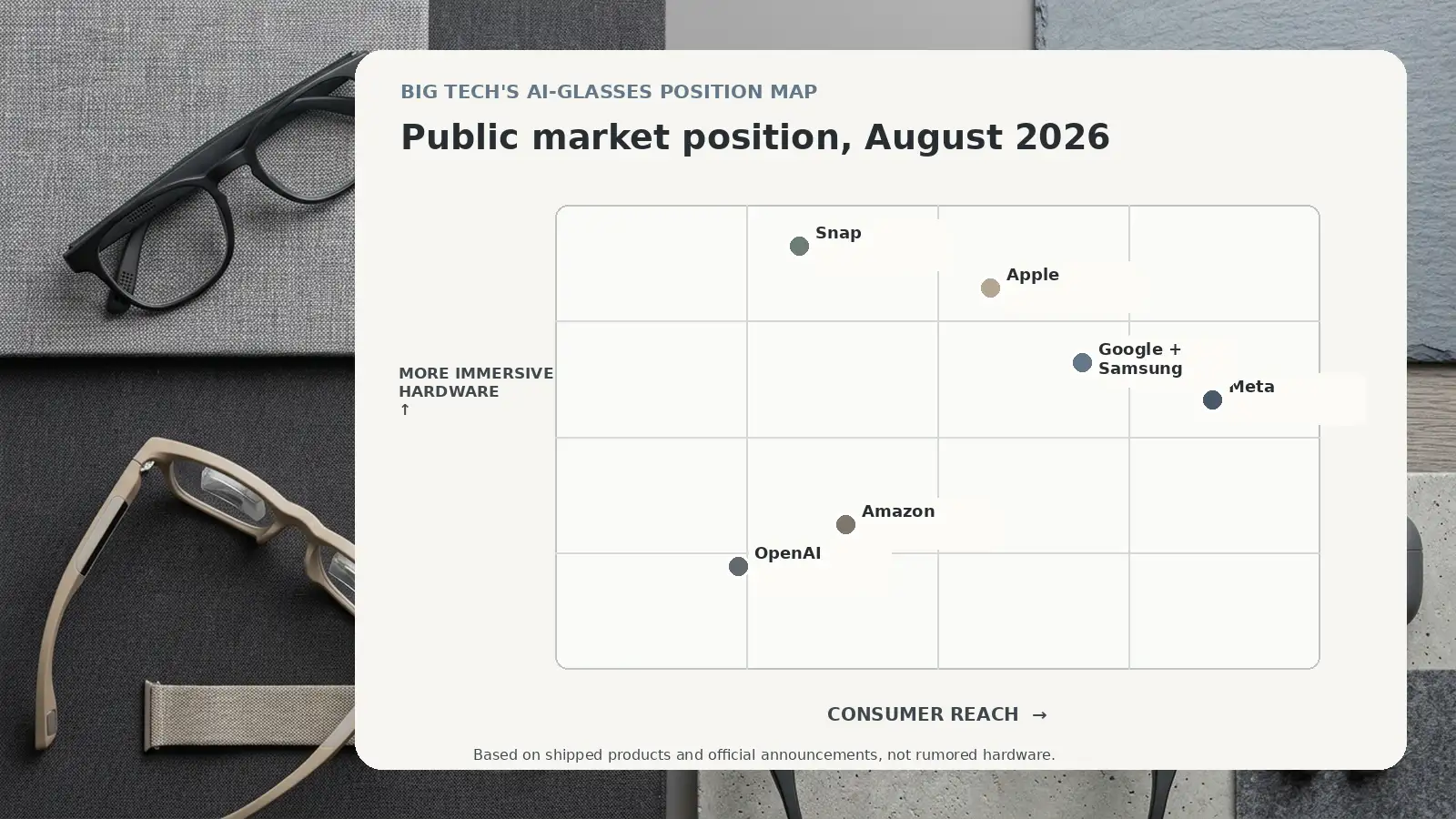
Google and Samsung offer the clearest platform challenge to Meta. Their strategy combines Gemini, Android XR, device manufacturing, and eyewear partners. It also gives hardware brands room to differentiate.
Specifically, Google announced two eyewear categories during I/O 2026:
- Audio glasses can provide spoken Gemini assistance.
- Display glasses may show directions, captions, and messages.
Looking ahead, Google’s I/O announcement says its first audio glasses may arrive during fall 2026. Partners include Samsung, Warby Parker, and Gentle Monster. The first models can support Android and iOS.
That cross-platform support may widen the audience and reduce lock-in concerns. Still, we won’t know its value until retail prices and battery details appear.
Galaxy XR establishes the platform before lighter glasses arrive
For now, Samsung’s Galaxy XR launch page lists an American price of $1,799.99. Samsung calls it Android XR’s first step. Its roadmap also includes AI glasses.
By design, Galaxy XR is an immersive headset, not daily eyewear. You can use it for workspaces, media, and spatial applications. Its size may limit where you’ll use it.
Until then, I’d avoid battery comparisons before retail glasses appear. Google has announced the category, not every final specification. That distinction prevents a common reporting error.
Verdict: Google and Samsung have credible platform assets. Meta still holds the current distribution and sales lead.
Apple can reduce screen time without weakening the iPhone
Apple has stronger reasons to extend the iPhone than replace it. Apple’s June 2026 filing report shows $196.515 billion in nine-month iPhone revenue. That’s a strong 22% yearly increase.
In practice, Apple can shift interactions toward watches, earbuds, and spatial devices. The iPhone may still handle identity, connectivity, data, and processing. So, less screen time doesn’t require less ecosystem dependence.
Meanwhile, Apple’s public spatial product remains Vision Pro. Its M5 product release lists a $3,499 starting price. You can use it for spatial work, media, and applications.
Still, reports describe glasses, camera-equipped AirPods, and a pendant. Apple hasn’t confirmed those products publicly.
For planning, that distinction matters because reported prototypes may never reach production. Launch dates can also move between reporting cycles.
Verdict: Apple is extending personal computing around the iPhone. Its financial disclosures don’t suggest an urgent phone exit.
Snap shows full AR still needs focused usage sessions
Snap’s SPECS show why full AR remains a premium category. They offer richer visual computing than audio glasses. Their cost, weight, and battery support shorter sessions.
Snap lists these six core specifications:
- First, SPECS starts at $2,195.
- The two frame sizes weigh 132 or 136 grams.
- The display provides a 51-degree field of view.
- Mixed-use battery can last up to four hours.
- Initial markets include America, Britain, and France.
- Snap expects to begin shipping during fall 2026.
In practice, Snap’s product announcement says SPECS can work without a tether. Two processors can handle vision and applications. You also get a charging case.
Even so, you can use those specifications for focused AR sessions. They don’t describe lightweight, all-day eyewear. Four hours may suit sessions better than full work shifts.
Also, Snap’s 2025 roadmap update reports over $3 billion spent across 11 years. That scale exposes the barrier facing smaller entrants.
Verdict: Snap offers the boldest consumer full-AR product. Audio glasses currently have an easier adoption path.
Amazon shows workplaces may adopt smart glasses first
Enterprise adoption can advance faster when glasses solve one costly task. Amazon’s project illustrates this approach by focusing on work steps, not general computing.
Specifically, Amazon says the glasses can support these tasks:
- The glasses can scan packages without holding a phone.
- They may show turn-by-turn walking directions.
- They can capture photographic proof of delivery.
- They may identify possible hazards using computer vision.
- The frames can support prescription and transitional lenses.
- They can use a swappable battery during work shifts.
According to Amazon’s project overview, hundreds of delivery workers shaped early versions. Amazon also added a separate controller and emergency button.
In daily use, drivers often carry packages with both hands. So, repeatedly checking a phone can add friction.
A narrow pilot can test value without major commitment
You can test one workflow before considering broader deployment. You don’t need to remove the phone during that pilot.
- First, you can choose one hands-busy task. Avoid testing every workflow at once.
- Next, you may record the phone-based baseline. Measure time, errors, and support needs.
- Then, you can give a small group glasses. Include different faces and prescription needs.
- During testing, you can track operational failures. Measure latency, battery, connectivity, and discomfort.
- You may also collect direct bystander feedback. Include privacy concerns and social acceptance.
- Afterward, you can compare fully loaded costs. Include hardware, cloud, support, and training.
- Finally, you can keep a fallback method. Workers may need phones during outages.
| Pilot measure | What it reveals | Useful comparison |
|---|---|---|
| Task completion time | Direct productivity effect | Glasses versus phone baseline |
| First-pass accuracy | Hidden correction costs | Error rate before and after |
| Battery coverage | Real shift suitability | Hours worked before charging |
| Failed requests | Network and model reliability | P50 and P95 failure rates |
| Support tickets | Training and fit problems | Tickets per 100 users |
| Safety events | Operational risk | Incidents and near misses |
| Cost per task | Financial viability | Hardware plus service costs |
So, enterprise value depends on measured workflow gains. Consumer novelty alone won’t justify the same investment.
OpenAI has a hardware team, not a confirmed phone killer
OpenAI’s hardware effort is confirmed, but its product remains undefined. OpenAI’s July 2025 update confirms the io Products merger. Jony Ive and LoveFrom retained design responsibilities.
Still, OpenAI’s official page doesn’t confirm a shape or launch date. Speaker, pendant, glasses, and pen details remain reported possibilities.
That’s relevant because OpenAI reaches users through third-party devices. Dedicated hardware could provide direct sensor access and context.
At the same time, that access creates difficult responsibilities. Agents may hear conversations and observe surroundings. They’ll need clear permissions, retention limits, and correction tools.
Verdict: OpenAI has credible talent and intent. Any specific product comparison remains premature.
The agent layer may matter more than the lenses
The largest business shift may happen above the hardware. Smartphones made apps the main route into services. AI agents may start choosing and operating those services.
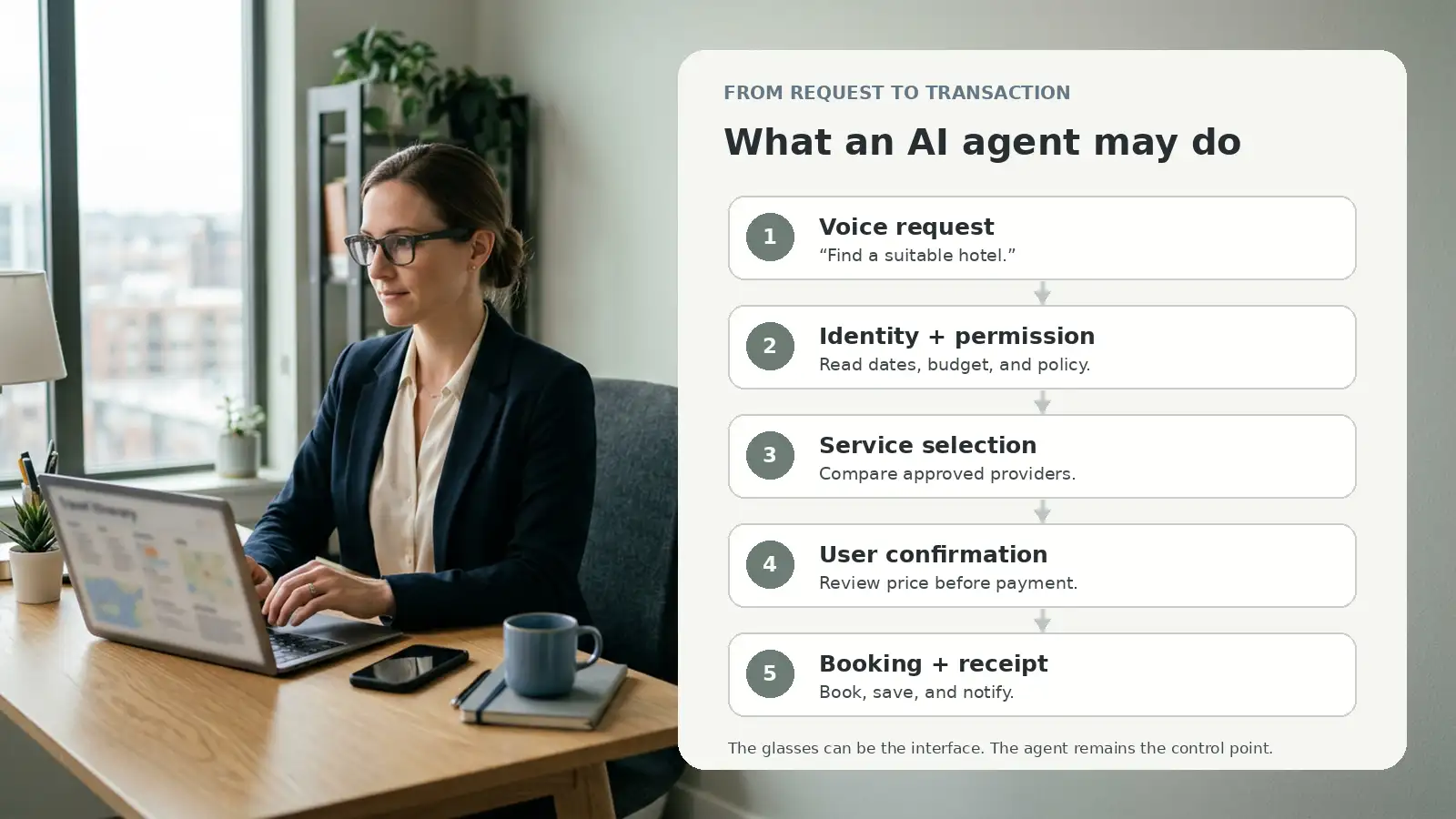
For example, here’s a simple business travel request. You might ask an agent for a suitable hotel. It can compare dates, prices, distance, and preferences.
From there, it may complete several actions:
- First, it can check your calendar for available dates.
- Next, it may compare approved travel providers and rates.
- Then, it can request confirmation before completing payment.
- After approval, it may book the selected room and transport.
- It can also add confirmed details to your calendar.
- Finally, it may send relevant updates to selected contacts.
Regardless of the device, the agent still controls discovery and execution. That position can affect customer acquisition and brand visibility.
Control points are moving across the computing stack
| Smartphone-era control | Emerging control | Possible business effect |
|---|---|---|
| Operating system | Personal agent | Agent decides which service receives demand |
| App store | Action and API directory | Developers compete for agent access |
| Touch interface | Voice, vision, and gesture | Visual branding receives less screen space |
| Phone camera | First-person sensors | Context improves, but privacy risk grows |
| Mobile notifications | Proactive assistance | Poor filtering can move distraction onto glasses |
| Electronics retail | Optical and workplace channels | Fit and support become sales requirements |
Businesses can prepare their services for agent-based access
Companies don’t need custom glasses immediately. They can prepare existing services for safer machine execution.
- First, you can list common customer intentions. Examples include booking, paying, checking, and canceling.
- Next, you can create stable action APIs. Give each action clear inputs and outcomes.
- Then, you may set clear permission boundaries. Sensitive actions may need explicit confirmation.
- You can also add clear rollback paths. Users need simple correction and cancellation options.
- Afterward, you can return structured results. Agents need prices, status, dates, and constraints.
- Meanwhile, you can log every completed action. Customers and support teams need readable histories.
- Finally, you may measure agent referrals separately. Traditional app attribution may miss them.
Together, these steps can support phones, watches, assistants, and future glasses. They’ll also reduce dependence on one hardware vendor.
Privacy and service continuity can slow adoption
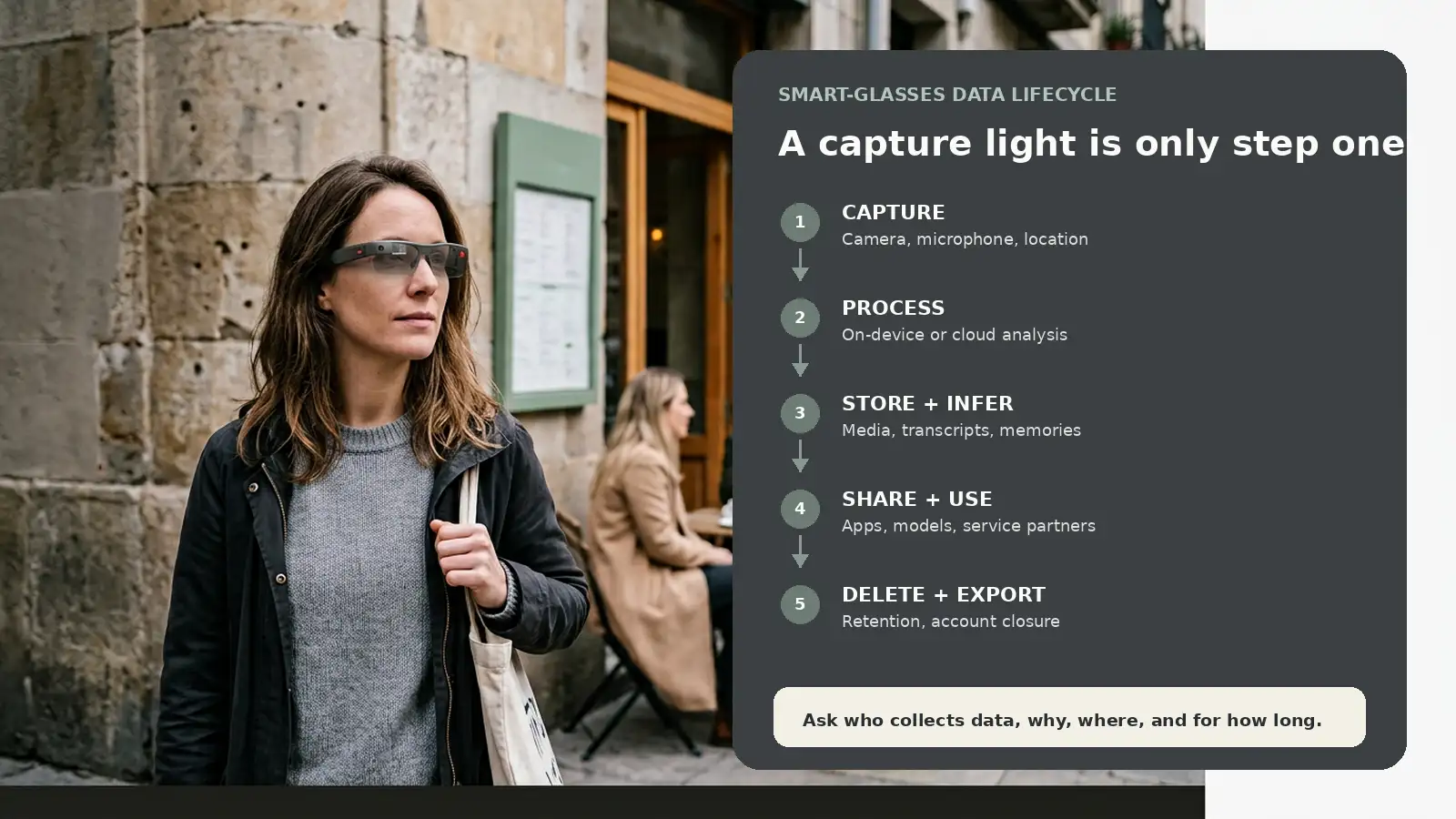
Trust problems can block adoption even when hardware improves. AI glasses collect first-person data, while bystanders may never become registered users.
For example, the ICO’s June 2026 research found a wide understanding gap. About 97% own a smart device, though only 14% understand its data use.
Therefore, the ICO’s 2026 guidance calls for privacy protections from the design stage. It emphasizes necessary collection, specific consent, clear notices, security, and impact reviews.
A recording light can’t solve every privacy problem
Still, a visible light can show capture, but not later uses. People may not know whether systems store, summarize, or identify them.
Across the EU, the European Commission’s AI Act guide explains several biometric restrictions. These cover sensitive categorization and specified remote identification. GDPR and ePrivacy duties may still apply separately.
In India, the official DPDP Act also applies to relevant global products. It requires free, specific, informed, and unambiguous consent. Consent should cover only necessary data.
A practical privacy review can cover seven questions
- First, which sensors operate during each feature? List every camera, microphone, and location signal.
- Next, which processing happens locally on each device? Separate device work from cloud work.
- Then, how long does personal data remain stored? Define deletion for every data type.
- Also, how do nearby bystanders receive clear notice? You can test both visibility and accessibility.
- Can users stop physical capture immediately? A hardware control may improve confidence.
- Who receives inferred or summarized information? Include every model provider and contractor.
- Finally, what happens after someone closes their account? Confirm both deletion and export procedures.
Cloud-dependent hardware also creates shutdown risk
For instance, Humane’s shutdown notice ended core Ai Pin services during February 2025. Calling, messaging, AI requests, and cloud access then stopped.
Likewise, Microsoft’s HoloLens support page says manufacturing ended during December 2024. The same page defines a security-support end date.
Before buying, you can ask about offline functions and data export. You may also request end-of-life commitments. Those terms may matter more than launch features.
AI glasses can support accessibility without replacing eye care
Accessibility offers meaningful uses, but market claims need restraint. According to WHO’s fact sheet, 2.2 billion people have vision impairment. Related annual productivity losses may reach $411 billion.
Those figures don’t define the smart-glasses market. Many people instead need affordable glasses, surgery, treatment, or rehabilitation. AI wearables can support selected daily tasks.
For now, current glasses may assist through several features:
- They may read labels, menus, signs, and documents aloud.
- They can describe nearby objects and possible obstacles.
- They may connect users with trained visual interpreters.
- They can provide live captions during conversations.
- They may reduce touch requirements through voice controls.
- They can guide users toward saved personal items.
For practical support, Meta’s accessibility update describes several third-party applications. Current examples include Aira, Be My Eyes, and OOrion.
Even then, AI descriptions can be wrong. Battery, connectivity, and camera position still matter. So, safety-critical navigation needs human fallback and careful testing.
These benefits also bring wider hardware costs. More devices create material and disposal questions.
More wearable devices can create more electronic waste
A distributed device future may increase hardware consumption. One phone could become several wearable devices. Each new product adds batteries and electronic components.
According to the ITU and UNITAR monitor, e-waste reached 62 million tonnes during 2022. Only 22.3% received documented formal recycling. By 2030, waste may reach 82 million tonnes.
So, you can include environmental factors during procurement:
- First, you can check whether batteries or modules are replaceable.
- Next, you may ask for security support and repair timelines.
- Then, you can compare warranties across expected usage periods.
- You may also request trade-in or certified recovery options.
- Afterward, you can include accessories within overall waste estimates.
- Finally, you may prefer data portability over hardware-dependent storage.
Over time, longer support can lower replacement pressure. Repairable designs may also reduce operating costs.
You can include that lifecycle review within the same pilot.
Businesses should prepare with narrow, measurable pilots
Most companies need agent-ready services before custom AI glasses. A narrow pilot can reveal whether wearable hardware adds value. Broad deployments should follow evidence, not category excitement.
A 90-day preparation plan keeps the scope practical
- First, you can audit mobile tasks during days 1 through 15. You can find hands-busy and context-heavy work.
- Next, you may choose one task during days 16 through 30. Write measurable success and failure criteria.
- Then, you can prepare action APIs during days 31 through 45. Add permissions, logs, and rollback controls.
- You may also design multimodal outputs during days 46 through 60. Support audio, short text, and phone fallback.
- Afterward, you can map personal data during days 61 through 75. Define purpose, processing, retention, and deletion.
- Finally, you can run a small pilot during days 76 through 90. Compare results with the current workflow.
At the end, your decision can remain simple. You may continue when performance improves without new safety or privacy costs. You can stop when phones remain faster, safer, or cheaper.
The verdict is companion glasses now, distributed computing later
The 2026 market favors companion glasses rather than phone replacements. Meta leads current consumer sales and optical distribution. Google and Samsung offer the strongest platform challenge.
For now, Apple continues extending its profitable iPhone ecosystem. Snap targets richer, focused AR sessions, while Amazon shows clearer workplace value.
Meanwhile, OpenAI’s hardware plans remain credible but undefined. Microsoft and Humane show why lifecycle planning matters. BCIs remain a separate medical category.
The most important signals now extend beyond shipment growth:
- Track daily retention after the novelty period ends.
- Measure battery coverage during normal work and travel.
- Check prescription support and optical service quality.
- Count agent actions across payments, bookings, and communications.
- Review privacy complaints involving users and bystanders.
- Compare enterprise outcomes against current phone workflows.
- Calculate support costs after warranties and launch periods.
- Watch platform margins alongside hardware shipment volumes.
Phones may leave our hands, though they will remain nearby for years.
Quick answers
AI glasses FAQs
Here are direct answers to common buying and planning questions.
Will AI glasses replace smartphones?
No, not during 2026. AI glasses can handle quick, contextual tasks, while phones remain better for complex, private, and battery-heavy work.
Which company leads AI glasses in 2026?
Meta leads current consumer sales and market share. IDC measured Meta’s Q1 2026 share at 69.2%.
What separates AI glasses from AR glasses?
AI glasses may have no visual display. They can use cameras, microphones, speakers, and an assistant, while AR glasses place digital visuals within your view.
Do AI glasses work without smartphones?
Some functions can work independently. Setup, connectivity, account management, and detailed controls may still require a companion phone.
Are brain implants likely smartphone replacements?
No near-term evidence supports that forecast. The FDA treats implanted brain-computer interfaces as significant-risk medical devices intended to restore lost capabilities.
Should a business build an AI-glasses application now?
You may start with an agent-ready action API. Then, you can test that service across phones and glasses before funding custom hardware work.
What is the biggest AI-glasses adoption risk?
No single risk applies everywhere. Battery, comfort, privacy, reliability, and service continuity matter differently across consumer and workplace uses.
Important Note: This article is based on shipped products and official announcements.All sources were verified very carefully!