Alaya AI Explained: Official Links, How It Works, AGT, NFTs, Activity, and Risks
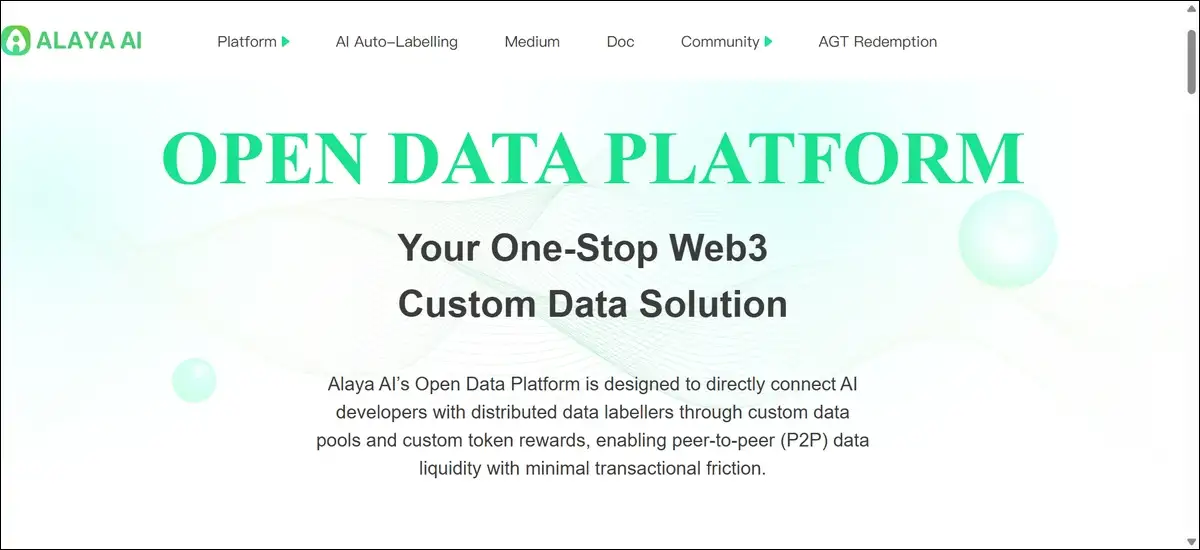
Alaya AI is a Web3 platform for collecting and labeling AI data. Basically, it connects data contributors with developers who need training datasets. The system adds tasks, tokens, NFTs, and blockchain records.
I reviewed Alaya’s public website, official documentation, and BNB Chain listing. I also checked online details for conflicting claims. But I did not submit paid tasks or connect a wallet.
That testing limit matters for this review. Public pages show the intended system, not every live workflow. Reward rates, task availability, and withdrawal behavior still need account-level testing.
Quick answer: Alaya AI may suit developers who need community-sourced labeled data. It may also interest contributors comfortable with token rewards. However, available details do not confirm fixed earnings, guaranteed accuracy, or broad regulatory compliance.
Alaya AI is a data infrastructure platform, not a chatbot
Alaya AI helps communities collect, label, and validate training data.
So, it doesn’t primarily work like ChatGPT or an automation assistant. Its official overview calls it an open, composable Web3 AI data network.
Instead, the platform can support distributed crowdsourcing and direct data requests. Developers may create reward pools for specific dataset needs. Contributors can complete tasks and receive token or NFT rewards.
Alaya’s public website lists five supported data categories:
- Image labeling for objects, regions, and classifications
- Audio analysis for speech or sound-related tasks
- Autonomous driving data for road and vehicle models
- Text analysis for language and meaning tasks
- Video annotation for events, objects, and movement
In addition, the site mentions an open data marketplace where projects may request data through on-chain or off-chain reward pools. Still, these statements bring possible capabilities, not service guarantees.
Also read: RedeepSeek.com Review
Important Alaya AI facts:
| Question | Short answer |
|---|---|
| What is Alaya AI? | A distributed AI data collection and labeling platform |
| Is it a chatbot? | No, its main focus is training data infrastructure |
| Who can use it? | Contributors, AI developers, researchers, and Web3 projects |
| What is AGT? | Alaya’s documented utility and governance token |
| Does it use NFTs? | Yes, Alaya NFTs and Medallion NFTs serve different roles |
| Is a wallet required immediately? | Official instructions say email users can start without one |
| Which networks are documented? | Arbitrum and opBNB |
| Is pricing public? | I found no verified enterprise price sheet |
| Are earnings guaranteed? | No, rewards and task supply can change |
The official Alaya AI website is aialaya.io
The official documentation links directly to aialaya.io. It also lists the project’s X, Telegram, and Medium accounts, so you can cross-check them. I used those first-party links during this review.
However, search results include other sites using similar Alaya branding. Some call themselves official without matching the GitBook links. Meanwhile, other results describe unrelated chatbots or business automation products.
Use this identity checklist before creating an account:
- Open the official GitBook overview here: https://alaya-ai.gitbook.io/alaya-ai
- Follow its website link to https://www.aialaya.io/.
- Check the complete address before entering wallet details.
- Review any wallet request before signing a transaction.
- Never treat a search-result label as proof.
For added confirmation, I tested the public aialaya.io homepage. It displayed platform statistics and a contributor link. The documentation also linked to its browser application.
However, I didn’t approve wallet permissions or sign transactions. Therefore, I can’t confirm the current withdrawal flow. Likewise, I can’t confirm regional task availability from public pages.

Alaya AI works through contributors, data requests, and quality controls
Alaya AI divides data work into small contributor tasks, so developers can request specific data, while users provide human judgments. The platform then applies sampling, preprocessing, and modeling processes.
More specifically, the official technical documentation mentions three connected layers. These layers organize user interaction, data optimization, and automated modeling.
Below, you can understand them easily:
| Layer | Documented purpose | Practical meaning |
|---|---|---|
| Interaction Layer | Connects users through browser and mobile interfaces | You can access tasks and receive documented rewards |
| Optimisation Layer | Targets samples and preprocesses submitted data | The system may filter and organize contributor responses |
| Intelligent Modelling Layer | Supports human-assisted automatic labeling | Human feedback may improve automated labels |
Alaya says the system uses RLHF and human-in-the-loop methods.
- RLHF means reinforcement learning from human feedback.
- Human-in-the-loop systems keep people involved in automated decisions.
Beyond those layers, the technical page mentions particle swarm optimization and Gaussian approximation. Those are first-party technical claims.
However, I couldn’t find a public benchmark showing their measured accuracy advantage.
So, that distinction can help you judge the evidence. A documented method isn’t an independent performance result. Therefore, developers may want sample-level validation before buying data.
A contributor can begin with email verification
They officially say users can register using email verification. A wallet may only become necessary when collecting tokens or NFTs externally. This lowers the initial technical requirement.
In practice, the documented contributor path looks like this:
- Create an account using email verification.
- Open the task area in the browser application.
- Select an available general or specialized task.
- Submit labels, judgments, or requested information.
- Receive rewards when the system accepts eligible work.
- Connect a wallet when moving supported digital assets.
If you’re on mobile, the documentation says you should use a wallet browser. It also identifies Arbitrum and opBNB as supported networks. Of course, network support may change after publication.
During my test, I confirmed that registration and task links existed. However, I didn’t complete registration or submit personal information. As a result, I couldn’t measure acceptance rates, review delays, or withdrawals.

A developer can request targeted training data
Developers may create custom reward pools for defined data needs. This model can support projects lacking an internal annotation workforce. It may also help with regional or specialist data.
To reduce confusion, a useful request can define:
- Data type, including image, text, audio, or video
- Target population, language, region, or specialist field
- Label instructions with positive and negative examples
- Acceptance threshold for agreement and accuracy
- Usage rights covering model training and redistribution
- Privacy rules for personal or sensitive information
- Delivery format and required metadata
Alaya’s overview says projects may offer custom token rewards. However, the public documentation doesn’t provide standard delivery times. I also couldn’t find a public enterprise service-level agreement, though.
Before paying, you should request a sample batch. So, you can compare labels against an expert-reviewed reference set. That way, you can measure quality more clearly than marketing claims do.
Alaya tasks vary by expertise, complexity, and access requirements
This tool separates tasks into general and specialized categories. In turn, both categories may use standard or advanced formats. As a result, advanced work may require stronger platform credentials.
| Task type | Access and example |
|---|---|
| General standard | Enough energy. You might identify an image object. |
| General advanced | Higher requirements. You might segment several objects. |
| Specialized standard | Matching expertise. You might classify programming concepts. |
| Specialized advanced | Expertise plus complex review, such as medical imagery. |
While general tasks may include object recognition or semantic segmentation, specialized tasks may cover medicine, programming, culture, or dialects. A matching Medallion NFT can control specialized access.
Standard tasks may use simple multiple-choice formats. Advanced tasks can include open questions and larger workloads. High-level NFTs or staked AGT may also be required.
Although the documentation says advanced tasks offer better rewards, it doesn’t publish fixed rates. So, you shouldn’t assume advanced access ensures steady work.
AGT serves utility and governance roles inside Alaya AI
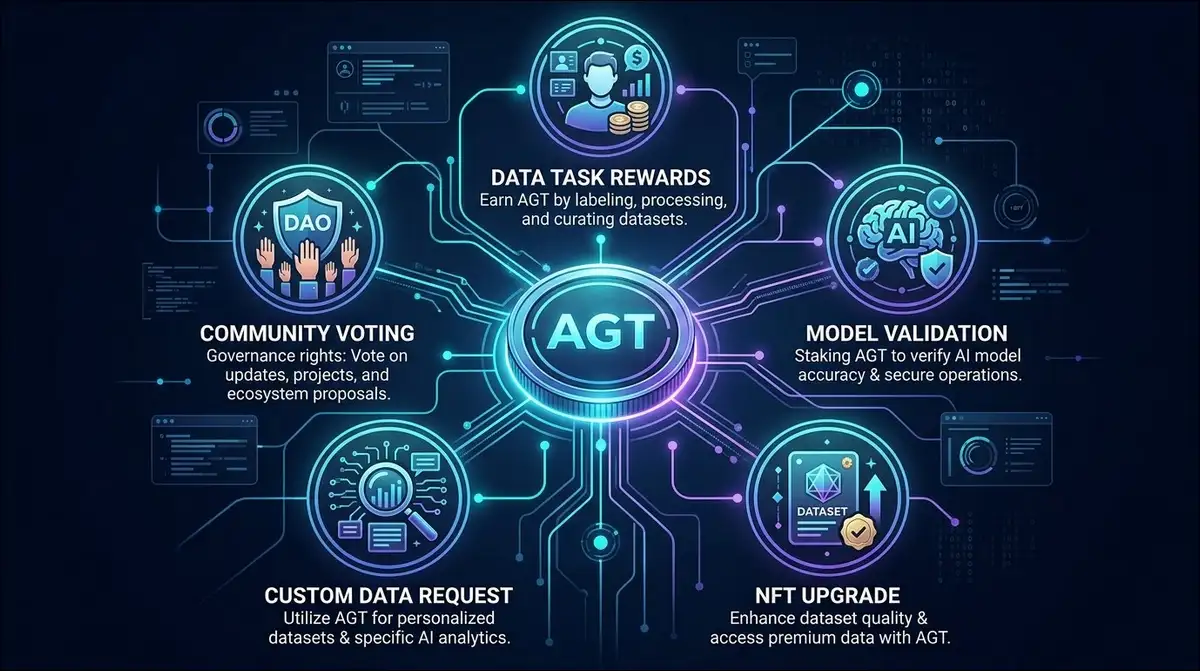
Currently, they mention AGT as both utility and governance currency. It states a maximum circulation of five billion AGT. However, this differs from secondary articles describing two separate tokens.
Documented AGT uses include:
- Paying for NFT upgrades at specified levels
- Creating custom data reward pools for developers
- Accessing advanced tasks alongside required Medallions
- Staking for validation and calibration work
- Supporting auto-labeling model development
- Participating in community governance
- Submitting data package offers through the platform
Crucially, the official token page includes an important limitation. AGT staking alone does not provide passive income. Instead, staking may provide access to advanced contributor roles.
Even so, this point conflicts with some exchange explainers. Several imply that staking automatically creates yield. The official documentation doesn’t support that interpretation.
AGT staking acts as an access and security mechanism
Alaya uses staking to create a cost for harmful submissions. A user may risk access or committed value when contributing poor data. This mechanism can discourage casual spam.
Still, staking can’t prove that a label is correct. It also can’t prove that one wallet represents one person. Therefore, quality still requires testing, agreement checks, and expert review.
Developers should ask these questions:
- How many contributors label each sample?
- What agreement level triggers acceptance?
- How does Alaya detect coordinated accounts?
- Who resolves disagreements between specialists?
- Are rejected labels retained or deleted?
- Can buyers inspect quality-control metadata?
During my review, I couldn’t find public answers covering every question. That doesn’t prove those controls are absent. Instead, it means buyers may need direct written confirmation.
ALA references require extra caution
Many online articles mention ALA as Alaya’s reward token. By contrast, current official token documentation centers around AGT. Most of first-party pages didn’t clearly explain ALA’s current role.
For that reason, I wouldn’t publish ALA supply figures yet. Instead, I’d first verify its official contract address. Then, I’d confirm the supported chain and current purpose.
This careful approach prevents token-name confusion. At the same time, it reduces the risk of linking counterfeit contracts. Search results and exchange descriptions may be outdated, so you better be careful.

Alaya NFTs control task participation, while Medallions show expertise
Alaya uses two NFT types for different platform functions. Their NFTs support participation and rewards. Whereas, Medallion NFTs represent achievements and specialized knowledge.
| Feature | Alaya NFT | Medallion NFT |
|---|---|---|
| Main role | User character and task participation | Expertise, ranking, and task targeting |
| Received at registration | Official docs say one basic NFT is provided | No, users earn these through achievements |
| Tradable | Official docs say yes | No, the NFT stays wallet-bound |
| Required for tasks | Used for training tasks and rewards | Used for matching specialized tasks |
| Upgrade method | Experience points and AGT at intervals | Experience points and AGT at intervals |
In simple terms, the player-character comparison makes Alaya NFTs easier to understand. Your chosen NFT may influence task access and energy behavior. But Medallions work more like non-transferable skill records.
The documentation says Medallions avoid formal KYC qualifications. As a result, that approach may reduce onboarding friction. However, it may also raise questions about expert verification quality.
For sensitive work, though, achievement records may not replace professional credentials. Medical or legal data can require documented qualifications. Buyers should define those requirements before commissioning data.
Energy limits how often users can complete task sets
New users receive three energy points under default rules. Completing a task set consumes one energy point, and one point returns every six hours.
The default storage limit is three points. Different Alaya NFT attributes may affect energy behavior. The public manual does not provide a complete current attribute table.
Consequently, this system can limit rapid task completion. At the same time, it may encourage NFT upgrades or acquisitions. Contributors should include these constraints when estimating earning time.
For this review, I verified these rules in the official manual. However, I didn’t confirm them inside a logged-in account. Live settings may differ from older documentation.

Public activity shows usage, but the metrics need context
On their website, they usually displays substantial registered users and daily activity figures. For example, on July 21, 2026, the homepage showed the following figure:
- 559,893+ registered users
- 50,794+ daily active users
- 47,376+ daily on-chain transactions
However, these are first-party counters, not independently audited figures. The page doesn’t explain its counting method. So, you may want to treat them as project-reported statistics.
BNB Chain’s DappBay listing showed different metrics. During the same time, it displayed 205.25K transactions and 202.71K users. However, it also showed sharp negative percentage changes.
| Source and metric | Observed value | Context |
|---|---|---|
| Alaya registered users | 559,893+ | First-party counter |
| Alaya daily active users | 50,794+ | “Active” isn’t defined |
| Alaya daily transactions | 47,376+ | Chain coverage isn’t stated |
| DappBay transactions | 205.25K | Period and method matter |
| DappBay users | 202.71K | May represent wallets |
| DappBay user change | -82.72% | Dynamic snapshot |
| DappBay transaction change | -82.54% | Period needs confirmation |
Importantly, these figures don’t necessarily conflict. That’s because each source may use different periods. Also, registered accounts aren’t the same as active wallets.
DappBay displayed a 3.6 rating from 29 reviews. In addition, the distribution was highly polarized. A small review sample should not drive procurement decisions.
The listing also named CertiK under its audit field. However, I didn’t locate and match the underlying report. Therefore, an audit label alone doesn’t establish complete safety.
Blockchain records provenance, but it cannot guarantee good data
Blockchain can record activity without proving label accuracy. It may show wallet actions, payments, timestamps, and staking events. Those records can support traceability.
However, blockchain can’t independently verify human judgment. For example, a recorded answer may still be wrong. A contributor may also misunderstand unclear instructions.
| Blockchain may help show | Blockchain does not automatically prove |
|---|---|
| A wallet submitted or validated work | The label is factually correct |
| A reward transaction occurred | The worker received fair compensation |
| An event happened at a recorded time | The source data had valid consent |
| A token was staked | The user is a qualified expert |
| A reference remained unchanged | Raw data remained private everywhere |
| Governance votes occurred | Governance represented unique people |
This distinction especially matters for regulated data. Health, financial, or biometric datasets may contain personal information. Immutable records can also complicate deletion requirements.
Therefore, a business buyer may want to ask where raw data lives. You may also ask whether on-chain records contain personal metadata. A data-processing agreement should explain retention and deletion.
Alaya AI’s benefits are practical, but each has conditions
Alaya can provide flexible access to distributed contributors. This model may help smaller teams request targeted datasets. Custom reward pools can also support unusual data needs.
Potential benefits include:
- Broader contributor access across regions and backgrounds
- Small-task distribution for large annotation projects
- Custom data requests tied to defined incentives
- Human feedback supporting automated labeling systems
- Traceable reward activity through supported networks
- Specialist routing using Medallion achievements
Still, each benefit depends on implementation quality. A large crowd doesn’t automatically reduce bias. Incentives can also favor speed over careful work.
During testing, I couldn’t find public benchmarks comparing Alaya with Labelbox or Scale AI. So, claims about lower costs remain unverified. Buyers can run the same test batch across vendors.
Alaya AI carries token, quality, privacy, and operational risks
The main risks involve variable rewards, uncertain quality, and Web3 complexity. None of them automatically makes the platform unsuitable. Instead, they simply users need a closer review.
Contributor risks
- Task supply may vary by location, expertise, and demand.
- Token values may change before withdrawal or conversion.
- Network fees may reduce earnings from small rewards.
- NFT or staking requirements may add costs for advanced access.
- Rejected work may lower effective hourly earnings.
- Tax obligations may apply in your country.
I couldn’t find a verified fixed hourly earning figure. Competitor payout tables lacked primary support. Contributors may want to track net earnings themselves.
Business and developer risks
- Crowd labels may contain errors or coordinated spam.
- Specialist badges may not equal professional certification.
- Dataset rights may differ across contributors and regions.
- Personal data may trigger privacy and deletion duties.
- Public documentation may trail current product behavior.
- Token-funded budgets may change with market prices.
Notably, the main GitBook pages said they were updated one year earlier. Buyers should confirm current features in writing. That’s especially important for security and compliance claims.
Also read: Neural TTS: The Complete Technical Guide
Smart-contract and wallet risks
In addition, connecting a wallet introduces transaction risks. For example, a malicious signature can grant unwanted permissions. Network or contract bugs may also affect assets.
You can reduce exposure with a separate wallet. Review each permission before approval. Avoid storing unrelated assets in a task wallet.
Alaya AI pricing and earnings remain publicly unclear
I couldn’t find a verified public enterprise price sheet. Developers may need a custom quote or reward budget. Contributors can register, but earnings depend on available work.
A useful cost model should include:
| Cost area | What to measure |
|---|---|
| Contributor rewards | Cost for accepted labels and validations |
| Quality review | Rework, expert review, and rejected samples |
| Token conversion | Price movement and exchange spreads |
| Network costs | Wallet transfers and contract interactions |
| Internal management | Instructions, sampling, and final acceptance |
| Compliance | Legal review, consent, and data handling |
So, don’t compare only the advertised label price. Poor labels can raise model-development costs. Instead, a small paid pilot can reveal the full cost.
Contributors should calculate net hourly value. Include active work, waiting, rejected tasks, fees, and conversion costs. Gross token rewards can hide these deductions.
Alaya AI may fit targeted projects, but not every workflow
Alaya may fit experimental or community-based data projects. It can also suit teams comfortable with tokens and wallet workflows. Specialized regional requests may benefit from distributed participation.
For example, it may fit:
- AI startups testing a narrow dataset idea
- Web3 projects preferring token-based contributor rewards
- Researchers seeking varied human judgments
- Teams wanting auditable reward transactions
- Contributors comfortable with variable task availability
However, it may not fit:
- Teams requiring fixed fiat pricing and strict service levels
- Projects needing verified licensed professionals
- Organizations avoiding tokens or wallet interactions
- Sensitive-data work without clear contractual safeguards
- Contributors expecting stable, guaranteed income
Alternatively, a hybrid model may work better for some teams. In that model, the crowd can handle broad initial labeling. Then, internal experts can review uncertain or sensitive samples.
You can evaluate Alaya AI with a small, measured pilot
A controlled pilot gives more evidence than feature claims. Start with a representative sample and clear acceptance rules. Compare results against expert-reviewed labels.
Here’s a buyer checklist you can use:
- Confirm the official domain and supported networks.
- Request current pricing and payment terms.
- Define label instructions with edge-case examples.
- Ask how contributors qualify for specialist work.
- Set agreement and adjudication thresholds.
- Confirm data storage, retention, and deletion rules.
- Review dataset ownership and training rights.
- Match any audit report to deployed contracts.
- Test exports and required metadata.
- Measure total cost per accepted label.
With that setup, your pilot can track precision, recall, and agreement. It can also measure turnaround and rework. Keep token-price effects separate from labeling performance.
Likewise, contributors can run a similar personal test. Track seven days of task availability and net rewards. Record rejection rates without sharing sensitive task data.
Verdict: Alaya AI is interesting, but evidence should guide adoption
Alaya AI presents a structured Web3 approach to AI data work. Its clearest features are custom requests, task-based contributions, AGT access, and dual NFTs. Official documentation explains these mechanics better than most reviews.
However, the platform still leaves important public questions unanswered. Pricing, measured accuracy, withdrawal performance, and compliance controls need stronger evidence. Several online articles overstate these areas.
Therefore, I’d suggest a limited pilot before larger spending. For contributors, I’d suggest tracking net returns before staking funds. Either way, you should use official links and verify contracts.
My verdict: Alaya AI may suit controlled, non-sensitive experiments. It needs deeper due diligence for regulated or production-critical datasets. Its blockchain layer adds traceability, not automatic data quality.
Frequently asked questions about Alaya AI
Alaya has an official website, documentation, and BNB Chain listing. Those signals confirm a public operating project. However, they don’t guarantee returns, accuracy, or contract safety.
Email registration may allow users to explore basic features. Advanced tasks can require AGT staking or upgraded NFTs. Business data requests may require funded reward pools.
You may receive token or NFT rewards for eligible contributions. Earnings depend on tasks, acceptance, token value, and fees. So, there isn’t any guaranteed income level.
Official instructions say most features support email-based access. However, a wallet may become necessary when collecting assets externally. Mobile registration may require a wallet browser.
Current official documentation names AGT as the native platform token. It serves utility and governance roles. The page states a five-billion maximum circulation.
The official token page says staking alone doesn’t provide passive income. Staking may grant access to advanced roles and rewards. Actual opportunities can depend on task demand.
Alaya NFTs function like user characters inside the task system. They support task access, rewards, and events. Official documentation says users receive a basic NFT after registration.
Medallions are wallet-bound achievement and expertise records. They help route specialized tasks to suitable contributors. Unlike Alaya NFTs, they aren’t tradable.
The official startup guide names Arbitrum and opBNB. DappBay currently displays opBNB activity. Support may expand or change.
No. Instead, blockchain can support transaction and provenance records. Accuracy still depends on instructions, contributor skill, validation, and expert review.