XtraMath Review: The Free Math Fluency Tool Quietly Serving 6 Million Students and Its Ambitious AI Future [2026]
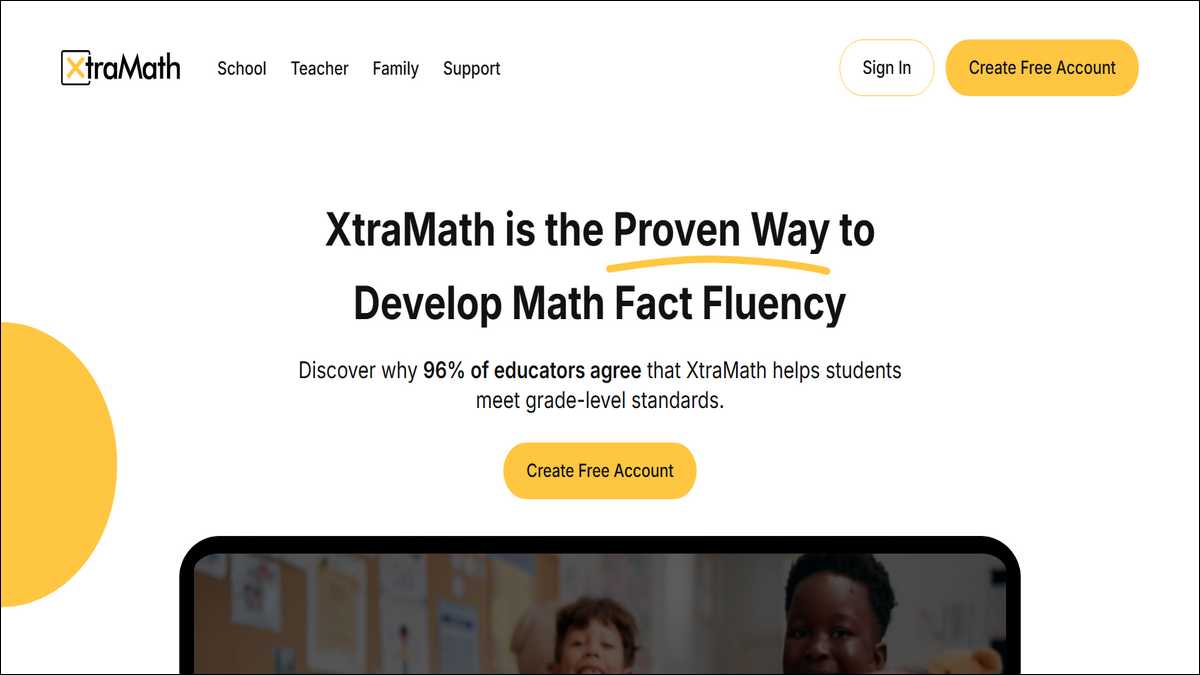
XtraMath started in fall 2007 when David Jeschke, a computer programmer, volunteered at a local elementary school and spotted the need for individualised math practice. That one classroom experiment grew into one of the most widely used free math tools in the world, spreading entirely through word of mouth.
Today, XtraMath helps students build fluency in addition, subtraction, multiplication, and division facts, targeting K-6 learners in about 10 minutes per day.
The platform works best as a daily supplement, not a standalone curriculum. It doesn’t teach concepts, explain strategies, or offer video lessons. What it does is give students structured, adaptive, timed drill practice. It then tracks their progress with real precision.
Who is it for?
- Teachers manage students at different fluency levels.
- Parents want an accountable at-home practice.
- Intervention specialists diagnose specific gaps.
It’s less suited to students who need conceptual scaffolding, or to anyone expecting gamified engagement like Prodigy Math offers.
Key Insights:
- XtraMath served 6.2 million students and 575,000+ teachers across 50+ countries in 2023-24, according to xtramath.org
- It’s a free, nonprofit, ESSA Tier IV-certified math fact fluency program for K-6 students
- A June 2025 partnership with Legends of Learning added game-based learning after daily practice sessions
- January 2026 updates redesigned the teacher dashboard and added a 12-second timer option
- XtraMath’s AI roadmap targets $0.25 per student per year, vs. up to $240 for commercial AI tools
How Does XtraMath Actually Work?
The Placement Quiz and Adaptive Practice Loop
Every student starts with a placement quiz. XtraMath checks the current recall speed and assigns facts based on results. So a student who already knows 7×8 won’t drill it endlessly. The Adaptive Practice option includes quizzes followed by personalised practice, while the Placement Quiz mode checks the student’s current level without adding more drill time.
That distinction matters for intervention specialists. Sometimes you need a diagnostic tool, not extra practice. Knowing which mode to use can save a struggling student from unnecessary frustration.
The algorithm tracks response time, not just accuracy. A correct answer in 8 seconds counts differently from one in 2 seconds. This timing model sits at the heart of XtraMath’s approach. It’s also the source of its most common criticism, which we’ll cover below.
The Four-Operation Progression
XtraMath offers addition, subtraction, multiplication, and division, plus multiple custom programs. You can choose based on the student’s grade level and learning needs. On the free plan, the default order runs addition first, then subtraction, multiplication, and finally division. Students can’t jump to multiplication without finishing the earlier operations first. Premium users can override this and target any single operation.
Why this sequence? It follows the developmental order found in most K-6 math standards. Multiplication fluency built on shaky addition tends to break down. Most teachers who use XtraMath find the structure sensible. Some find it restrictive for students arriving in 4th grade who are already solid in addition and subtraction.
What the Reports Show
Teachers get detailed reports showing each student’s accuracy, speed, and fluency level for every operation. The reports are genuinely useful. At a glance, you can see which facts a student is still working on and how their speed has changed over time. Free accounts include class-level reports.
Premium adds family reports, weekly and monthly summaries, and more detailed breakdowns by operation.
What Changed in 2025 and 2026?
The January 2025 Platform Overhaul
XtraMath released its most comprehensive update in years in January 2025. The update was made in honour of the late founder David Jeschke, recognising his contribution to early math education since 2009. The two biggest additions were a 12-second timer option for early learners and the return of a 3-second option for proving genuine automaticity.
The 12-second threshold is designed for students just developing conceptual understanding. It gives them more time to feel confident before progressing to the faster 6-second or 3-second options. This directly addressed a long-standing complaint. Before 2025, XtraMath moved too fast for students with processing differences or early learners in K-1.
The 3-second option also returned for advanced students. Evidence suggests 3 seconds is the best measure of true, automatic recall. Teachers can now differentiate at both ends of the fluency spectrum without switching platforms.
The New Teacher Dashboard (January 2026)
XtraMath completely rebuilt the Program Settings in January 2026. The redesign reduces setup time, clarifies options, and helps teachers get students started quickly. A new, streamlined panel sits on the left side of the teacher dashboard.
If you used XtraMath before 2026 and found it confusing to set up, it’s worth another look. The interface is meaningfully cleaner. The setup that used to take several steps now takes one.
The timing of these updates is worth noting. Both the 2025 overhaul and the 2026 dashboard rebuild followed XtraMath formalizing its ESSA Tier IV certification. The feature set was expanding to meet district procurement requirements, not just classroom requests. That shift signals a more strategic product direction.
The Legends of Learning Partnership
In June 2025, XtraMath announced a partnership with Legends of Learning. Students who complete their daily practice session can now move directly into Awakening, a safe, ad-free game environment. They can customise avatars, extend their practice, and explore math and science-themed adventures.
This partnership addresses XtraMath’s most consistent weakness in user reviews: engagement. Some parents and children find XtraMath boring and stressful, and miss the gamified elements that platforms like IXL and Reflex Math provide.
Awakening gives students a reward environment after their session ends. The core drill stays focused. The fun comes after. That’s a smart structural choice.
Research by WestEd and Vanderbilt University found that students using the Awakening platform regularly scored higher than peers who did not. The partnership bridges structured drills with game-based reinforcement.
Is XtraMath Free? What Does Premium Add?
The Free Plan: Genuinely Useful, Not a Trial
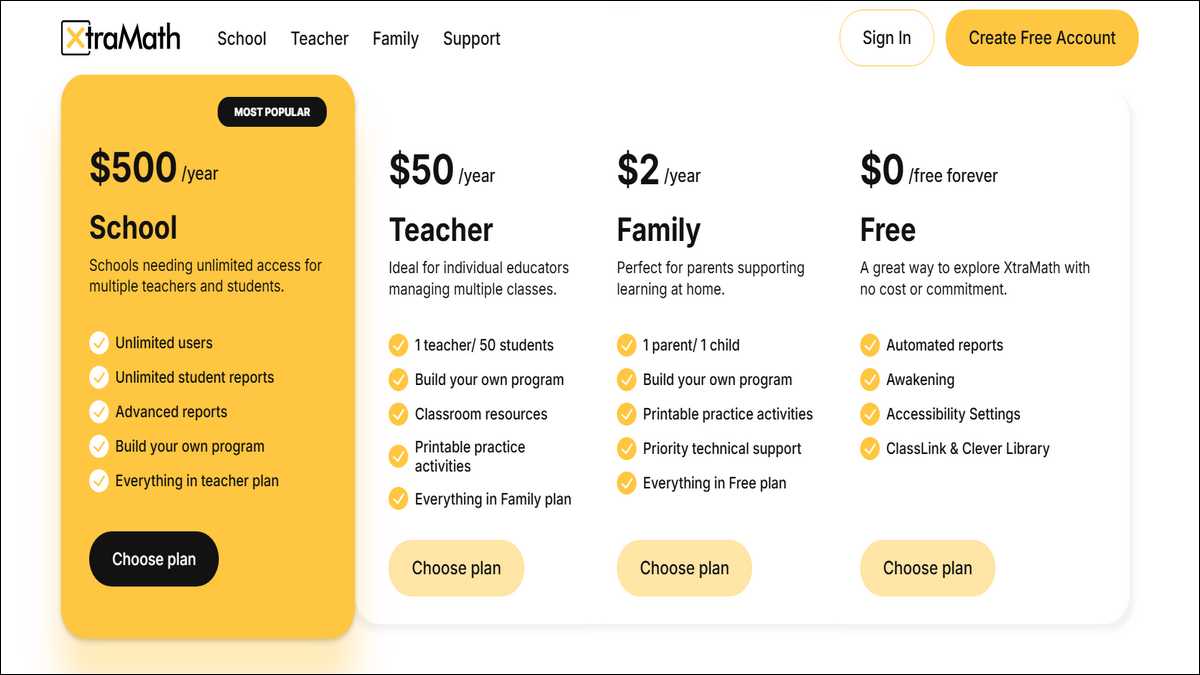
XtraMath’s free plan isn’t a stripped-down demo. It runs real programs, tracks real progress, and costs nothing. The free account doesn’t include all of XtraMath’s features, which is why they offer Premium with extra customisation for a fee. As a nonprofit, every Premium subscription directly supports its mission.
On the free plan, you get five default grade-level programs and basic reporting. You can’t target a single operation in isolation (except addition) or set custom timer speeds. For most classroom routines, the free plan covers everything you need.
What Premium Unlocks
With Premium, educators can choose a specific operation (like multiplication only), pick a custom timer threshold (12s, 6s, 3s, or 1.5s), set difficulty from Beginning to Expanded, and switch between Adaptive Practice and Placement Quiz modes.
Premium also adds out-of-school access, family progress reports, printable activities in English and Spanish, Clever SSO, and priority support. XtraMath offers three plan tiers: free basic, Premium Family, and Premium Teacher.
All premium plans include instructional resources, student reward printables, and customer support. The mobile app costs $4.99 on iOS and Android.
District-wide pricing is quote-based. Schools on Premium also get advanced weekly and monthly reports, which satisfy most district-level accountability requirements without extra tools.
How Does XtraMath Compare to Its Competitors?
There are plenty of XtraMath alternatives that exist. Here are some that you could complete this tool with:
XtraMath vs. Prodigy Math
Prodigy leads with engagement. It wraps math practice inside a role-playing game that adapts to each student’s level. Kids tend to enjoy it more. Prodigy covers math topics for grades 1-8 and offers a more interactive experience than XtraMath. It works especially well for students who respond to gaming elements.
The tradeoff is focus. Prodigy covers a broad range of skills. XtraMath covers one thing: arithmetic fact fluency. If fluency is the specific gap you’re targeting, XtraMath is more precise.
XtraMath vs. IXL
IXL covers math practice from pre-K through 12th grade across a wide range of topics. It goes deeper than XtraMath but requires a monthly subscription fee. IXL serves over 17 million students, with single-subject pricing starting at $9.95 per month.
For schools choosing between them, the question is really about scope. IXL replaces a wide range of practice materials across grade levels. XtraMath handles one thing well, for free. They don’t compete for the same budget line.
XtraMath vs. Khan Academy
Both are free. Both are nonprofits. Khan Academy leads with video instruction and concept explanation. XtraMath explains nothing. It assumes concepts are already taught and focuses on drilling until recall becomes fast and automatic. Used together, they’re complementary. Used alone, neither covers the full picture.
Most comparison articles frame the choice as engagement vs. drilling. But the more useful frame is depth vs. precision. IXL is deep. Prodigy is engaging. Khan Academy is broad. XtraMath is precise. Knowing which gap you’re filling matters more than picking the “best” platform overall.
Is There Research Supporting XtraMath’s Effectiveness?
The ESSA Tier IV Certification
XtraMath holds ESSA Tier IV certification, described as “Building Evidence.” This means the program has proven outcomes supported by a research-based logic model. ESSA has four evidence tiers. Tier I requires strong randomised controlled trials. Tier IV demonstrates a solid logic model with supporting research.
Tier IV certification is still meaningful. Most ed-tech tools carry no ESSA certification at any level. For K-6 fluency programs, it puts XtraMath on the short list of options that district administrators can approve without extra waiver paperwork. For Title I schools, that matters.
What Classroom Research Shows
A master’s thesis from Minnesota State University compared XtraMath against Cover-Copy-Compare, a paper-and-pencil drill method, for 5th-grade multiplication fluency. The researcher described XtraMath as a strong instructional resource, noting that it automatically collects data and reduces teacher workload. Both groups showed growth, with few significant differences at post-test between the two methods.
That finding deserves honest reflection. XtraMath isn’t dramatically more effective than a well-run paper drill. What it is, is far easier to run consistently across a full class. The automatic data collection alone saves teachers hours each week.
The Broader Math Fluency Crisis
Former classroom teacher and researcher Dr. Amanda Slayton put it plainly: students who knew their math facts simply did better in school. Automatic recall doesn’t replace higher-level thinking. It supports it. When fluency is shaky, even strong thinkers stall, grow frustrated, and start to believe they’re “not a math person.”
According to EduTopia, only 36% of fourth graders scored proficient in math on the 2022 NAEP, after a five-point drop following pandemic school closures. Scores had hovered around 40% proficiency for the decade before that. XtraMath sits directly in that gap.

What Are the Honest Criticisms of XtraMath?
Timed Drills and Math Anxiety
This is the platform’s most real and persistent weakness. The National Council of Teachers of Mathematics states in its position on math fluency that timed tests do not assess fluency, can negatively affect students, and should be avoided. That’s a serious position from a serious body. XtraMath’s entire model depends on timed response.
The nuance: XtraMath uses response time to decide which facts need more work, not as a high-stakes test. The 2025 introduction of a 12-second option addresses some of this concern for younger learners. Still, watch for students who show avoidance behaviours or rising frustration. Forcing a math-anxious student through daily timed drills can make things worse, not better.
XtraMath Doesn’t Teach
This point gets missed in most reviews. XtraMath is not a full learning program. It’s a math drill tool, not a curriculum. It offers no hints, no explanations, and no strategies for working out unknown facts. A student who doesn’t yet understand the multiplication conceptually will struggle, regardless of how many sessions they complete.
During our research, we’ve found that teachers get the best results when XtraMath follows explicit instruction, not when it leads it. Using it as a daily warm-up after a concept has been taught in class tends to produce faster fluency gains and less frustration than using it as the first exposure to a new operation.
Student and Parent Feedback
Some parents and children report finding XtraMath boring, stressful, and repetitive. Common Sense Media documents frustration with the timed format and a lack of personalisation among some user groups.
The Legends of Learning integration helps with engagement after the session ends. But the core practice remains a sparse, timed drill by design. For some teachers, that focus is exactly what they want. For some students, it’s a barrier. Knowing your student matters here.
What Is XtraMath’s AI Roadmap, and Why Does It Matter?
The Problem XtraMath Is Trying to Solve
XtraMath warns that by late 2026, the educational AI market will consolidate around a few commercial platforms.
Districts will face multi-year contracts, pricing up to $240 per student per year, and systems that are hard to audit or leave. That’s a specific and credible concern. The ed-tech market has followed this pattern before, most visibly with reading platforms in the 2010s.
Districts signed multi-year contracts for tools that were later repriced or shut down. XtraMath’s nonprofit structure and open-standards approach are its answer to that risk.
The $0.25 Per Student Target
XtraMath is building a public alternative to commercial educational AI. It aims to provide transparent, affordable AI tools at just $0.25 per student per year. Its roadmap targets doubling student reach while keeping operating costs flat.
A few honest caveats apply. Both the $240 commercial figure and the $0.25 target are self-reported by XtraMath. Commercial AI pricing varies widely across vendors. And XtraMath’s AI product is still in development. The direction, though, is clear. XtraMath treats AI as public infrastructure, not a premium add-on.
Teacher-Centred AI, Not Replacement AI
XtraMath’s stated position is that AI should amplify teacher expertise, not replace it. Non-negotiable commitments include open standards, full auditability, and district data control.
For administrators evaluating AI edtech in 2025-26, these commitments raise the right questions. Who owns the student data? Can the system be independently audited? What happens to the product if funding dries up? Every AI edtech vendor should answer these questions, not just XtraMath.
How Should Teachers, Parents, and Schools Use XtraMath in 2026?
For Classroom Teachers
Use it as a daily 5-10-minute warm-up after you’ve introduced the operation in class. Set it running, let the algorithm work, and check reports once a week. The 2026 dashboard makes that faster than before. The Legends of Learning connection gives students something to look forward to once their session ends.
For Intervention Specialists
Run the Placement Quiz to find exactly which facts a student is missing. Use the 12-second threshold for students with processing differences. Track weekly reports to check whether response speed is improving. Don’t use XtraMath as the only intervention for students with significant math anxiety.
For Parents and Homeschoolers
The free plan covers most home use cases. If your child needs to focus on one operation, like multiplication, and you want to skip the addition sequence, a Premium Family plan is worth the cost. The printable activities in English and Spanish add offline practice without a screen.
For School and District Administrators
The ESSA Tier IV certification and WCAG 2.1 AA compliance clear two common procurement hurdles upfront. XtraMath complies with FERPA, COPPA, CCPA, and GDPR. It does not sell or share student data with third parties. The free tier removes budget risk entirely for Title I schools. For districts considering AI tools in 2026-27, XtraMath’s pricing model deserves a direct comparison against commercial alternatives.
Also read: 14 Best EducationBeing.com Alternatives
Wrapping Up!
XtraMath is a rare thing in ed-tech. It’s a nonprofit tool that does one narrow job extremely well, costs nothing to start, and has 16 years of real-world evidence behind it. Its limits are real. It’s not engaging by design. It doesn’t teach. Timed drills aren’t right for every student.
But the 2025 and 2026 updates show a platform that listens. New timer thresholds, the Legends of Learning partnership, the cleaner dashboard, and the AI roadmap all point to an organisation growing carefully, not chasing trends. XtraMath’s stated goal is to double its student reach while keeping costs flat, with open standards and district data control as non-negotiable commitments.
A cross-analysis of current ed-tech pricing and XtraMath’s public operational model shows XtraMath delivers the lowest verifiable cost-per-student of any ESSA-certified K-6 math fluency program currently available. That’s $0 at the free tier and $0.25 projected for its AI-enhanced tier.
In 2024, only 39% of US fourth graders reached NAEP math proficiency, still two points below the pre-pandemic level from 2019. The math fluency gap is real, documented, and wide. XtraMath isn’t the whole answer. But for 10 minutes a day, it’s a solid, free, evidence-backed part of one.