E-Shikshakosh Explained: Bihar’s Teacher-Attendance Revolution (& Its Rough Edges)
A computer-science teacher in East Champaran missed his attendance for three straight days last October. The reason was not absence. Heavy monsoon rains had killed his network signal, and the E-Shikshakosh app would not let him sign out.
His story, reported by Careers360 in October 2025, captures the platform in one frame. It works powerfully when everything aligns — but it fails painfully when one thing breaks.
So here’s the complete picture: what E-Shikshakosh is, how to use it, what changed in 2026, and what teachers actually say.
Key findings:
E-Shikshakosh is Bihar’s official digital backbone for school education. The Bihar Education Project Council runs it from eshikshakosh.bihar.gov.in, covering Class I to XII across all 38 districts.
- App downloads crossed 1.4 million by early 2026.
- Latest version is 3.5.1, released February 23, 2026.
- Statewide rollout became mandatory through an order dated August 27, 2025.
- Over 1,000 teachers were issued show-cause notices due to app disputes.
- Architect: Dr. S. Siddharth, IAS, Additional Chief Secretary.
What is E-Shikshakosh?
E-Shikshakosh is a centralised education platform built by the Bihar Education Project Council under the National e-Governance Plan. It links every government school, teacher, and student in Bihar through one Aadhaar-authenticated system. The portal handles attendance, salary, leave, inspections, and Mid-Day Meal reporting.
According to the National e-Governance Division directory, it covers the entire lifecycle of stakeholders across Class I to XII — students, teachers, headmasters, and officials from the state down to the block level.
On top of that, it connects to UDISE+, DIKSHA, Shala Darpan, and the Shagun Repository.
Most state education portals digitise either records or attendance. E-Shikshakosh tries both inside a single workflow — which explains both its reach and its rough edges.
Who built it, and when?
The Bihar Education Project Council commissioned the platform, and CSM Technologies developed it under a Waterfall delivery model, per the NeGD India Stack Local listing. The app first appeared on Google Play in May 2023.
That said, statewide enforcement is more recent. A source reports that a chief secretary’s order dated August 27, 2025, made app attendance compulsory across schools. Before that, it ran as a pilot from early 2024.
The campaign owes its momentum to one person. Dr. S. Siddharth, who took charge as Additional Chief Secretary (Education), pushed the app to reduce manual monitoring overhead.
E‑Shikshakosh
Integrated Education Management Platform
Teacher Module
Registration, profile, and teacher search
Student Module
Admission and disenrollment (Class 1–12)
School Module
Infrastructure data, internet, toilets, classrooms
e‑PMS
Salary and project monitoring system
e‑LOTS
Digital textbook access and learning resources
e‑Library
STEM material and reference content
HM District Choice
Headmaster posting and district preferences
Niyojit Login
Contractual teacher service records
SHAKTI Grievance
Complaint and grievance redressal system
E-Shikshakosh module map showing nine connected modules for teachers, schools, and students
What can you do on the portal?
In short, almost the whole life cycle of a Bihar government school sits on one dashboard. That includes teacher registration, school profile updates, student admission, leave, salary tracking, infrastructure reporting, and grievance filing. Each task lives in a dedicated module.
| Module | Core function |
|---|---|
| Teacher Module | Registration, profile, search |
| Student Module | Admission, disenrollment (Class 1–12) |
| School Module | Infrastructure data — toilets, classrooms, internet |
| e-PMS | Salary and project monitoring |
| e-LOTS | Digital textbooks |
| e-Library | STEM and reference content |
| HM District Choice | Headmaster posting preferences |
| Niyojit Login | Contractual teacher service records |
| SHAKTI Grievance | Complaint redressal |
How do you log in to E-Shikshakosh?
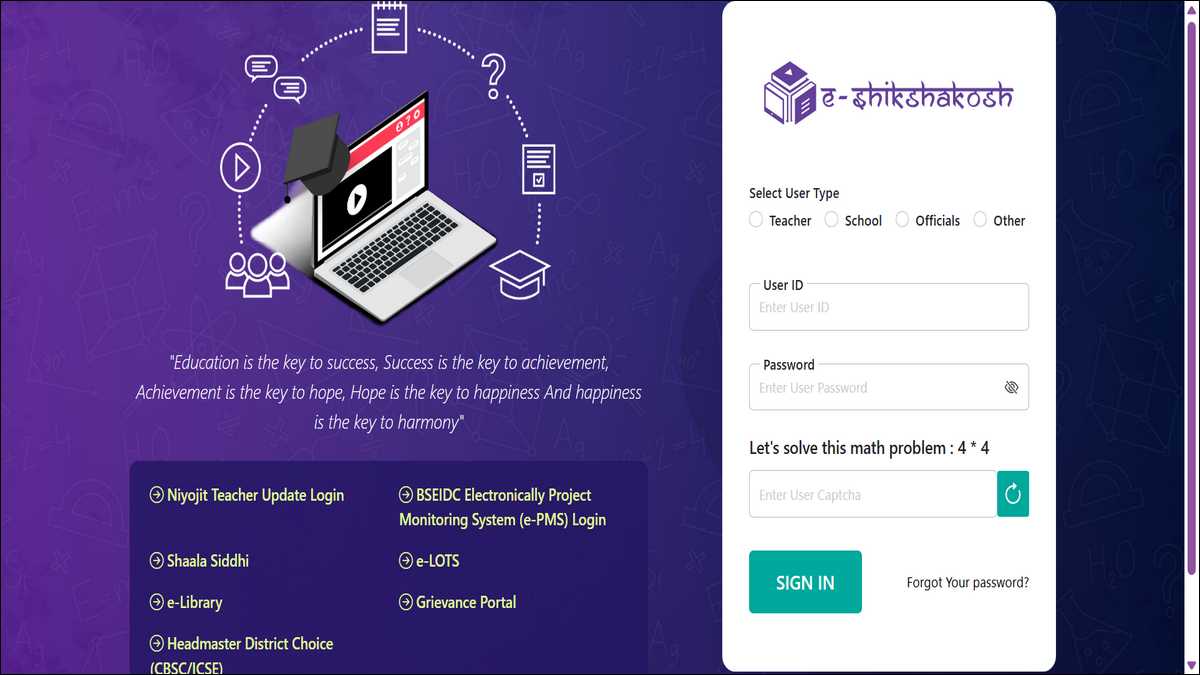
To put it simply: open eshikshakosh.bihar.gov.in, choose your user type, enter your ID, solve the captcha, and submit. Teachers use a 12-digit Teacher ID with an OTP. Schools log in with their 11-digit UDISE+ code.
The user-type list includes Teacher, School, Officer, Niyojit Teacher, and Other — each path leads to a different dashboard.
Still, 2026 added an extra layer. Sensitive actions like student disenrollment or transfer approvals may now trigger biometric or Aadhaar-linked OTP verification.
Quick login checklist:
- Use the official URL only — avoid lookalike
.in,.co, or.orgdomains. - Keep your registered mobile number active for OTP delivery.
- If the captcha is blurry, click “Reload Captcha” once.
- Match your User Type before entering credentials.
How do you register on E-Shikshakosh?
Here’s the catch — you cannot self-generate a Teacher ID. Your headmaster submits your details, the District Education Office verifies them, and the system issues a 12-digit ID within about 72 hours. Schools register using their UDISE+ code.
For teachers, the flow runs in five steps:
- Submit the joining letter, Aadhaar, and bank passbook to the headmaster.
- HM enters your details under Teacher Module → Teacher Registration.
- Block Education Officer routes the file for verification.
- ID is generated after DEO clearance.
- HM shares the ID confidentially with you.
Schools follow a similar arc — enter the 11-digit UDISE+ code, and the system auto-fetches basic school data. Registration is mandatory for government, aided, and private schools.
Worth Knowing: New BPSC TRE 3.0 and 4.0 recruits often find their ID stuck in “Returned with Query” status — silent, with no SMS or email. Ask your HM to check the registration tray in your first week.
What is the app, and where do you get it?
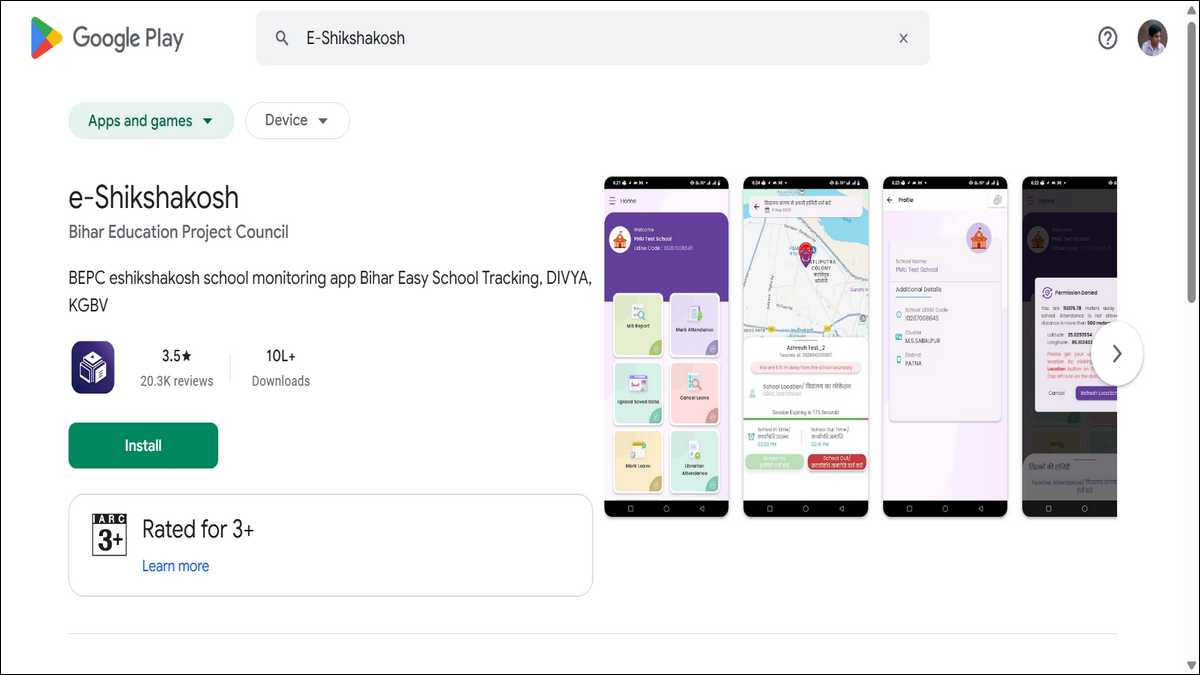
The app is the official Android tool for daily attendance, leave, MDM entry, and inspections. Download it from the Google Play Store, and confirm the developer is listed as the Bihar Education Project Council.
AppBrain records the app at version 3.5.1, a 49.10 MB download, with 1.4 million installs by early 2026. It needs Android 6.0 or higher — and there is no official iOS app yet. AppBrain
| App fact | Value |
|---|---|
| Developer | Bihar Education Project Council |
| First Play Store listing | May 2023 |
| Latest version | 3.5.1 |
| Last updated | 23 February 2026 |
| Size | 49.10 MB |
| Minimum Android | 6.0 |
| Total downloads | 1.4 million+ |
How does selfie attendance actually work?
It pairs GPS geo-fencing with a live selfie. When a teacher reaches school, the app captures time, location, and photo — then locks the entry once the teacher confirms the picture.
The detail matters. A teacher in Motihari said that the app activates within 500 metres of the school and starts recording attendance within 5 metres of the building.
There’s a clock, too. Teachers must mark in before 9:30 AM and mark out after 4:00 PM every working day. If sync fails before 8:00 PM, the district report may flag the entry as pending or absent.
The 5-metre rule is the single most common cause of “Out of Range” disputes. Standing inside the school office, near the registered GPS coordinate, usually fixes it.
What changed in the 2026 update?
The 2026 build introduced “Fused Location” technology to cut GPS errors, added offline attendance capture, and sped up sync for low-bandwidth zones. Together, these target the failure pattern from 2024 and 2025.
Fused Location blends GPS satellite signals with mobile tower data, so the app can place a teacher correctly even when one signal is weak.
Offline mode is the bigger shift. You can now capture a timestamped selfie and coordinates without internet, and the data uploads when the device reconnects.
Even so, offline mode does not remove the 8:00 PM deadline. You still need to be online once for master-data sync, and again before cut-off. Treat it as a buffer, not a replacement for connectivity.
Most common E-Shikshakosh errors and their quick fixes
Most errors trace back to four issues: GPS signal, app version, OTP delivery, or server load. The fixes are usually simple — the frustration comes from frequency.
| Error | First fix | Second fix |
|---|---|---|
| Out of Range / GPS error | Move to open ground near school office | Clear cache, update to v3.5.x |
| OTP not received | Wait 2–3 minutes, retry | Switch network, check spam |
| Captcha unreadable | Click “Reload Captcha” | Switch browser, clear cookies |
| Server down | Try late evening or early morning | Check official social handles |
| “Profile locked” | Contact your HM | Escalate to BEO via grievance |
| Mobile number update fails | Verify Aadhaar link | Submit Edit Profile + OTP again |
For persistent issues, the official technical helpdesk is widely cited as 0612-2215181, with email helpdesk.esks@gmail.com — verify these on the portal footer before sharing.
How does the portal connect to other systems?
E-Shikshakosh does not work in isolation. It pulls and pushes data across four major national platforms — which is why a single Teacher ID or UDISE+ code carries so much weight.
| External system | What it shares |
|---|---|
| UDISE+ | School code, enrolment, infrastructure |
| DIKSHA | Teacher training records and content |
| Shala Darpan | School-level governance data |
| Shagun Repository | Performance dashboards |
| Aadhaar (UIDAI) | OTP and biometric verification |
What this means is salary disbursement and transfer eligibility now flow through the same Teacher ID. A single attendance gap can hold up a payslip — and that link tightened further during the 2025 rollout.
What do teachers actually say?
The honest answer is mixed. The app has cut absenteeism, but it has also added friction, paperwork-by-screenshot, and salary anxiety. A source reports that over 1,000 teachers have been penalised and had their salaries docked due to app-related issues.
On the union side, criticism is sharper. Ashwini Pandey, a Bihar State Teachers Association spokesperson, told Careers360 that server downtime hit five to ten times in the past year.
Privacy worries run alongside the technical ones. Keshav Kumar of Shikshak Sangh Bihar argued that allowing the app on personal phones gives the government access to private data, which he framed as a constitutional issue. Many teachers want biometric attendance or HM-led verification instead.
What expanded in September 2025?
In September 2025, the government extended the app’s scope to student attendance. The state promised tablet PCs for every school — but the hardware rollout lagged behind the order.
As per our research, we confirm the tablet promise was still pending when Bihar Assembly polling began on November 6 and 11, 2025. Results came on November 14, with the platform’s future raised as a campaign issue.
On the ground, that one decision changed the daily workload. Teachers who marked only their own attendance before now handled student rolls on personal phones, too.
The technology stack behind E-Shikshakosh
E-Shikshakosh runs on a fairly conventional government-tech stack — Angular frontend, PHP with Laravel and Lumen on the backend, fronted by a KONG API Gateway and Redis caching, with MySQL underneath.
| Layer | Technology |
|---|---|
| Frontend | Angular 13.x |
| Application | PHP 7.4, Laravel 5.7, Lumen 8.x |
| API Gateway | KONG |
| Cache | Redis |
| Database | MySQL 8.0.33 |
| Methodology | Waterfall |
All this is listed publicly by the NeGD India Stack Local registry — an unusual level of transparency for a state portal.
A monolithic Waterfall delivery explains the “server down” pattern teachers describe. Peer portals like UP’s Manav Sampada are shifting to microservices to isolate spikes — and a future E-Shikshakosh 3.0 will likely face the same pressure.
How does it compare to other state portals?
It sits at the more ambitious end. Most state portals focus on a narrow slice; E-Shikshakosh tries to combine HR data, attendance, and learning content. The trade-off is depth versus reliability.
| Portal | State | Primary focus | App-based attendance |
|---|---|---|---|
| E-Shikshakosh | Bihar | Full school + teacher lifecycle | Yes (selfie + GPS) |
| Manav Sampada | Uttar Pradesh | HR and service records | Limited |
| Shala Darpan | Rajasthan & national | School governance data | No |
| Vidya Samiksha Kendra | National | Analytics | No |
| MP Education Portal | Madhya Pradesh | Records and scholarships | No |
Out of this list, E-Shikshakosh is the only one tying daily presence to monthly salary through software alone. That’s its boldest feature — and its biggest political risk.

What’s coming next?
Three things are on the roadmap: biometric attendance pilots, regional-language interfaces, and AI-driven analytics. Each responds to a specific gap that surfaced through 2024 and 2025.
Of these, biometric attendance is the most likely near-term shift. Many teachers prefer fingerprint or face-scan inside the school over selfie-on-personal-phone, and the political mood post-November 2025 makes the change plausible.
The rest is fuzzier. Regional language support — Maithili, Bhojpuri, Magahi — has been mentioned in third-party coverage but not confirmed officially. AI-based dropout prediction has been discussed by the department, but lacks a public timeline.
Whichever government runs Bihar next, scrapping the system is unlikely. The salary linkage and UDISE+ integration are now too embedded — expect iteration, not abandonment.
FAQs
Yes. It is run by the Bihar Education Project Council; schools outside Bihar cannot register.
Only eshikshakosh.bihar.gov.in. Most other variants are third-party guides.
Yes — using their 11-digit UDISE+ code as the user ID.
Roughly 72 hours after DEO verification.
Third-party guides cite 0612-2215181 and helpdesk.esks@gmail.com. Confirm on the portal footer.
Union demands point that way, but no replacement has been announced.
Salary now ties to attendance sync — a “pending” entry can pause payment until the HM verifies it.
Wrapping Up This Guide!
E-Shikshakosh sits at the centre of one of India’s largest state-level e-governance experiments. We can call it a reform that has curbed absenteeism while adding new burdens — and both descriptions are accurate.
For teachers, the practical message is simple: keep the app on version 3.5.1, sync before 8:00 PM, and file every grievance through the official SHAKTI track. For schools, the priority is keeping the UDISE+ profile, infrastructure photos, and teacher mapping clean.
In the end, the most important fact about E-Shikshakosh is not its technology — it’s that a 12-digit ID now decides whether a Bihar teacher gets paid that month. Every checklist, every login fix, and every privacy debate runs through that one design choice.
The next twelve months will decide whether the portal becomes a model for other states or a cautionary tale. Either way, it has already reshaped the daily life of every government schoolteacher in Bihar.