The Chair You Sit In All Day Deserves More Thought Than You’ve Given It
Most people spend more time choosing a laptop than they do choosing the chair they’ll sit in for eight hours a day. The laptop gets researched, compared, and deliberated over for weeks. The chair gets a quick glance, maybe a brief sit-test on the showroom floor, and that’s about it. Then the back pain starts showing up around 3pm, the neck gets stiff by Thursday, and everyone quietly assumes that’s just how office life feels.
It doesn’t have to be that way. The chair is one of the most consequential pieces of equipment in any workspace, and treating it as an afterthought is a habit worth reconsidering.
Why the Chair Matters More Than People Realise
The average desk worker spends close to eight hours a day seated. Over a working week, that adds up to forty hours of continuous pressure on the spine, hips, and shoulders. Done without proper support, that kind of sustained sitting contributes directly to musculoskeletal problems, the kind that start as mild discomfort and slowly become something harder to ignore.
Research published in Applied Ergonomics found that employees who switched to properly designed chairs reported a meaningful reduction in musculoskeletal pain within just a few months. The Occupational Safety and Health Administration also recognises improper seating as a contributor to nearly a third of all workplace injuries. These aren’t abstract statistics. They reflect the day-to-day reality of what poor seating does to the body over time.
Beyond physical health, there’s a productivity angle that often gets overlooked. When you’re uncomfortable, part of your attention is always managing that discomfort rather than focusing on the task in front of you. A chair that works with your body lets you forget you’re sitting in one, which is exactly the point.
What Separates a Good Chair from a Basic One
The difference between a standard chair and a well-designed one isn’t always visible at first glance. It shows up in the adjustability, the support structure, and the quality of the materials that contact your body for hours at a time.
Lumbar support is probably the most important single feature. The lower back has a natural inward curve, and when a chair fails to support that curve, the body compensates by slouching. Slouching flattens the spine’s natural shape and puts sustained pressure on the discs and muscles of the lower back. A chair with adjustable lumbar support lets each user position that support to match their own back shape, which is not something a fixed design can accommodate well.
Seat height is equally fundamental. When your feet can rest flat on the floor and your knees sit at roughly a right angle, the weight of your legs is properly distributed and the pressure on your thighs stays manageable. A seat that’s too high or too low shifts that balance and creates tension in areas that shouldn’t be working hard while you’re sitting still.
Seat depth is one that people often overlook. Too deep a seat pushes against the back of the knees and discourages the user from sitting back against the lumbar support, which defeats the purpose of having it. Ideally there should be a small gap between the front edge of the seat and the back of your knees.
Backrest recline matters too. A fixed, rigid backrest forces the spine to stay in a single position for extended periods, which creates fatigue in the muscles that support it. A backrest with tension adjustment allows the body to shift and move slightly throughout the day, which is closer to what the spine actually needs.
Types of Office Chairs and What They’re Built For
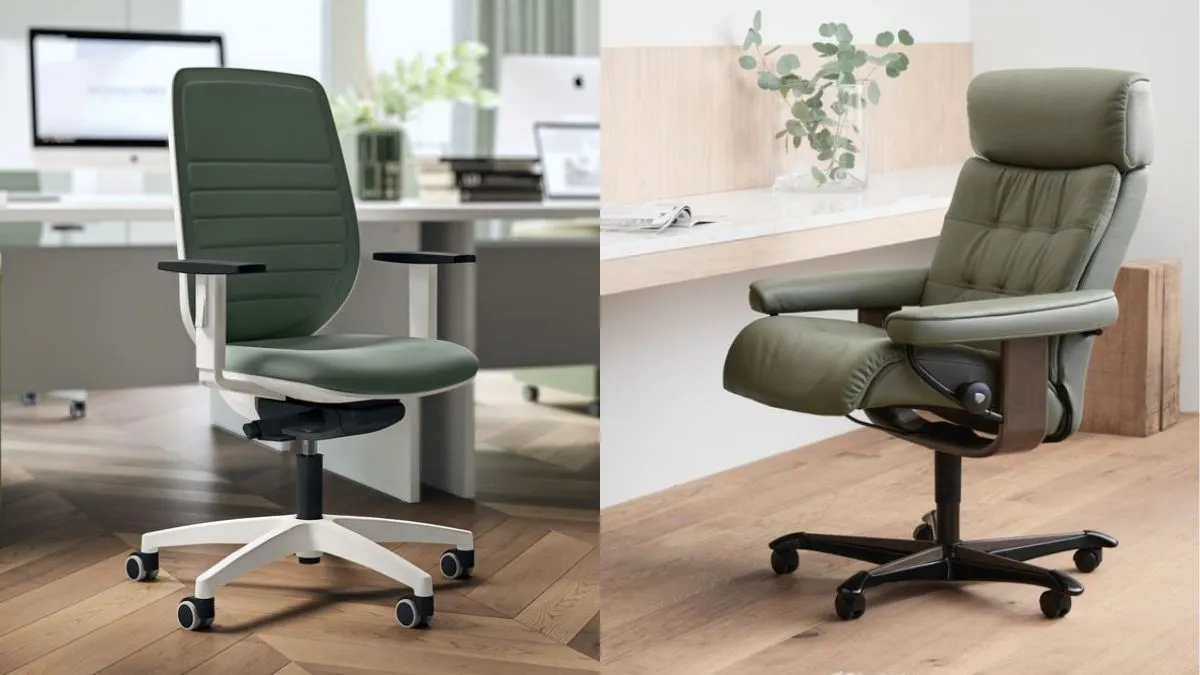
Not every office chair is designed for the same purpose. Task chairs are the most common choice for desk-based work and offer the widest range of ergonomic adjustments. They’re built for long hours of sustained use and typically feature full lumbar support, height adjustment, and a swivel base.
Executive chairs tend to prioritise a more substantial appearance with higher backs and padded armrests. They can still offer good support but are sometimes designed with aesthetics as a priority alongside function.
Mesh-back chairs have become popular in warmer climates and busy environments because the breathable backrest reduces heat buildup over long periods. For Singapore’s climate specifically, this is a practical consideration rather than just a style preference.
Visitor and conference chairs serve a different function entirely. They’re designed for shorter-duration use and prioritise ease of movement and a compact footprint over extensive adjustability.
Choosing the Right Chair for the Space
Office chair selection works best when it starts with the people who will actually use them rather than with a catalogue. Body size varies, tasks differ, and what suits someone who spends most of their day typing may not suit someone who moves between their desk and meeting rooms throughout the day.
Trial periods where possible make a real difference. A chair that feels comfortable for ten minutes on a showroom floor may reveal its limitations only after a full workday. The adjustability range matters because a shared workstation used by people of different heights needs a chair that can genuinely accommodate that range, not just technically offer it.
Browsing office chair equipment options gives a useful picture of the variety available across different categories, from basic task seating to fully featured ergonomic models built for demanding workday requirements.
A Simple Investment That Pays Over Time
Good seating isn’t a luxury purchase. It’s a functional investment in the people using the space. The productivity gains from reduced discomfort, the reduction in sick days linked to musculoskeletal strain, and the simple fact of having a workspace that people don’t dread sitting in are all outcomes that show up over time.
The chair is where work actually happens. It deserves to be chosen with that in mind.