Best Time to Post on Instagram In 2026 [Backed By Real Data]
Based on research from Sprout Social, Buffer, Hootsuite, Later, and RecurPost — covering over 9.6 million posts and nearly 2 billion engagements.
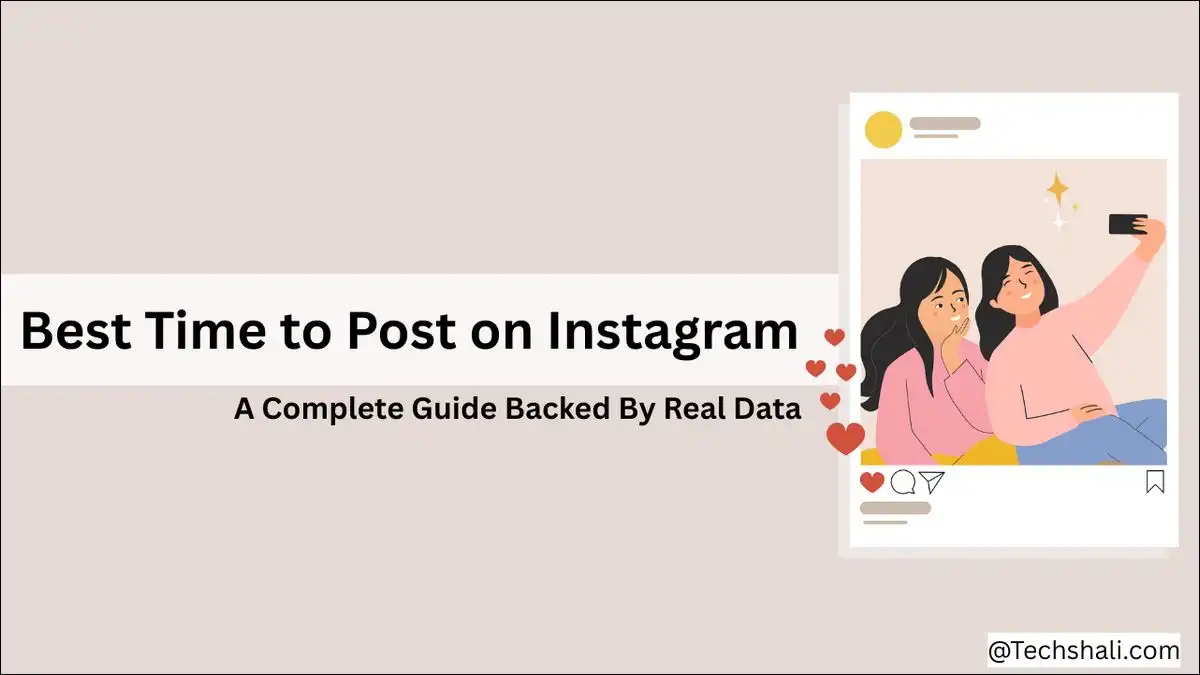
You’ve spent an hour crafting the perfect Instagram post. The photo is sharp. The caption is good. The hashtags are ready. You hit publish. And then… almost nothing.
No, your content probably wasn’t bad. You might have just posted at the wrong time.
Timing on Instagram matters more than most people realize. The platform’s algorithm rewards posts that get quick engagement. If your audience isn’t online when you publish, the post gets buried fast. And once it’s buried, it rarely climbs back.
To figure out the best time to post content on Instagram, we dug deep into the latest data — from multiple major studies — to give you a clear, practical answer on when to post. No fluff. Just what works.
Why Timing Still Matters in 2026
Instagram’s algorithm doesn’t use a simple chronological feed anymore. It uses AI to decide what shows up, when, and to whom. But here’s the thing — timing still plays a direct role in how that AI scores your content.
When you post while your followers are active, you get fast likes, comments, and shares. That early engagement is a signal to Instagram that your content is worth pushing out to more people. Miss that window, and the signal never fires.
Sprout Social, which analyzed nearly 2 billion engagements across 307,000 global profiles, put it plainly: hitting publish when your audience hits their midday slump or their post-work scroll signals immediate relevance to the algorithm. That relevance drives exponential reach.
This doesn’t mean your content doesn’t matter. It does, enormously. But even great content fails if it launches into a dead feed.
The Best Days to Post on Instagram
Before we get to specific hours, let’s talk days. Because day-of-week matters just as much as time-of-day.

Across every major study we looked at — Buffer’s 9.6 million post analysis, Hootsuite’s 1 million post study, and Sprout Social’s global data — the same days came out on top: Wednesday and Thursday. Tuesday is a close third.
The logic is simple. By midweek, people are fully back into their routines. They’re on their phones during breaks, commutes, and slow afternoon hours. They’re engaged, not distracted.
Fridays start to decline as people mentally check out for the weekend. Saturday and Sunday are the weakest days across almost all industries and audience types. If you have a big piece of content, don’t waste it on a weekend.
Buffer’s data found that Friday and Saturday are consistently the worst days to post for maximum reach. That’s not to say you can never post on a weekend — but save your best content for weekdays.

The Best Hours to Post (Day by Day)
Here’s where it gets more specific. We’ve pulled together what the research agrees on, day by day.
| Day | Best Time Window | Engagement Level |
|---|---|---|
| Monday | 2–4 PM | Good |
| Tuesday | 5–8 AM and 1–7 PM | Very strong |
| Wednesday | 12–9 PM (wide window) | Best overall |
| Thursday | 9 AM, 12–2 PM, 4–5 PM | Very strong |
| Friday | 4 PM | Moderate |
| Saturday | 11 AM, 5 PM | Weak |
| Sunday | 12–3 PM | Weak |
A few things worth noting here. Wednesday has an unusually wide engagement window — nearly the full afternoon and evening. That gives you more flexibility if you’re not able to nail a specific hour.
Thursday at 9 AM is Buffer’s single top-performing hour across their entire 9.6 million post dataset. That’s a number worth taking seriously.
Tuesday is interesting because it has two separate peaks — an early morning one (5–8 AM) and a strong afternoon-evening window. If you can only post once on Tuesday, go for the afternoon. But if you’re managing Stories alongside feed posts, you can hit both.
Monday 2–4 PM catches people coming out of their lunch hour and into that mid-afternoon slump. It’s not the flashiest window, but it’s reliable.

Three Time Windows That Work Almost Every Day
If you want to simplify all of this, just remember three daily windows. These perform well regardless of which day you’re posting on.
- Morning: 6–9 AM. People check their phones before work, before school, before the day gets loud. You’re competing with fewer posts, and early engagement compounds quickly.
- Lunch: 11 AM–1 PM. This is a strong window across almost all industries. People are on break, eating, scrolling. Food, retail, and travel brands do especially well here.
- Evening: 6–9 PM. This is the strongest window overall. Work is done. People are relaxed. They have time to watch a full Reel, swipe through a carousel, or leave a real comment. Hootsuite’s analysis found that early evenings — particularly on Mondays through Thursdays — drive the most sustained engagement.
The evening window is especially important for Reels. People are more willing to watch a 60-second video at 7 PM than they are at noon during a rushed lunch break.

When to Post by Content Format
Not all posts are the same. A Reel, a carousel, a static photo, and a Story each work differently — and they each have a slightly different optimal timing.
- Reels need an audience that has time and attention. Post them during evenings (6–8 PM) on weekdays, or on weekend evenings when people are relaxed and scrolling casually. Reels are also competitive — you need that early push of views and DM shares to get the algorithm to distribute them. If you post a Reel at 8 AM during someone’s rushed commute, it’s unlikely to get the watch-time it needs.
- Carousels reward dwell time. Someone needs to swipe through your slides, which takes longer than a quick double-tap. The lunch window (11 AM–2 PM on Tuesdays through Thursdays) works best here. People have a few minutes to actually engage. Multiple sources note that educational and informational carousels perform especially well during midday weekday windows.
- Single image posts are fast and easy to consume. The morning window (8–10 AM) is ideal. Someone scrolling before work can like a photo in two seconds. You don’t need them to be in a leisurely mood.
- Stories are different from feed content entirely. They’re intimate and real-time. Post them early morning (7–9 AM) to catch people as they start their day, and late at night (9–11 PM) to catch the evening wind-down crowd. Stories should be posted daily — at least once. According to Buffer, Adam Mosseri himself recommends 1–2 Stories per day alongside a couple of weekly feed posts.
Best Times by Industry
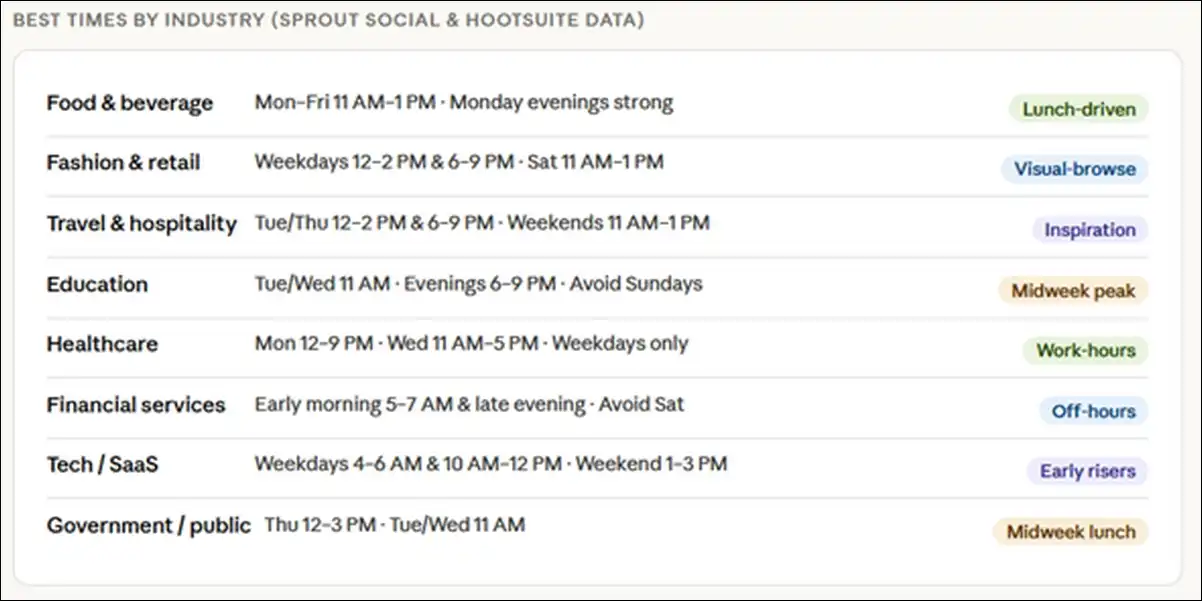
Your niche matters here. A fitness brand and a financial services firm don’t share the same audience behavior. Here’s what the data from Sprout Social and Hootsuite shows across major industries:
| Industry | Best Posting Times |
|---|---|
| Food & Beverage | Mon–Fri 11 AM–1 PM; Monday evenings also good |
| Fashion & Retail | Weekdays 12–2 PM and 6–9 PM; Sat 11 AM–1 PM |
| Travel & Tourism | Tue/Thu 12–2 PM and 6–9 PM; weekends ok |
| Education | Tue/Wed 11 AM; evenings 6–9 PM; avoid Sundays |
| Healthcare | Mon 12–9 PM; Wed 11 AM–5 PM; weekdays only |
| Financial Services | Early morning 5–7 AM and late evening; skip Saturdays |
| Tech / SaaS | Weekdays 4–6 AM and 10 AM–12 PM |
| Government | Thu 12–3 PM; Tue/Wed 11 AM |
A food brand dropping a mouthwatering lunch post at 12 PM on a Monday makes total sense. Someone is literally thinking about lunch. A financial brand doing the same post at the same time would likely land with a thud — that audience prefers early mornings when they’re thinking about markets and money.
We can see clearly from this data: always layer your general posting schedule with industry-specific behavior. It’s not a huge extra effort, and the payoff is real.

Does Your Follower Count Change the Equation?
Interestingly, yes. Account size affects what time of day works best. This surprised us, but the reasoning makes sense once you hear it.
Smaller accounts with nano or micro audiences (under 10K followers) tend to have very localized, closely-knit communities. Their engagement is more predictable. Posting 5–7 PM on weekdays tends to hit well because those followers share similar daily rhythms.
Larger mid-tier accounts (25K–500K) have broader audiences spread across more time zones and lifestyles. Their data often points to less conventional windows — like late-night Sunday posting or early Monday evening — where less competition for feed space creates a genuine advantage.
For macro accounts (500K+), the audience is so spread out geographically that a single “best time” is harder to pin down. These accounts can afford to post across wider time ranges and still get strong initial engagement. The algorithm picks up the momentum regardless.
If you’re just starting out or have a smaller account, don’t overthink this. Stick to the 5–7 PM weekday window and let your Instagram Insights tell you more as your account grows.
Times You Should Always Avoid
We’ve talked a lot about when to post. Let’s flip it quickly and talk about when not to.
- Overnight hours — roughly 1 AM to 5 AM — are dead zones in every single study we reviewed. No data from any source points to a benefit here. Even if you’re targeting a different time zone, there are smarter ways to do that than posting in the middle of your night.
- Early morning before 6 AM on weekends is consistently weak. People sleep in. They don’t check Instagram the moment they wake up on a Saturday. The 8 AM Saturday scroll isn’t the same as the 8 AM Monday scroll.
- Late night after 10 PM on most days also tends to underperform. There’s a small window around 9 PM on Sundays and Wednesdays that RecurPost found to be an exception — but outside that, evenings should wrap up before 10.
How the Instagram Algorithm Connects to Your Timing
We touched on this at the start, but let’s go a bit deeper. Because understanding the algorithm helps explain why the timing data looks the way it does.
Instagram doesn’t have one algorithm — it has four. There are separate ranking systems for your Feed, Stories, Reels, and the Explore page. Each has slightly different priorities. But all of them share one underlying logic: they reward content that gets fast, genuine engagement.
In research, Adam Mosseri confirmed that the three ranking signals that matter most right now are: watch time, likes per reach, and DM shares (also called Sends per Reach). DM shares carry 3–5x more weight than a simple like for reaching new audiences.
What does this mean for timing? Simple. Post when people are relaxed enough to actually share something. People don’t DM a Reel to their friend during a hectic Tuesday morning meeting. They do it at 7 PM when they’re laughing on the couch.
The algorithm also tests your content immediately after you post it. It shows your content to a small sample of your followers first. If that group engages quickly, distribution expands. If they don’t — because they’re asleep, at work, or offline — the content doesn’t get the test signal it needs, and the algorithm moves on.
One more thing worth knowing: scheduling tools don’t hurt your reach. Instagram treats a scheduled post exactly the same as a manually published one. So don’t avoid using tools like Buffer, Later, or Hootsuite out of fear. Use them to post at the right time, even when you’re busy.
Also read: Top 10 Instagram Lite Tricks You’re Missing
How to Find Your Own Best Time To Post On Instagram (The Practical Way)
All of this data gives you a strong starting point. But the most accurate data for your account is the data that comes from your account.
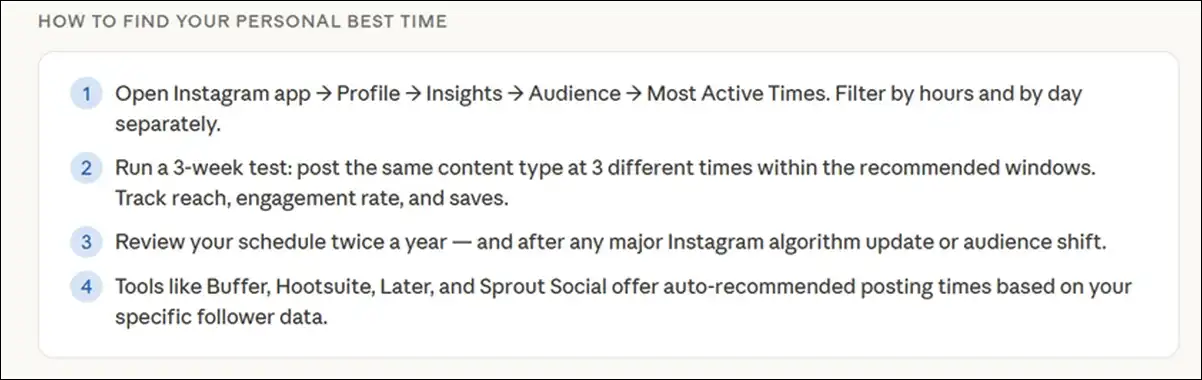
- Every Instagram Business or Creator account has access to Instagram Insights for free. Open the app, go to your profile, tap Insights, then scroll to the Audience section. You’ll find a breakdown of when your followers are most active — by hour and by day of the week.
- Cross-reference that with the general benchmarks above. If your audience peaks at 8 PM on Tuesdays, and the general data says Tuesday 3–7 PM is a strong window — great, you’re in alignment. If your audience is active at a completely different time, trust your data.
- From there, run a simple 3-week test. Pick three different time slots within the recommended windows. Post the same type of content at each time. After three weeks, look at the patterns. Which posts got more reach? Which ones got more saves? Saves, by the way, are a strong signal of real content value. They tell you people found your post useful enough to come back to.
Revisit your schedule every 6 months or so. Instagram’s algorithm gets updated. Audience behavior shifts. A timing strategy that worked perfectly in early 2025 may need small adjustments by late 2026.
Posting Frequency: How Often Should You Actually Post?
Timing and frequency go hand-in-hand. No point in nailing your timing if you’re posting once a month.
Buffer’s 2025 study analyzed 2.1 million posts from 102,000 accounts and found that 3–5 feed posts per week is the sweet spot for most accounts. That includes Reels, carousels, and photo posts. Posting more than that doesn’t proportionally increase reach — but going below 2 posts per week can actively stall your growth.
For Stories, post at least once per day. Stories are low-effort and high-frequency by design. They keep your account visible in the Stories bar at the top of the feed, which is valuable daily real estate.
The same Buffer study also found something interesting: posting more often correlates with better per-post reach. The algorithm rewards active, consistent accounts. There’s no shortcut here — consistency builds credibility with the platform, not just your audience.
The Bottom Line
You don’t need to be perfect about all of this. You need to be consistent and thoughtful.
The core takeaway from all this data is clear: post midweek, during afternoon and evening windows, when your specific audience is most active online. Wednesday and Thursday are your strongest days. The 6–9 PM window is your strongest daily slot. Weekends, especially Saturdays, are worth treating cautiously.
Your content quality will always be the biggest driver of long-term growth. But timing is the lever that makes sure good content actually gets seen. Think of it like this: a great restaurant in an empty street still needs foot traffic.
Use the general benchmarks to start. Use your Instagram Insights to fine-tune. And test, test, test — because the best timing strategy is one you’ve validated with your own audience’s real behavior.