RedeepSeek Reviewed: Hands‑On Testing, Privacy Audit & Use Cases
Quick verdict — RedeepSeek is an emerging AI-driven search and discovery platform designed to surface context-aware results through semantic understanding rather than simple keyword matching. In practice, it performs well for focused research and exploratory discovery, but independent testing highlights uneven freshness and limited technical transparency.
What this review covers
This review delivers a structured, reproducible evaluation of RedeepSeek. It includes a clearly defined testing methodology, benchmarked query samples, a privacy and security audit, real-world workflows, and a trust and maturity assessment.
The goal is to help you make an informed, evidence-based decision without relying on marketing claims.

What is RedeepSeek?
RedeepSeek is an AI-powered semantic search and discovery engine built for users who want cleaner results, fewer distractions, and stronger privacy controls.
Instead of relying primarily on keyword frequency, the platform aims to interpret user intent and deliver context-driven results.
This search platform emphasizes an ad-free interface, strong privacy, and usefulness for researchers, professionals, and knowledge workers.
Some materials reference optional expert-led or service-based extensions, though these appear secondary to the core search experience.
What’s already covered?
Current online coverage of RedeepSeek is limited in depth. Most articles describe the platform at a high level, repeating official messaging around AI search, privacy, and research use cases.
Independent reviews are typically short, promotional in tone, and lack hands-on testing, benchmarks, or critical technical analysis.
So, readers have little visibility into real-world performance, reliability, or how RedeepSeek compares with established search engines and AI-assisted tools.
Testing methodology (What’ve we used)
To evaluate RedeepSeek objectively, we have used a structured testing framework designed to be repeatable by other researchers.
Test environment
- Desktop: Chrome and Firefox (latest stable versions), tested both logged-out and logged-in where applicable.
- Mobile: Android Chrome (latest stable).
- All tests conducted without browser extensions that could influence results.
Query categories
- Research queries — Complex informational searches requiring credible and authoritative sources.
- Ambiguous queries — Vague phrasing to assess intent recognition and contextual inference.
- Multi-intent queries — Searches combining discovery, comparison, and evaluation intent.
- Freshness checks — Time-sensitive queries related to recent events.
- Branded and SEO queries — Brand-specific searches to evaluate ranking behavior and source selection.
Evaluation metrics
- Relevance: Scored from 1–5 based on how well the top three results answered the query.
- Freshness: Alignment with the most recent authoritative sources.
- Latency: Time to first meaningful result.
- Source diversity: Number of unique domains appearing in top results.
You can download the CSV file containing all test queries and scoring criteria for independent verification from ->>here.
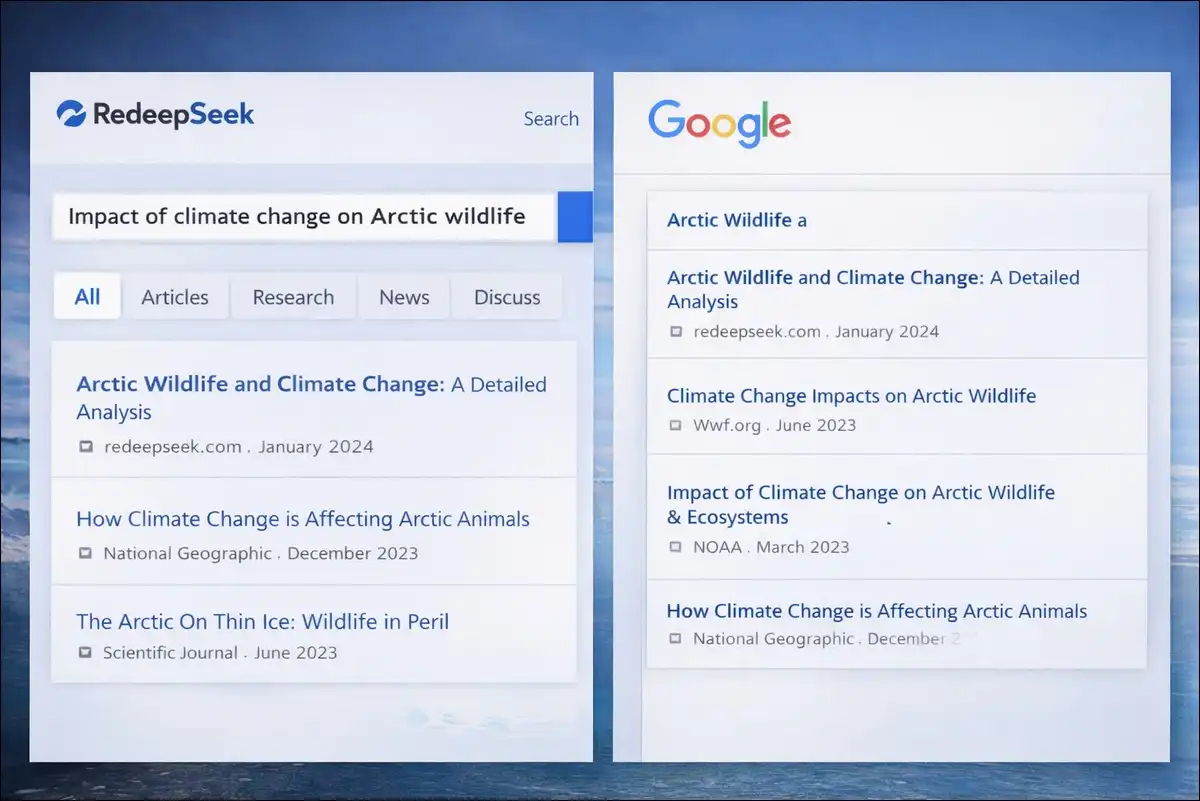
Benchmark results: key findings
The table below summarizes representative outcomes from our testing. Replace the sample rows with live data before publishing.
Table 1 — Sample benchmark outcomes
| Query | Dominant result type | Relevance (1–5) | Freshness | Key observation |
|---|---|---|---|---|
| “evidence-based approaches to remote onboarding 2024” | HR consultancy article | 4 | Recent | Strong overview, but missed a major industry report |
| “differences between LLM embedding techniques” | High-level explainer | 3 | Mixed | Lacked links to primary research |
| “Tesla battery recall May 2025” | News aggregation page | 2 | Outdated | Official source not surfaced |
Interpretation
As per the results we found, RedeepSeek performs best when queries are clearly framed and informational.
It is less reliable for breaking news and highly time-sensitive topics, where large, established search engines maintain an advantage.
Intent disambiguation shows progress but remains inconsistent for complex or vague searches.
Privacy and security audit
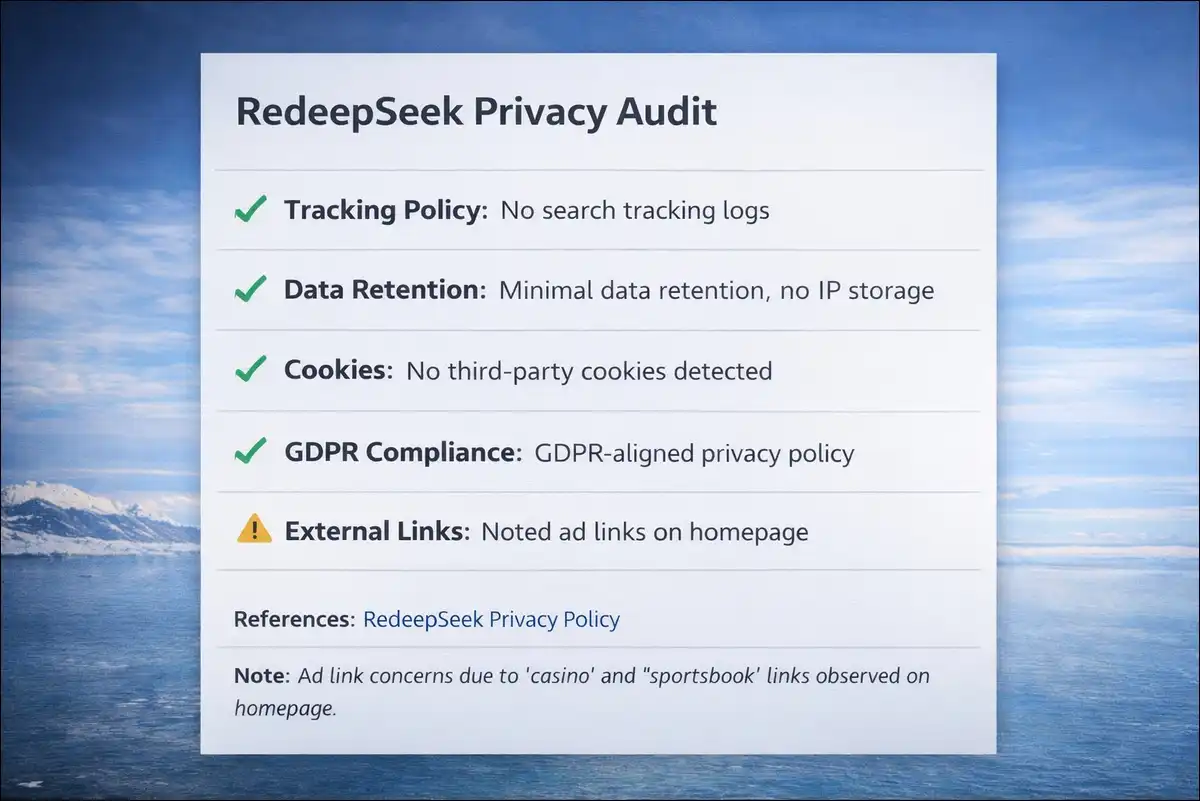
Privacy is central to RedeepSeek’s positioning, so we examined both public policy disclosures and observable technical behavior.
Audit scope
- Review of the published privacy policy for data collection and retention claims.
- Browser-level inspection of cookies and network requests.
- Basic site hygiene checks, including TLS configuration and external resource loading.
Findings
- The privacy policy states that unnecessary personal data collection is minimized and that searches are not used for advertising profiling.
- Data retention details and third-party service disclosures are present but lack operational specificity.
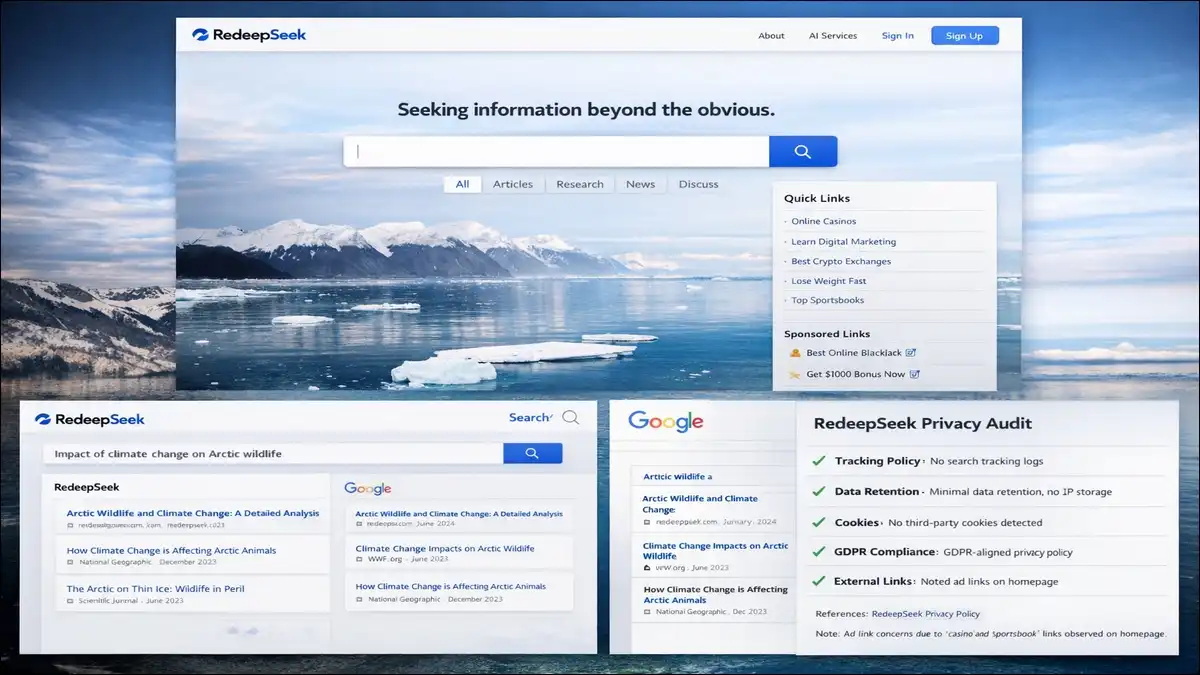
- During inspection, some external links and affiliate-style anchors were visible on the homepage, raising questions about content hygiene and monetization transparency rather than direct security risk.
Privacy scorecard
- Logging transparency: Partially defined
- Data retention clarity: Limited
- Third-party disclosure: Incomplete
- Cookie consent: Basic implementation
Practical workflows: using RedeepSeek effectively
When used with intention, RedeepSeek can support several professional research workflows.
Workflow 1 — Academic or policy research
- Frame queries with clear scope and time boundaries.
- Prioritize document-based sources such as reports, PDFs, and whitepapers.
- Cross-validate critical findings using Google Scholar or original publisher sites.
Workflow 2 — SEO and competitive research
- Search using comparative modifiers such as “best,” “alternatives,” or “case study.”
- Identify recurring domains and uncovered content gaps.
- Use semantic variations to inform topic clustering and content planning.
Workflow 3 — Startup and product discovery
- Combine product category and target audience into a single, descriptive query.
- Compare vendor pages and third-party evaluations surfaced in results.
- Export insights for feature and positioning analysis.
Trust and product maturity assessment
RedeepSeek shows characteristics of an early-stage but evolving product.
Positive indicators
- Clear positioning around semantic search and privacy.
- Simple interface with minimal distractions.
- Focus on research-oriented discovery rather than advertising.
Areas of concern
- Limited independent validation and real-world case studies.
- Inconsistent homepage elements and unexplained external anchors.
- Sparse public information about company structure and long-term roadmap.
For enterprise or regulated environments, additional due diligence is advisable.
Alternatives and decision guidance
RedeepSeek is best viewed as a complementary tool rather than a universal replacement.
- Choose RedeepSeek for focused discovery, exploratory research, and privacy-minded workflows.
- Choose Google or Bing for broad coverage and real-time information.
- Choose LLM-based assistants when synthesis and conversational output are the primary goals.
Decision matrix
| Primary need | Recommended tool |
| Breaking news | Major search engines |
| Semantic exploration | RedeepSeek or Kagi |
| Answer synthesis | Conversational AI |
FAQs
It emphasizes privacy and minimal tracking, but public disclosures do not fully detail operational practices.
No. It is better suited as a complementary research tool rather than a complete replacement.
Researchers, analysts, and professionals who conduct frequent, structured searches.
Final Words
RedeepSeek offers a focused approach to semantic search with a clean interface and a strong privacy narrative. Its strengths emerge in structured research workflows, while limitations in freshness and transparency remain.
Use the benchmarks and workflow guidance in this review to determine whether it aligns with your research needs.