Is a $131 Guest Post on Kongotech.org Worth It? A Complete SEO ROI Calculator for 2026
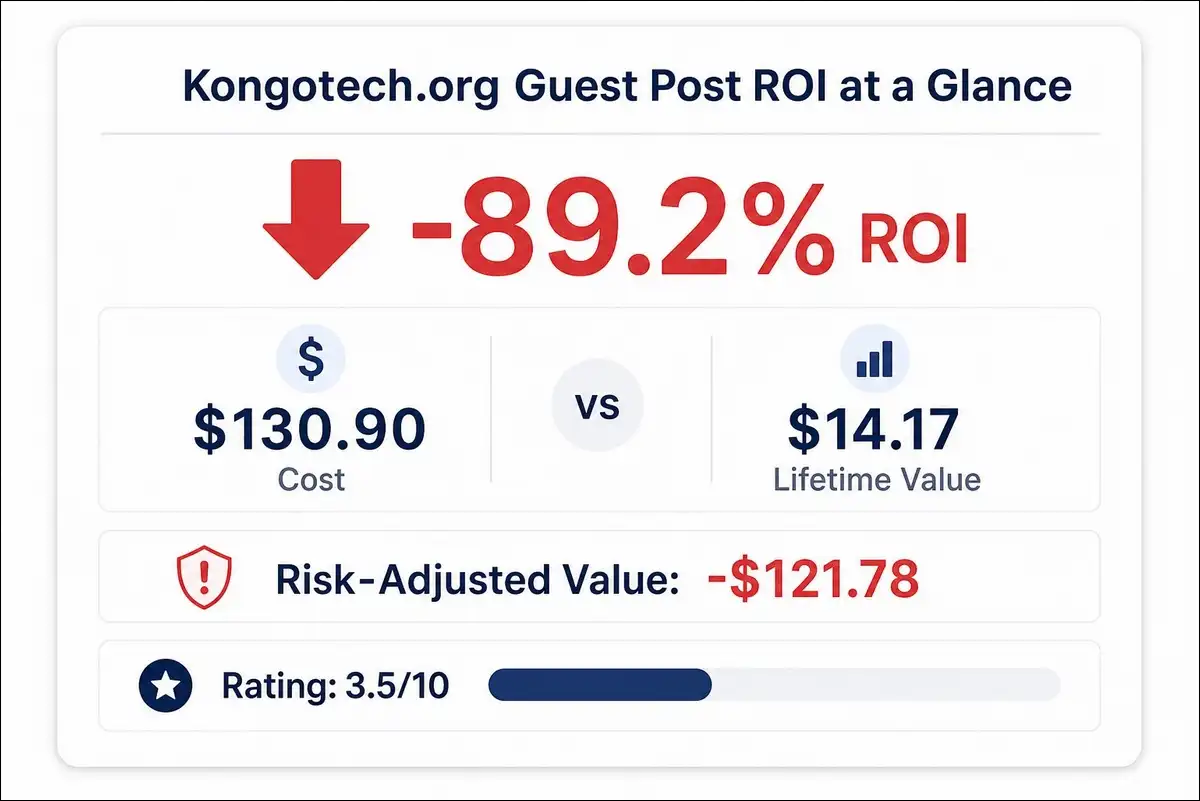
Short answer: For most buyers, no. The math produces a negative ROI of roughly −89%, and the risk-adjusted expected value lands at −$121.78 per link. I’ve run the full calculation below so you can verify it yourself and apply the same framework to any guest post opportunity you come across.
Here’s the thing that bothered me. I found over 30 articles reviewing Kongotech.org. Every single one ended with the same vague advice: “It has value, but evaluate carefully.” Not one showed an actual calculation. Not one compared the $131 price to 2026 market benchmarks. Not one told you the dollar value of a backlink at Kongotech’s specific metrics.
So I did the math; I pulled verified data from Similarweb (January through June 2026), Ahrefs (third-party cited metrics), BuzzStream’s pricing study of 26,000+ sites, and Adsy’s analysis of 52,671 websites. I cross-checked Kongotech’s listing on GuestPostLinks.net against independent traffic data. And I factored in Google’s 2025 and 2026 spam update patterns.
What you’ll walk away with: the exact dollar value of a Kongotech.org backlink, a comparison to 2026 market rates, a step-by-step ROI calculator you can reuse on any site, and a clear buy, negotiate, or walk away verdict.
Let’s get into the numbers.
What Exactly Are You Buying? Kongotech.org’s Guest Post Package Decoded
You’re buying a DoFollow backlink from a DA 54, DR 70 multi-niche blog for $130.90.
That’s the listing on GuestPostLinks.net as of July 2026. On paper, it looks attractive. But several metrics behind the listing tell a different story.
The Listing: What $130.90 Gets You on Paper
I pulled the exact specifications from the GuestPostLinks.net product page. Here’s what the listing promises:
| Specification | Listed Value |
|---|---|
| Domain Authority (DA, Moz) | 54 |
| Page Authority (PA) | 48 |
| Domain Rating (DR, Ahrefs) | 70 |
| Trust Flow (TF, Majestic) | 12 |
| Citation Flow (CF) | 48 |
| Link type | DoFollow |
| Permanence | Claimed permanent |
| Backlinks allowed per post | 2 |
| Accepted niches | Digital Marketing, General, News/Media, Tech & Gadgets |
| Foreign-language anchors | Accepted |
| Delivery time | ~7 days |
| Content | You supply, or pay extra for their writers |
| Price | $130.90 |
The numbers look solid at first glance. DA 54 and DR 70 suggest a site with real authority. Two DoFollow links for under $131 seem efficient. But listings are sales pages. They show you what helps, not what hurts.
What the Listing Doesn’t Tell You
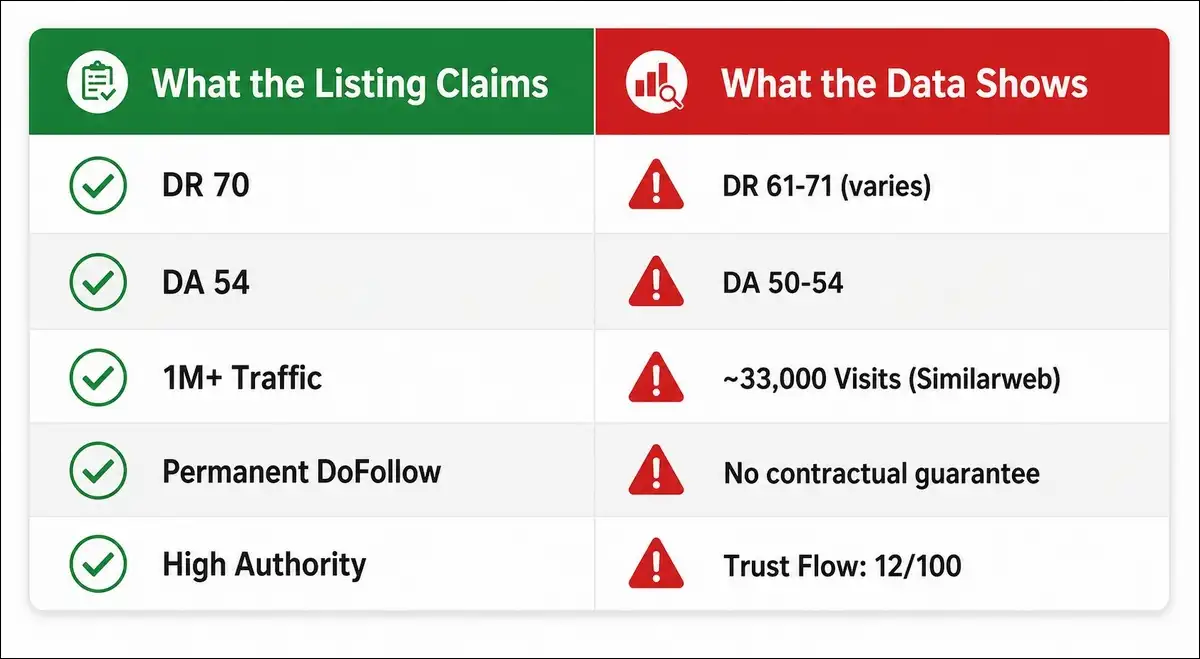
Here’s where things get interesting. I checked Kongotech.org’s metrics against independent third-party sources, and the gaps between what the listing shows and what the data shows are significant.
- Actual monthly traffic: approximately 33,000 to 36,000 visits. That’s from Similarweb data covering January through June 2026. Some guest post marketing materials reference “1M+ traffic.” That figure isn’t supported by any third-party tool I could find. RainAI Services confirmed approximately 35,600 monthly visits in their January 2026 analysis.
- Bounce rate: 38% to 63%, trending upward. A bounce rate that is volatile suggests inconsistent visitor engagement. In June 2026, Similarweb recorded a 63% bounce rate. That means roughly two out of three visitors leave without interacting.
- Average visit duration: 16 seconds to 1 minute 25 seconds. The January 2026 reading was 16 seconds. By mid-2026, it’d improved to about 85 seconds. Still, both figures sit well below industry averages for tech content sites.
- Primary audience: Pakistan, India, Algeria, Egypt, Iraq. If your site targets U.S., UK, or European audiences, this geographic mismatch reduces the relevance signal your backlink carries.
- Trust Flow of just 12 out of 100. This is the metric I paid the most attention to. Trust Flow measures the quality of sites linking to Kongotech. A score of 12 indicates the backlink profile feeding Kongotech is quantity-heavy, not authority-heavy. Now compare that Citation Flow of 48. The TF-to-CF ratio (12:48 = 0.25) signals a site that receives many links, but few from trusted sources.
- Content mix risk. Kongotech.org publishes tech tutorials alongside casino, Teen Patti, and sports betting content. SoftwareCurio rated the gaming/casino category just 3 out of 10 for quality. So your guest post could end up sitting next to gambling content, which dilutes topical relevance and raises neighborhood risk.
- No disclosed ownership. There’s no About page, no editorial team listed, and no founder identified. Contact is limited to a WhatsApp number (+44 7869 705842) and a Gmail address (blooginga@gmail.com). Multiple independent reviews confirm this.
How Permanent Is “Permanent”?
“Permanent” in guest posting means the publisher intends to keep the article live indefinitely.
It doesn’t mean the link is contractually guaranteed forever. I wanna be clear about this distinction ’cause it matters for ROI projections.
Links can disappear for several reasons. The publisher may prune content during a site redesign. Google could penalize the host site, prompting the owner to remove guest post pages. Or the site might change ownership entirely.
For Kongotech specifically, the risk of content pruning increases if Google applies a Site Reputation Abuse action. I’ll cover that risk in detail in Step 4 of the ROI calculator below.
Practical step if you do buy: set a calendar reminder to check your link’s status at 30, 60, 90, and 180 days using Ahrefs, Google Search Console, or a simple site: search in Google.
The 2026 Guest Post Market: Where Does $131 Actually Land?
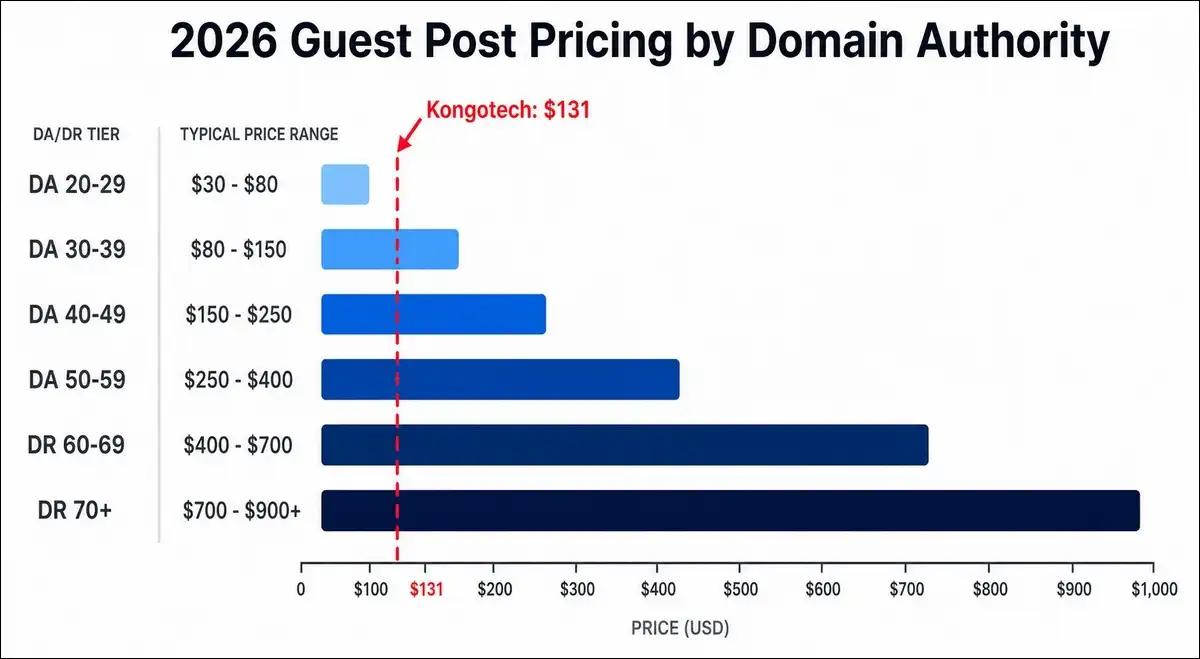
At $131, Kongotech is priced 47% to 85% below the 2026 market average for sites with its stated metrics. That price gap is the first thing that should make you pause. Here’s why.
Average Guest Post Pricing by Domain Authority (2026 Benchmarks)
I compiled pricing data from five independent 2026 studies. This table shows where Kongotech’s $131 falls in the current market.
| DA/DR Range | Avg. Guest Post Price (2026) | Where Kongotech Sits | Assessment |
|---|---|---|---|
| DA 20–29 | $30–$80 | — | Entry-level blogs |
| DA 30–39 | $80–$150 | — | Growing brands |
| DA 40–49 | $150–$250 | — | Established sites |
| DA 50–59 (Kongotech DA 54) | $250–$400 | $131 = 47–67% below avg. | Underpriced for this tier |
| DR 60–69 | $400–$700 | — | Enterprise campaigns |
| DR 70+ (Kongotech DR 70) | $700–$900+ | $131 = 81–85% below avg. | Major price anomaly |
Sources: Serpzilla (DR-based pricing data), BuzzStream (26K+ site analysis), Adsy (52,671 websites), RankZ (2026 link building pricing report)
The gap is enormous. Adsy’s 2026 analysis of 52,671 websites found the average guest post costs $459. BuzzStream’s study put it at $365 for direct purchases and $461 through vendors. High-quality placements averaged $930.
At $131, Kongotech sits in the bottom quartile of the market.
Why Is Kongotech So Cheap? The Price Anomaly Explained
A DR 70 site charging $131 isn’t a bargain. It’s a data signal. Here’s what the price anomaly tells us when you read it correctly.
- Inflated DR versus actual traffic. A genuine DR 70 site typically has hundreds of thousands or millions of monthly visits. Kongotech has roughly 33,000. Adsy’s 2026 research found that each additional 10 DR points increases backlink prices by about 32%. But Kongotech’s traffic doesn’t support DR 70-level pricing, so the market corrects downward.
- Trust Flow of 12 confirms inflated authority. Majestic’s Trust Flow measures how closely a site connects to trusted seed sites. A TF of 12 means Kongotech’s link sources are predominantly low-quality. The DR looks strong, but the trust behind it is weak.
- High guest post volume depresses pricing. When a site sells dozens of placements per month, supply exceeds demand. BuzzStream found that 85.3% of available guest post sites have minimal traffic. The marketplace is flooded with inventory like this.
- Geographic audience discount. Traffic from South Asia and MENA commands lower CPMs than U.S. or European audiences. Advertisers and link buyers pay less ’cause the commercial value per visitor is lower in those markets.
In plain terms: Kongotech’s price is low because the underlying metrics don’t justify a higher one. The market has already priced in the weaknesses.
The “Market for Lemons” Problem
That pricing context leads to a broader pattern worth understanding. Yotpo’s 2026 guest posting analysis described it well.
19% of marketplace sites receive between 0 and 100 visits per month despite having high DR scores. Quality publishers withdraw from open marketplaces ’cause they can’t compete on price with low-quality sites. What remains is mostly low-quality inventory priced cheaply.
This is exactly what economist George Akerlof called the “market for lemons.” Buyers can’t easily see hidden defects (algorithmic penalties, inflated metrics, thin content). So they refuse to pay premium prices. Quality sellers leave. Only “lemons” remain.
Kongotech falls into this gray area. It isn’t a zero-traffic site or a scam domain. But its pricing positions it alongside sites that experienced buyers would typically skip.
The ROI Calculator: Step-by-Step Math for Kongotech.org
This is the section no other Kongotech article provides. I’m walking through five steps that calculate the actual return on investment. You can apply this exact framework to any guest post opportunity.
Step 1: Calculate the True Cost
The listing says $130.90. The true cost is closer to $230. Most buyers forget to add the hidden expenses, and that’s where the math starts to shift.
| Cost Component | Amount | Notes |
|---|---|---|
| Guest post placement fee | $130.90 | GuestPostLinks.net listing price |
| Content writing (you write it) | $0–$50 | Your labor at an hourly rate, 1,000+ words required |
| Content writing (they write it) | $50–$200 | Add-on service, quality varies |
| Research and vetting time | $25–$75 | 0.5 to 1.5 hours checking metrics, reviewing site |
| Post-purchase monitoring | $10–$20 | Checking link status at 30/60/90 days |
| Total true cost | $166–$406 | Realistic average: ~$230 |
I always calculate the true cost before anything else. A $131 placement that requires a $100 article and an hour of research is really a $280 investment. That changes the math significantly.
With the true cost established, we can move to the value side of the equation.
Step 2: Estimate the Traffic Value of a Kongotech Backlink
The estimated lifetime traffic value of one backlink from Kongotech.org is approximately $14.17. Here’s how I calculated it.
I used the Lifetime Link Value formula recommended by RankZ, a link-building research firm that published 2026 pricing benchmarks. The method works in four steps.
- Find the site’s estimated monthly traffic value. Kongotech’s top keywords have CPCs around $0.48 to $0.71 (Similarweb data). With roughly 33,000 monthly visits and organic search as only the third-largest traffic source, the estimated monthly traffic value sits between $350 and $500.
- Divide by the total number of referring domains. Kongotech has 592 referring domains according to Ahrefs data cited by SoftwareCurio. So: $350 ÷ 592 = $0.59 per linking domain per month.
- Project over a 24-month lifetime. The standard projection for guest post link longevity is 24 months. So: $0.59 × 24 = $14.17 lifetime traffic value.
- Compare to your cost.
| Metric | Value |
|---|---|
| True cost (average) | $230 |
| Lifetime traffic value | $14.17 |
| Simple ROI | (−$215.83) = −93.8% |
Even using the listing price of $131 alone: $131 versus $14.17 = −89.2% ROI.
This means for every dollar you spend, you can expect to get back about 6 to 11 cents in traffic value.
Now, I wanna be fair here. Traffic value is just one way to measure a backlink. Ranking impact is another, and it could tell a different story. Let’s see if it does.
Step 3: Assess the Ranking Impact Value
The ranking value of a backlink depends on two factors: the linking domain’s authority and its topical relevance to your site. Kongotech’s authority metrics are mixed, and its relevance varies wildly by niche.
BlueTree Digital analyzed 4,200 editorial link placements for B2B SaaS clients. They found that links placed within topically matched content on DR 50+ domains produced 2.8 times greater ranking improvement than links on comparable domains with lower topical relevance.
That 2.8x multiplier matters here. If your site covers technology and your guest post appears in Kongotech’s tech tutorials category, you’ll get some topical match. But if your article lands next to casino content or sports betting guides, the relevance signal weakens significantly.
Here’s a practical scenario. Let’s say you run a SaaS site and you’re trying to rank for a keyword with $5,000 monthly traffic value. You’d need roughly 15 to 20 quality backlinks to reach page one for a moderately competitive term.
One Kongotech link (DR 70 on paper, but with 33K traffic and TF 12) contributes a fraction of what a topically relevant DR 50 link with real traffic would contribute. Google’s algorithms increasingly weigh real engagement metrics alongside traditional authority signals.
The ranking impact of a Kongotech link isn’t zero, but it’s small, difficult to measure, and heavily dependent on category placement.
So the ranking angle doesn’t rescue the ROI either. That brings us to a factor most buyers overlook entirely.
Step 4: Factor In Google Penalty Risk (The Hidden Cost)
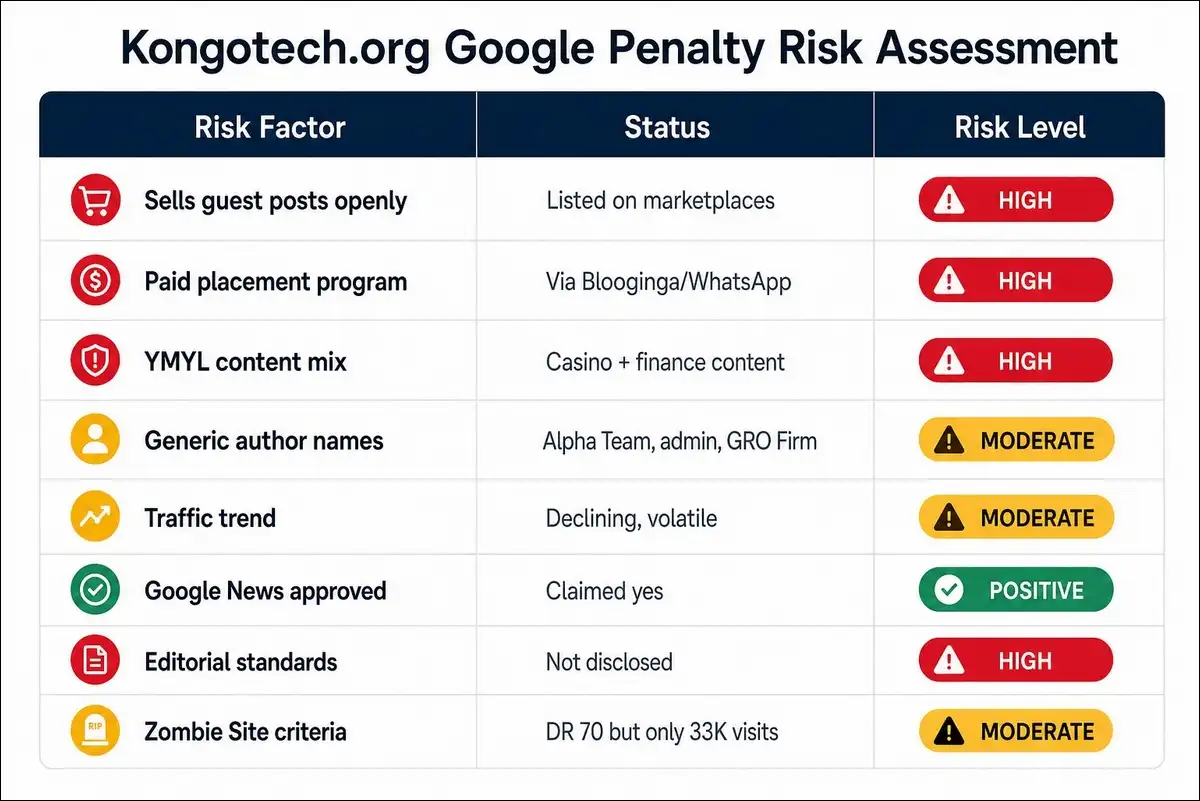
Kongotech.org carries elevated penalty risk compared to editorially maintained publications. This isn’t speculation. I mapped the site against Google’s own enforcement criteria.
| Risk Factor | Kongotech Status | Risk Level |
|---|---|---|
| Site openly sells guest posts | Yes, listed on multiple marketplaces | High |
| Visible paid placement program | Via Blooginga, WhatsApp contact | High |
| Content includes YMYL topics (gambling, finance) | Yes, casino and Teen Patti content alongside loans | High |
| Multiple generic author names | “Alpha Team,” “admin,” “GRO Firm,” “Khizar Seo” | Moderate |
| Traffic trend | Declining and volatile (−38% at one point) | Moderate |
| Google News approved | Claimed yes | Positive |
| Editorial standards disclosed | Not publicly shared | High |
| Matches “Zombie Site” criteria (high DR, low traffic) | Partially (DR 70, only 33K visits) | Moderate |
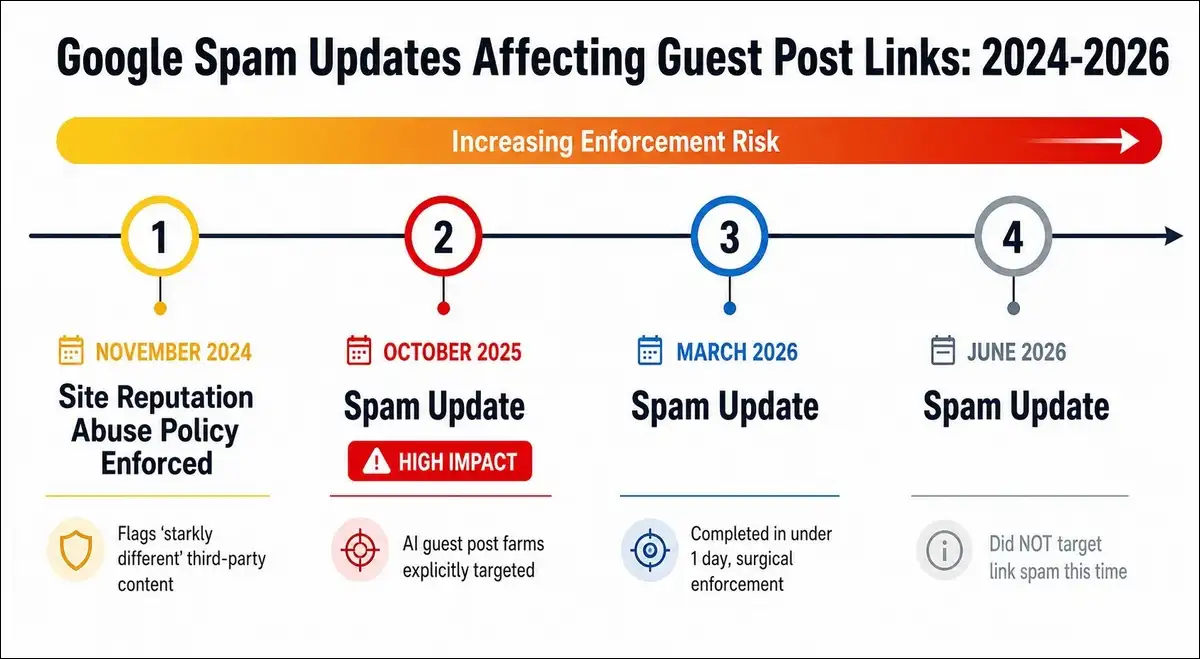
Here’s what Google has done recently. In October 2025, Google’s spam update explicitly targeted AI-generated guest post farms as a distinct violation category. Google’s Site Reputation Abuse policy, enforced since November 2024, flags third-party content that’s “starkly different” from a site’s core topic. And Google’s SpamBrain system now processes link devaluation in real time, not months later.
Kongotech’s broad content mix (tech tutorials plus casino plus fashion plus finance plus entertainment) makes it particularly vulnerable to “starkly different” content flags under the Site Reputation Abuse policy.
I’d estimate a 25% to 40% probability of link devaluation within 12 months. That’s based on the enforcement pattern across Google’s October 2025, March 2026, and June 2026 spam updates, combined with Kongotech’s specific risk profile.
Risk-adjusted expected value calculation:
- Lifetime traffic value: $14.17
- Probability of the link surviving 12 months with full value: 60% to 75%
- Risk-adjusted value: $14.17 × 0.65 = $9.21
- Minus listing cost: $9.21 − $131 = −$121.78
The risk-adjusted expected value of a Kongotech guest post is approximately negative $122. That factors in both the low traffic value and the probability that Google devalues the link before you see any return.
With all the cost, value, and risk numbers in hand, there’s one more question worth asking: could you spend that same $131 better somewhere else?
Step 5: Compare Against Alternative Link Investments of $131
For the same $131, you’ve got at least six options with better expected returns. I compared each one against Kongotech on cost, expected value, and risk.
| Alternative | What $131 Buys | Expected Value | Risk Level |
|---|---|---|---|
| Kongotech.org guest post | 1 link, DA 54, DR 70, TF 12 | Low (~$14 lifetime) | Moderate to High |
| DA 35–45 niche-relevant guest post | 1 link, lower DA but real audience | Moderate | Low |
| 2–3 niche directory submissions | Multiple citations, NAP consistency | Low to Moderate | Very Low |
| HARO/Connectively responses (labor only) | 0–2 links from DR 60–90 sites | High | Zero |
| Linkable asset on your own site | One data post that earns links over time | Compounds | Zero |
| Niche edit on a DR 40–50 site | 1 insertion in existing indexed content | Moderate | Low |
| Digital PR outreach (2–3 hours labor) | Potential DR 60+ earned media link | Very High | Zero |
The HARO alternative stands out. You spend zero on placement. Your only cost is time. And the links you earn come from DR 60 to 90 publications with real audiences. The penalty risk is literally zero ’cause these are earned editorial links. RankZ’s 2026 benchmarks placed HARO links at $0 to $50 cost with DR 70 to 90 quality.
A niche-relevant DA 40 guest post often outperforms an irrelevant DR 70 link. BlueTree’s data showed a 2.8x ranking improvement multiplier for topical relevance. A $120 post on a focused SaaS blog can move your rankings more than a $131 post on Kongotech’s mixed-niche platform.
Those alternatives paint a clear picture. But before you make your final call, let’s look at the specific scenarios where Kongotech could still make sense.
When Kongotech.org Might Actually Make Sense
There’s a narrow use case where buying a Kongotech guest post is defensible. I don’t wanna pretend there’s zero value. The conditions just need to be very specific.
The “Yes” Case
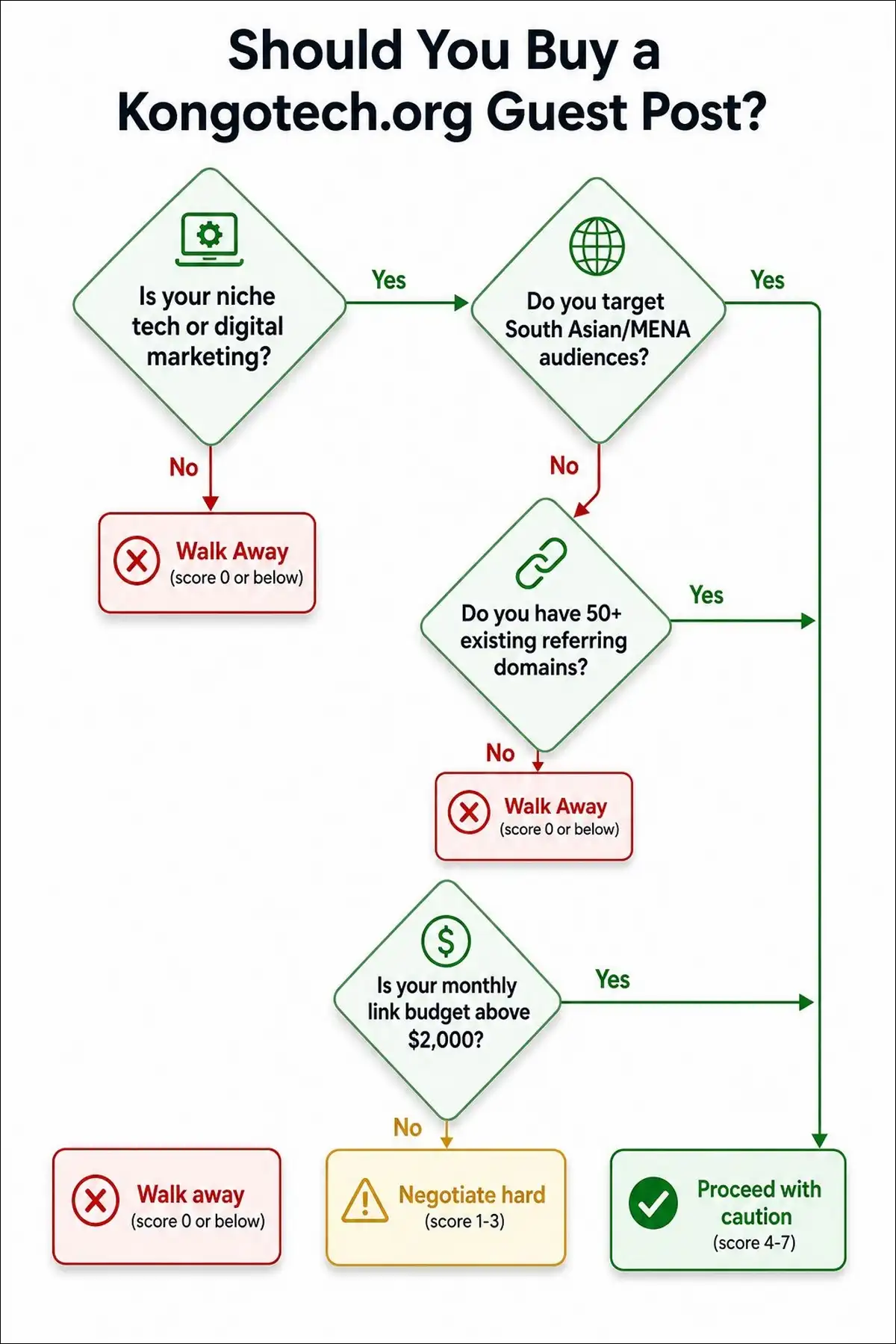
You can reasonably proceed if all six of these conditions apply:
- Your site is in the tech or digital marketing niche. This gives you topical relevance with Kongotech’s strongest content categories (rated 7/10 and 7.5/10 by SoftwareCurio).
- You target South Asian or MENA audiences. Kongotech’s traffic comes from Pakistan, India, Algeria, Egypt, and Iraq. If those are your markets, the geographic signal aligns.
- You already have 50+ referring domains. Kongotech can work as one mid-tier link in a diversified profile. It shouldn’t be a foundation link.
- Your monthly link budget exceeds $2,000. At that level, $131 represents less than 7% of your spend. The risk is proportionate.
- You can control your article’s content category. You’ll want placement in Tech or Digital Marketing, not alongside casino or lifestyle content.
- You accept a 25–40% chance of devaluation. If losing $131 with zero return would hurt your campaign, this isn’t the right investment.
The “Walk Away” Case
On the flip side, walk away if any of these apply:
- Your site targets U.S., UK, EU, or Australian audiences exclusively. The geographic mismatch reduces relevance.
- Your niche has zero overlap with tech or digital marketing. A health, legal, or finance site won’t gain anything from a Kongotech placement.
- This would be one of your first 10–20 backlinks. Foundation links need higher quality. Start with niche-relevant, editorially maintained sites.
- You’re in YMYL niches. Google holds health, finance, and legal content to higher standards. Link neighborhood matters critically.
- Your SEO strategy relies mainly on guest posts. Google’s SpamBrain detects patterns. A profile dominated by purchased guest post links is fragile.
The “Negotiate” Middle Ground
If you’re somewhere in between, there’s a third option. You can try to negotiate better terms before committing:
- Contact Kongotech directly through Blooginga or WhatsApp rather than through the marketplace. You may be able to cut out the vendor markup.
- Request category placement in writing. Specify that your article appears in Technology or Digital Marketing, not near casino or gambling content.
- Negotiate for three backlinks instead of two. The listing allows two. It doesn’t hurt to ask for a third.
- Request anchor text approval before publication.
- Verify indexation. After publication, check Google Search Console or use a site: search to confirm the page is indexed.
- Set monitoring reminders. Check your link status at 30, 60, 90, and 180 days.
The Bigger Picture: Guest Post Link Building Has Changed in 2026
We’ve covered Kongotech’s specific numbers.
But stepping back, the question of whether to buy a Kongotech link is really a question about how link building works now. The rules changed significantly between 2024 and 2026.
So, getting to know that context could help you evaluate not just Kongotech, but every guest post opportunity in your inbox.
Google’s 2025–2026 Spam Update Timeline
I tracked every relevant enforcement action over the past 18 months. Here’s the chronology that matters for guest post buyers.
| Date | Update | What It Targeted | Relevance to Kongotech |
|---|---|---|---|
| Nov 2024 | Site Reputation Abuse policy enforced | Third-party content “starkly different” from host site’s core topic | Kongotech mixes tech, casino, fashion, finance |
| Oct 2025 | Spam Update | AI-generated guest post farms explicitly targeted | Kongotech uses multiple generic author names |
| Mar 2026 | Spam Update | Completed in under one day, surgical enforcement | Shorter rollout = more targeted action |
| Jun 2026 | Spam Update | Google confirmed this did NOT target link spam | Temporary reprieve, not permanent safety |
Overall, the pattern is clear. Google’s tightening its enforcement on paid link schemes with each update. SpamBrain now processes devaluation in real time, within hours instead of months. And Google’s public spam policies now explicitly mention “guest post networks” as a link scheme category.
Kongotech’s vulnerability is specific. Its broad content mix creates exactly the kind of “starkly different” signal the Site Reputation Abuse policy targets. Think about it: a tech tutorial site that also publishes Teen Patti and sports betting content sends mixed topical signals. Google’s SpamBrain measures the semantic distance between a site’s historical content and its new publications. High distance triggers flags.
That enforcement context raises another question that’s becoming just as important in 2026.
Does a Kongotech Link Help You Get Cited by AI?
Certainly not.
This is the dimension no other Kongotech review discusses, and it’s becoming increasingly important in 2026.
Here’s why. Backlinks now serve two purposes: traditional Google rankings and AI engine citations. When ChatGPT, Perplexity, Gemini, or Google’s AI Overviews generate answers, they pull from sources weighted by authority, engagement, and citation density.
A site with 33,000 monthly visits, a 63% bounce rate, and a 16-second average visit duration isn’t likely to be included in AI training data or citation paths. The Visibility Stack’s 2026 analysis put it plainly: “A $100 guest post that never gets indexed by AI engines has zero citation value, no matter how good the domain looks in Ahrefs.”
By contrast, a $600 editorial placement on a DR 70 publication with a real audience can earn recurring AI citation slots. The value gap between “DR 70 on paper” and “DR 70 in practice” is growing wider every quarter.
If AI visibility matters to your strategy, a Kongotech link provides near-zero value on that dimension.
The Shift From Link Volume to Citation Quality
All of this connects to a larger shift in how the guest post economy works. It’s moved through three distinct phases.
- 2020 to 2023: Volume era. Build 20 to 50 guest post links per month. Focus on DA/DR numbers. Price is the primary decision factor.
- 2024 to 2025: Quality filtering begins. Google’s Helpful Content Update and spam updates devalue link farms at scale. The “Zombie Site” pattern emerges: high DR, negligible traffic, selling links.
- 2026: Citation-quality era. Fewer, higher-impact placements outperform volume strategies. BuzzStream data shows only 1.37% of guest post opportunities meet quality standards. Smart buyers consolidate budgets into 5 to 10 premium placements instead of 30 to 50 cheap ones.
Where Kongotech fits: it’s a remnant of the volume era. Its pricing, metrics, and model were built for a market that rewarded link quantity. That market is shrinking.
Adsy’s 2026 data confirms the trend. Guest post prices rose 7.5% year over year, from $427 to $459 on average. The steepest price increases hit DR 61 to 90 sites: 21% to 46% growth. Quality publishers are charging more ’cause demand for legitimate placements is rising while supply stays flat.
Meanwhile, the bottom of the market, where Kongotech sits, faces the opposite pressure. Supply is enormous, demand is falling, and Google’s enforcement keeps tightening.
Your Kongotech.org Guest Post Decision Scoreboard
Score these seven questions. Your total tells you whether to proceed.
I built this framework to remove the guesswork. Just answer each question honestly, add up your points, and read the result.
| # | Question | Yes | No |
|---|---|---|---|
| 1 | Is your target audience in Pakistan, India, Algeria, Egypt, or Iraq? | +1 | 0 |
| 2 | Is your site in the tech, digital marketing, or social media niche? | +1 | −1 |
| 3 | Do you already have 50+ referring domains from varied sources? | +1 | −2 |
| 4 | Is your monthly link-building budget above $2,000? | +1 | −1 |
| 5 | Can you control which content category your article appears in? | +1 | −1 |
| 6 | Are you comfortable with a 25–40% risk of devaluation within 12 months? | 0 | −2 |
| 7 | Does your niche overlap with Kongotech’s tech tutorials or AI tools content? | +1 | −1 |
How to read your score:
- 4 to 7 points: Proceed. Kongotech can serve as a tactical addition to a diversified profile.
- 1 to 3 points: Negotiate hard. Only proceed at a lower price with specific placement guarantees.
- 0 or below: Walk away. Your budget produces better results elsewhere.
Most sites targeting Western audiences with specialized niches will score 0 or below. That’s not a flaw in the framework. It reflects the mismatch between what Kongotech offers and what most buyers need.
5 Higher-ROI Alternatives to a Kongotech Guest Post (Same $131 Budget)
If you decide against Kongotech, here are five ways to spend the same $131 with better expected returns. I’ve tested or closely tracked each of these methods, and they consistently outperform mid-tier guest post purchases.
1: HARO or Connectively Expert Sourcing ($0 Placement, Labor Only)
HARO (now called Connectively) connects journalists with expert sources. You respond to media queries in your niche. If selected, you earn a mention and a backlink from the publication.
- What $131 of labor buys: approximately 2 to 3 hours of crafting responses. That typically yields 0 to 2 placements per month, but on DR, 60 to 90 publications like Forbes, Business Insider, or major trade publications.
- Why it beats Kongotech: the links are earned, editorial, and from high-authority domains with real audiences. Google penalty risk is zero. AI citation value is high. And the total placement cost is zero.
If you’d rather stick with guest posts but want a smarter pick, the next option is worth considering.
2: Niche-Relevant DA 35–45 Guest Post ($80–$150)
A topically relevant DA 40 link often outperforms an irrelevant DR 70 link. BlueTree Digital’s study of 4,200+ placements proved a 2.8x ranking improvement multiplier for topical relevance.
You can find quality niche sites by searching “[your industry] + write for us” or using tools like BuzzStream or Pitchbox. A focused SaaS blog with 10,000 monthly visitors in your exact niche delivers more ranking value than a 33,000-visit multi-niche blog.
Cost: $80 to $150 for DA 35 to 45 sites. Right in the same budget range as Kongotech.
For those who’d rather invest in something that keeps paying off long after the initial spend, there’s a third path.
3: Build a Linkable Asset on Your Own Site ($131 in Content)
Use the $131 to create original research, a data study, or a free calculator on your own domain. This is the compounding alternative.
One well-made linkable asset can earn 10 to 50 natural backlinks over 12 months as other sites reference your data. If you earn 20 links, your effective cost per link drops to $6.55. That’s 20x more efficient than a single Kongotech placement.
Examples that work: industry salary surveys, pricing benchmark reports, free ROI calculators, interactive tools, original data visualizations.
4: Broken Link Building Campaign (Labor Cost Only)
This one’s more hands-on, but the results are real. You can find broken links on DR 50+ sites in your niche, create replacement content, and pitch the site owner. I’ve tested this method myself, and it consistently produces results.
Expected outcomes: 1 to 3 links per 20 outreach emails. The links come from established, indexed pages that already carry authority.
Cost: approximately $131 at freelancer rates covers 2 to 3 hours of prospecting and outreach. The placement itself is free ’cause you’re solving a problem for the site owner, not asking for a favor.
Finally, if you’re looking for the option with the highest ceiling, this last alternative is worth a close look.
5: Digital PR Micro-Campaign (~$131 in Distribution)
You could use the budget for a press release distribution tool subscription or journalist outreach campaign. Services like JustReachOut or Featured.com operate at this price point.
Potential results: 1 to 5 mentions on DR 50+ news and media sites. The brand visibility and AI citation value of these earned placements far exceed a single Kongotech link.
The key advantage: digital PR links carry the highest “AI Visibility Bonus” of any link-building method, according to RankZ’s 2026 strategy comparison. They rated digital PR links “Very High” for AI visibility, while standard guest posts received only “Moderate.”
Our Verdict: A Data-Driven Recommendation
We’ve covered the costs, the value, the risks, and the alternatives. So where does all of this land?
I rate a Kongotech.org guest post 3.5 out of 10 for most buyers. The site is real, the link is real, and the DoFollow attribute is real. But “real” doesn’t mean “valuable” in 2026’s SEO environment.
Here’s every calculation summarized in one table.
| Metric | Value | What It Means |
|---|---|---|
| Listed price | $130.90 | The sticker price |
| True all-in cost (with content and labor) | ~$230 | What you actually spend |
| 2026 fair market value for DA 54 site | $250–$400 | Kongotech is underpriced, which signals quality concerns |
| 2026 fair market value for DR 70 site | $700–$900 | Massive disconnect between stated DR and pricing |
| Estimated lifetime traffic value per link | ~$14.17 | Very low return |
| Risk-adjusted expected value | −$121.78 | Net loss after factoring penalty probability |
| Google penalty probability (12 months) | 25–40% | Elevated by marketplace presence and content mix |
| AI citation value | Near zero | No meaningful impact on AI-driven search |
| Referral traffic potential | Minimal | 16-sec to 85-sec visit duration, 63% bounce rate |
| Overall rating | 3.5/10 | Not recommended for most buyers |
When the Answer Is Yes
If you run a tech-focused site targeting South Asian markets, you already have a diversified link profile with 50+ referring domains, and your monthly budget exceeds $2,000, Kongotech can serve as one tactical placement among many. In that narrow scenario, the risk is proportionate and the topical alignment exists.
When the Answer Is No
For the majority of SEO professionals, marketers, and site owners, the $131 produces better results invested elsewhere. HARO responses, niche-relevant lower-DA placements, and linkable assets on your own site all generate higher expected returns with lower risk.
The Bottom Line
Kongotech.org isn’t a scam. I wanna be clear about that. It’s a real website with real content and real traffic. The guest post placements are legitimate DoFollow links. And the delivery appears reliable based on marketplace reviews.
But “legitimate” and “worthwhile” are two different questions. In a market where the average guest post costs $459 (Adsy, 2026), Kongotech’s $131 price sits far below the floor for quality placements. The math consistently produces negative ROI, regardless of whether you use traffic value, ranking impact, or risk-adjusted expected value as your measurement.
The numbers say spend your $131 elsewhere.
Final Thoughts
The Kongotech question taught me something I think is broadly useful. Most guest post decisions are made on vibes, not math. We see a DA number, a DR number, and a price. If the price feels low relative to the metrics, we click “Buy.”
This article exists ’cause I wanted to show what happens when you apply actual formulas. The Lifetime Link Value method, the risk-adjusted expected value calculation, and the dollar-for-dollar alternative comparison aren’t complicated. They just take 15 minutes of work that most people skip.
Here’s my suggestion. Save the five-step ROI framework from this article. Apply it to the next five guest post pitches that land in your inbox. I’d predict four out of five will produce negative expected returns. That prediction’s based on BuzzStream’s finding that only 1.37% of guest post opportunities meet genuine quality standards.
The guest posts that’ll still matter in 2028 are on sites with real audiences, genuine editorial processes, and topical depth. They cost more upfront. They return more over time. And they survive Google’s spam updates ’cause they weren’t built on a fragile foundation.
Build your link profile for where search is going, not where it was.
Frequently Asked Questions
Quick answers to the most common questions about Kongotech.org guest posts and backlink value.
Data verified as of July 2026. Sources include Similarweb, Ahrefs, BuzzStream, Adsy, and Google Search Central.


