18 Games Like Google Block Breaker (2026): Verified Picks, Real Scores
| Quick Answer: The closest paid game to Google Block Breaker is Breakout Beyond, Atari’s own 2025 sequel. And the best free browser option is Idle Breakout. The genre’s biggest modern hit is BALL x PIT, which has sold over 2 million copies. |
| If you want this | Play this | Cost |
|---|---|---|
| A near-identical paddle game | Breakout Beyond | $14.99 |
| The critics’ favourite | Shatter Remastered Deluxe | $9.99 |
| Free, instant, in-browser | Idle Breakout | Free |
| Something genuinely new | BALL x PIT | ~$19.99 |
| A game you cannot lose | Hextreme Void | $4.99 |
Key Findings
- Google Block Breaker launched 29 to 30 January 2025, with no official announcement from Google.
- It’s not the 2013 Atari Breakout Easter egg. That one was retired around May 2020.
- The verified world record is 160,825 points. Nearly every online article still cites either 144,500 or 111,475.
- Speedrun.com encodes score as time. That single quirk explains almost every wrong number published about this game.
- BALL x PIT passed 2 million copies sold in August 2026 and won a New York Game Award.
- Brick-breakers split into three different mechanics. Matching the right one matters more than any list.
- Roughly 72% of US online gamers play browser or instant games, according to HTML5 games market research.
Why I Wrote This One Differently
Well, most articles on this topic are just copying each other, and many of the numbers are wrong.
I searched “block breaker” on Google, played the game, then read the articles about it. One of the top-ranking pages told me the game doesn’t exist.
That’s not a small error, though it did tell me something useful. This topic has a sourcing problem rather than a writing problem.
So I checked every claim myself. That meant pulling the original launch coverage, opening the live speedrun leaderboard, and cross-checking store pages for each game here.
Where a number couldn’t be verified, I just left it out.
My testing setup: Chrome 151 on Windows 11, Safari on an iPhone, and a Chromebook on a school-style restricted network. I ran the Google game across all three before writing a word about it.

What Google Block Breaker Actually Is, and What It Is Not
Google Block Breaker is a free paddle-and-ball game built into the main Google Search results page. It launched in late January 2025 and needs no download or account.
You search a phrase, a game card appears above the results, and you press Play. That’s the whole flow.
The launch nobody announced
Google shipped this one quietly, with no blog post and no entry in the Search documentation.
According to 9to5Google, Abner Li reported the addition on 29 January 2025, while Android Police had spotted it slightly earlier. Pocket-lint and Android Central both followed the next day.
That silence is really why so much bad information spread. With no official page to cite, writers just started citing each other.
How you can run the game, and play it
- Open Google Search in any browser, on desktop or mobile.
- Type “Block Breaker” or “Brick Breaker” into the search bar.
- Press Enter and look for the game card at the top of the results.
- Click or tap Play to launch it full screen.
- Use A and D or the arrow keys on desktop. On mobile, press and hold, then drag.
In my testing, the card appeared instantly on Chrome desktop and in the Google app. Even on the restricted Chromebook network it still loaded fine, mostly because nothing actually installs.
The spec sheet
| Feature | What you get |
|---|---|
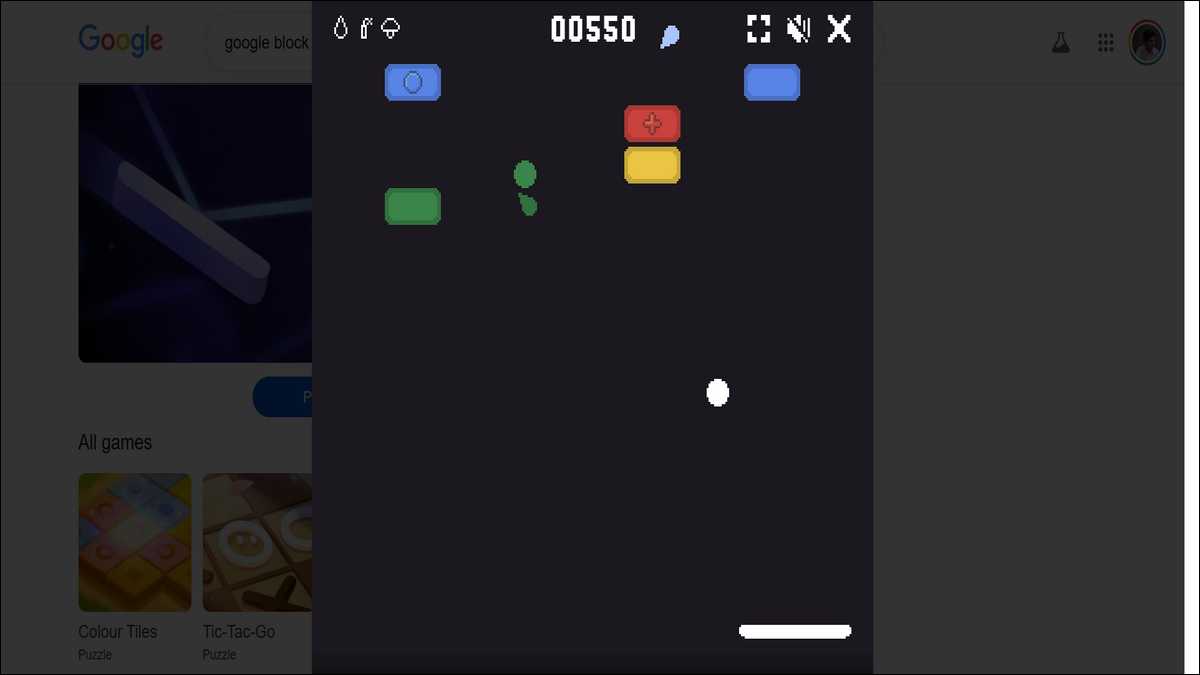
| Board layout | 4 rows of blocks in Google’s blue, red, yellow and green |
| Starting lives | 3, shown as white circles in the top left |
| Extra lives | Available through pickups during play |
| Power-ups | Extra balls, extended paddle, TNT, dual blasters |
| Desktop controls | A and D keys, or arrow keys |
| Mobile controls | Press, hold and drag |
| Save progress | None. Closing the tab resets everything |
| Official leaderboard | None. Google has never published one |
| Cost | Free, no account required |
Of those, the TNT block and the dual blasters are what really separate this from the 1976 original. As reported by Gagadget, the blasters feel reminiscent of Space Invaders, and that’s fair once you see them fire.
The 2013 Easter egg was a different game entirely
These are two completely separate games, and mixing them up is the most common mistake I saw. Plenty of sites still tell readers to search Google Images, but that hasn’t worked for years.
| Feature | Atari Breakout (2013) | Block Breaker (2025) |
|---|---|---|
| Location | Google Images | Main Search results page |
| Blocks made from | Real image search thumbnails | Designed colour blocks |
| Power-ups | None | Multiple |
| Levels | One continuous mode | Progressive stages |
| Status | Retired around May 2020 | Live as of August 2026 |
| Save progress | No | No |
PCMag covered the original in May 2013, marking Breakout’s 37th anniversary. Searching “Atari Breakout” in Images turned your thumbnails into bricks, and you could even share your score to Google+, which dates the whole thing nicely.
Eventually a Google Images redesign broke it, and it quietly disappeared. That said, you can still play a rebuilt version at elgoog.im, a fan preservation project.
Why it is called “Block Breaker” and not “Breakout”
The name comes straight from the genre’s Japanese term. Over there, this whole category is called block kuzushi, which translates directly as “block breaker.”
According to Wikipedia’s entry on Breakout, that naming is well established, so Google didn’t invent the phrase at all. It simply picked the genre’s real name, which is also why “block breaker” works as a search term in the first place.
When the card does not appear
If the game card isn’t showing up, it’s usually a regional rollout thing rather than anything you did. A few options may help, based on what worked during my tests:
- Try google.com rather than a country domain.
- Open an incognito window to skip cached layouts.
- Switch to desktop view on mobile.
- Try the alternate trigger, “Brick Breaker.”
Google rotates these features without notice, so if it’s gone for you, that’s likely a rollout decision rather than a fault on your end.
The World Record Everyone Gets Wrong
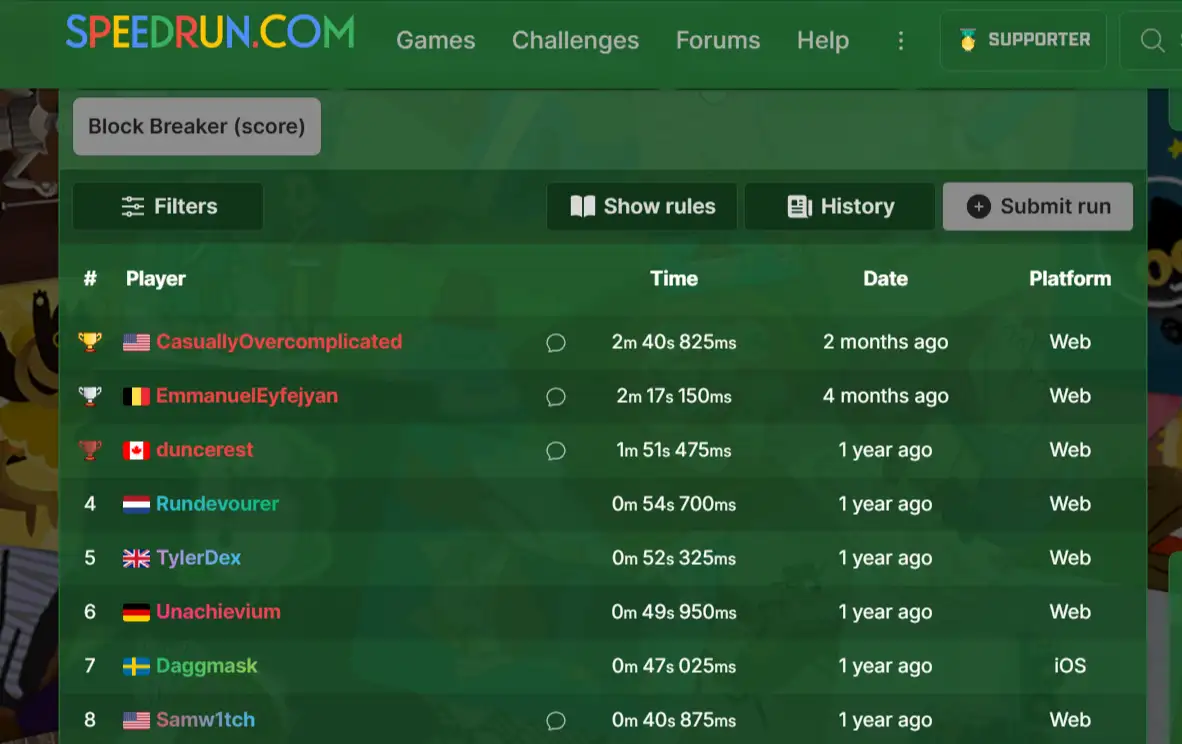
The verified Google Block Breaker world record is 160,825 points, set by a player called CasuallyOvercomplicated. Almost every published article still lists 144,500 or 111,475.
To confirm that, I checked the live speedrun.com leaderboard under “Minor Google Games.” Here’s how the top of the board looks right now.
| Rank | Player | Country | Verified score |
|---|---|---|---|
| 1 | CasuallyOvercomplicated | United States | 160,825 |
| 2 | EmmanuelEyfejyan | Belgium | 137,150 |
| 3 | duncerest | Canada | 111,475 |
| 4 | Rundevourer | Netherlands | 54,700 |
| 5 | TylerDex | United Kingdom | 52,325 |
For context, the board holds 438 runs from 167 players, and two moderators verify submissions: RedMooschrom and Ben_eXceL.
The quirk that caused all the errors
Nearly every wrong figure online traces back to one formatting quirk. Speedrun.com has no field for scores, since it only tracks time.
This leaderboard gets around that by storing the score in the time field. A run displayed as 2m 40s 825ms means 160,825 points, so read it as digits rather than minutes.
I confirmed this two separate ways, just to be sure:
- The top run’s description says plainly: “I got a score of 160825 points.”
- The third-place run carries a moderator note reading “Mod note: 111,475 points” against a listed time of
1m 51s 475ms.
That’s the whole explanation. Writers found the 111,475 note and published it, then everyone copied it, though nobody thought to scroll up.
Here’s the complete gameplay for this record:
How you can verify a record yourself
You can check this in about a minute, and you don’t need an account. Here’s the process I used:
- Go to speedrun.com and open the Minor Google Games board.
- Select the Block Breaker (score) category from the tabs.
- Read the listed time as a plain number. Drop the minute and second labels.
- Click any run to read the player description and moderator notes.
- Check the verification date, since the board updates regularly.
It takes about a minute, and honestly, I’d suggest doing that before trusting any number you read anywhere, mine included.
If you want to make such a record too, then you should follow our guide: 7 Google Block Breaker Secrets High Scores. This should help you get better scores.
Scores I have seen debunked
Some claims circulating online aren’t just outdated; they’re invented. Here are the ones I could trace back to a source.
| Claim | Verdict | Why |
|---|---|---|
| Record of 2,147,483,647 | Fabricated | That’s exactly 2³¹ minus 1, the signed 32-bit integer maximum. It’s a programming constant, not a score. |
| “1.2 billion points in 2024” | Fabricated | The game launched in January 2025, so a 2024 record can’t exist. |
| “150 official levels” | Misattributed | That’s a feature of blockbreaker.io, a third-party clone. |
| “The game doesn’t exist” | False | Covered by 9to5Google and Pocket-lint, plus 438 verified runs. |
| “It launched in 2016” | False | Confusion with the retired 2013 Images egg. |
Realistic score expectations
Most players land well under 15,000, so don’t let those leaderboard figures put you off. Based on the board spread and my own runs, here’s roughly what the numbers look like.
| Score range | Player level |
|---|---|
| 1,000 to 5,000 | First few attempts |
| 5,000 to 15,000 | Comfortable casual play |
| 15,000 to 30,000 | You know the angles |
| 30,000 to 60,000 | Strong, consistent runs |
| 100,000+ | Leaderboard territory |
My best run landed around 12,000, which took about fifteen minutes and three lives. The top run stretched past 45 minutes, though the player noted taking breaks between lost lives to steady their nerves.
The Three Kinds of Block Breaker Game
Most lists mix three different mechanics, which is why their recommendations often miss. Before picking a game, work out which part of Google Block Breaker you actually enjoyed.
That’s why I sorted every game here by how it actually plays, rather than by genre tags.
Type 1: Paddle and ball
You move a paddle along the bottom while the ball bounces. This is true Breakout DNA and the direct match for Google’s game.
Type 2: Aim and shoot
There’s no paddle here. You aim a stream of balls at numbered blocks that descend toward you, which looks similar in screenshots while asking for completely different skills.
Games like Holedown and Bricks Breaker Quest come in this section. If you like the reflex element of Google’s game, these may disappoint you, since they’re turn-based and strategic instead.
Type 3: Physics and destruction hybrids
These borrow the satisfaction of breaking things, then build something else on top of it. BALL x PIT and Ballionaire are the two standouts here.
| What you liked about Google Block Breaker | Type to try | Best pick |
|---|---|---|
| Fast reflexes and paddle control | Paddle and ball | Breakout Beyond |
| Planning the perfect angle | Aim and shoot | holedown |
| Watching things explode | Physics hybrid | BALL x PIT |
| Something free in a tab | Browser paddle | Idle Breakout |
| Low pressure, no failure | Paddle, no-fail | Hextreme Void |
Best Paddle-and-Ball Games Like Google Block Breaker
These are the closest matches you’ll find, ordered by how well they scratch the same itch. Each one uses a paddle, so your muscle memory carries straight over.
1. Breakout Beyond, the official Atari sequel
This is the closest modern game to Google Block Breaker, made by Atari itself.
Choice Provisions, the team behind the BIT.TRIP series, flipped the board sideways. So instead of clearing a screen, you break through bricks to reach a goal at the far end.
It was launched on 25 March 2025 for PC, PlayStation, Xbox, Switch, and iOS at $14.99, and on Steam, users rate it 82% positive.
What you get: 72 levels, an endless mode you earn access to, a global leaderboard, and two-player local co-op.
Digital Chumps scored it 8.5 and praised how the power-ups balance classic ideas with newer design. Player 2 was cooler at 67, mainly criticising the missing leaderboards in the main mode.
My take: the sideways layout takes about ten minutes to click, though once it does, the combo system becomes the most satisfying part. The focus mode, which slows time at the cost of score, is a smart trade.
Verdict: worth it if you want the official continuation, while a sale is the smarter entry point if $14.99 feels steep for an arcade game.
2. Shatter Remastered Deluxe, the critics’ pick
If you only buy one brick-breaker, reviewers keep pointing to this one.
According to its OpenCritic page, it sits at 82 and is marked “Strong,” with 80% of critics recommending it. The 2009 original holds an 86 on Metacritic from 34 critics, and IGN gave that version a 90, calling it one of the best brick-breaking games ever made.
It was originally made by Sidhe, then remastered by PikPok and released 2 November 2022 at $9.99.
The mechanic that sets it apart: you can suck and blow air to pull or push the ball, which changes trajectories mid-flight and adds real control.
What you get: 71 levels across 10 worlds, boss battles, and a soundtrack running over 90 minutes.
My take: the air mechanic is the reason to play, since it converts a reflex game into something closer to a physics puzzle. One caution, though, if you suck a brick into your paddle, you lose control briefly.
Verdict: the best value on this list at $9.99.
3. Caromble!, eleven years in the making
This finally left Early Access on 22 April 2026, after launching into it back in August 2015.
Crimson Owl Studios built a 3D physics brick-breaker where levels collapse as you hit them. Some stages run five minutes or longer, which is pretty unusual for the genre.
Priced at $12.99 on Steam, with 75% positive user reviews. Lords of Gaming scored the 1.0 release 7 out of 10, while Phenixx Gaming gave it an 8. Rock Paper Shotgun once called it “Super-Duper Breakout.”
Fair warning, though: reviewers flagged the difficulty. Lords of Gaming noted the Mercy mode only adds lives and disables your score, so it doesn’t really solve the underlying problem.
My take: the destruction physics are genuinely fun, and buildings crumble properly, though you may bounce off the difficulty curve if you want something relaxing.
4. Hextreme Void, the one you cannot lose
This removes the Game Over screen entirely, which makes it the most accessible pick here.
Released 21 January 2026 by Eastasiasoft and Double Mizzlee for $4.99. You never fail, so the challenge becomes clearing each screen efficiently within a time limit.
What you get: 250 stages across five themed Voids, hexagonal brick layouts, and roguelite stat progression. Every brick you break adds points to your stats, while consecutive breaks speed that growth up.
Your ball moves automatically, while you decide how to spend the power-ups it releases.
The honest limitation: you can finish the full talent tree in about an hour, and reviewers cleared the game itself in roughly 30 minutes. The art and UI stay minimal throughout.
My take: at $4.99 that’s fine, since this is a game to keep open on a second monitor rather than a main event. The Xbox store shows a 4.6 out of 5 from early ratings.
Verdict: the pick if you find traditional brick-breakers stressful.
5. Arkanoid: Eternal Battle, the 25-player experiment
This is the boldest thing anyone has tried with the genre, and also the hardest to recommend.
Pastagames built a battle royale for 25 players, where the last paddle standing wins. Whoever sits in last place gets eliminated every 20 seconds, with the final four facing a boss.
It released on 27 October 2022, scoring 68 on Metacritic and 70 on OpenCritic.
The catch is the player count. Push Square described the online community as minuscule, with matches often filled out by CPU opponents. One user review even reported just two real humans in a 25-player match.
What saves it: the 1986 arcade original comes bundled in, while the Neo single-player mode drew consistent praise. IGN Italy scored it 7 and called that mode the highlight.
My take: buy it for the single-player and the arcade original, then treat the battle royale as a bonus rather than the reason.
6. Breakout: Recharged, the honest middle option
I’m including this with a caveat, because most lists recommend it without one.
Atari’s Recharged series gave the 1976 original a neon coat of paint. It arrived 10 February 2022 at $9.99, with a soundtrack by Megan McDuffee.
Metacritic lists 65, while OpenCritic rates it 64 and marks it “Weak,” with only 29% of critics recommending it.
EGM called it the weakest entry in the Recharged series, though God is a Geek went further, scoring it 50 and questioning the value at that price.
What you get: 50 challenge levels, endless arcade mode, global leaderboards, and local co-op in every mode. Power-ups include rail guns, homing missiles and explosives.
My take: it plays fine, though it doesn’t do much that Arkanoid hadn’t already done in 1986. ThisGenGaming’s 7.5 feels about right.
Verdict: get it on sale, or pick Shatter instead at the same price.
7. Wizorb, brick-breaking with a JRPG attached
A cult favourite from Tribute Games that mixes Breakout with 16-bit role-playing.
You play a wizard, and between levels you walk around a ruined town spending gold to rebuild it. Destructoid scored it 8.5 and praised the presentation as professional-grade.
Spells matter. You can cast fireballs, nudge the ball with wind, or place it manually, though magic is limited enough that you can’t lean on it.
The known issue: later levels pack in unbreakable blocks, which several reviewers found frustrating rather than challenging.
At roughly $2.99 across PC, Mac and iOS, it’s an easy recommendation for the art alone.
8. DX-Ball and the 90s freeware canon
If your nostalgia is specifically for 90s PC brick-breaking, this is the best source.
Michael P. Welch released DX-Ball in 1996, building on the Amiga game Megaball. According to GamesNostalgia, it’s one of the best freeware brick-breakers of that decade.
DX-Ball 2: 20th Anniversary Edition is available on Steam, while the original remains free.
My take: the physics feel dated next to Shatter, though the power-up variety still holds up well.
9. Atari 50, where the actual originals live
This is the legal way to play the 1976 Breakout, and it includes something most lists miss.
Atari 50: The Anniversary Celebration launched 11 November 2022 at $39.99, developed by Digital Eclipse, and it carries over 100 games across seven platforms.
Breakout titles inside:
- Breakout (1976 arcade original)
- Super Breakout (1978, introduced multiple balls)
- Off the Wall (2600, added in the Wider World of Atari DLC on 26 September 2024)
- Neo Breakout, a new game combining Breakout and Pong for two players
That last one gets almost no coverage, though it’s a modern hybrid built specifically for this collection.
The Wider World DLC also includes a video interview with Al Alcorn on the creation of Breakout. For anyone interested in the history, that alone justifies the $7.99.
10. Glaive: Brick Breaker, the budget 3D pick
This is the budget pick if you want to build your own levels. It’s $5.99 on Steam with 73% positive reviews.
You get classic, pong, shape breaker and boss fight modes, plus a level editor. Nindie Spotlight called it a well-made variant of Breakout and Arkanoid, scoring it 7.5, a quote carried on its Steam listing.
My take: the level editor is the real value here, while the core game stays competent rather than remarkable.
Paddle games compared
Here’s the short version, kept to three columns so it stays readable on a phone.
| Game | Price | Score |
|---|---|---|
| Shatter Remastered | $9.99 | OC 82 |
| Breakout Beyond | $14.99 | MC 75 |
| Caromble! | $12.99 | 7–8 / 10 |
| Hextreme Void | $4.99 | 4.6 / 5 |
| Arkanoid: Eternal Battle | ~$29.99 | MC 68 |
| Breakout: Recharged | $9.99 | MC 65 |
| Wizorb | ~$2.99 | 8.5 / 10 |
| Glaive: Brick Breaker | $5.99 | 73% |
| Atari 50 | $39.99 | Acclaimed |
And if you need release dates and platforms too, they’re here:
| Game | Released | Platforms |
|---|---|---|
| Shatter Remastered | Nov 2022 | PC, PS, Xbox, Switch |
| Breakout Beyond | Mar 2025 | PC, PS, Xbox, Switch, iOS |
| Caromble! | Apr 2026 | PC |
| Hextreme Void | Jan 2026 | PC, PS, Xbox, Switch |
| Arkanoid: Eternal Battle | Oct 2022 | PC, PS, Xbox, Switch |
| Breakout: Recharged | Feb 2022 | PC, PS, Xbox, Switch |
| Wizorb | 2011 | PC, Mac, iOS |
| Glaive: Brick Breaker | 2018 | PC |
| Atari 50 | Nov 2022 | PC, PS, Xbox, Switch |
Best Free Browser and Mobile Alternatives
If you want the Google Block Breaker experience without paying, these four cover most needs. None require a download except the mobile picks.
11. Idle Breakout, the browser pick
This is the closest free equivalent to opening a tab and playing.
Kodiqi built it in GameMaker, and it runs as HTML5 right in the browser, with a Windows download available too. On itch.io it holds 4.6 out of 5 from 902 ratings.
You buy balls that break bricks automatically, then upgrade them, which makes this an idle game wearing a brick-breaker costume.
What the community flags: the progression front-loads the fun. Several long-time players on r/incremental_games said the first few hours were excellent, while the later boss fights turn into a grind for single skill points.
My take: the first session is genuinely good, so expect two to five hours of interest rather than fifty.
12. holedown, the best premium mobile option
This is the one mobile pick I’d pay for without hesitation.
It’s made by grapefrukt games in Sweden, priced at $3.99 with zero ads, and it’s free if you’ve got a Google Play Pass subscription.
You shoot balls downward to drill into planets, with each block needing a set number of hits. The skill lies in managing limited shots while lining up angles for maximum breakage.
Over on Google Play it carries a 3.9 to 4.0 star rating across roughly 3,200 reviews, with 100,000+ downloads.
The consistent criticism: it’s short, with players finishing the content and finding the endless mode repetitive.
My take: that criticism is fair, though it still beats the ad-filled alternatives. Being ad-free matters more than people expect in this genre.
13. Bricks Breaker Quest, the volume leader
With 100 million-plus downloads, this is the most-played game in the genre by a wide margin.
It’s developed by mobirix, and its Play Store listing holds a 4.2 star rating from over 605,000 reviews. Third-party trackers put the actual install count closer to 138 million.
It’s free with ads and in-app purchases, and it’s also available through Play Pass.
My take: this is the aim-and-shoot format rather than a paddle game, so play it for a commute rather than for a Breakout fix.
Also read: 10+ Popular Google Doodle Games
14. BBTAN and the ball-shooter template
This one’s worth naming because it started the whole format. BBTAN by 111% defined the aim-and-shoot mobile style around 2016, and both holedown and Bricks Breaker Quest descend from it.
Free and low-cost picks compared
| Game | Cost | Ads |
|---|---|---|
| Idle Breakout | Free | Minimal |
| holedown | $3.99 | None |
| Bricks Breaker Quest | Free | Yes |
| Smash Hit | Free | None |
Ratings and platforms, if you want them:
| Game | Rating | Platform |
|---|---|---|
| Idle Breakout | 4.6 / 5 (902) | Browser, Windows |
| holedown | 3.9–4.0 (3.2K) | iOS, Android |
| Bricks Breaker Quest | 4.2 (605K) | iOS, Android |
| Smash Hit | 4.4–4.5 (4.67M) | iOS, Android |
Playing on a Chromebook or restricted network
Google’s own game is probably your best bet here, since nothing installs. Idle Breakout also runs happily in a browser tab.
During my Chromebook test on a filtered network, both loaded without issue, while anything requiring an install or a game portal was blocked.
For ad-free and child-friendly play, holedown and Smash Hit are the two I’d point to, since both feel premium and run without interruptions.
Looking for unblocked games? You must check out this list of 50+ Trending Free Unblocked Games.
15. BALL x PIT: The Game That Rebuilt the Genre
This is the most commercially successful brick-breaker in decades. It sold over 2 million copies and picked up awards from BAFTA to the New York Game Awards.
Kenny Sun developed it, while Devolver Digital published it. It launched on 15 October 2025 on PC, PS5, Xbox Series, Switch, and Game Pass, then arrived on Switch 2 on 28 October.
What it actually is
There are two loops running side by side. You bounce balls at monsters in a pit to collect resources, then spend those resources building a city that grants new heroes and abilities.
Devolver described it as “brick-breaking, ball-fusing, base-building,” which is accurate.
The sales story
| Milestone | Figure | Date |
|---|---|---|
| First 24 hours | 100,000 copies | 16 Oct 2025 |
| First 5 days | 300,000 copies | 22 Oct 2025 |
| Three months | 1,000,000 copies | 2 Dec 2025 |
| Ten months | 2,000,000+ copies | 7 Aug 2026 |
As reported by VGChartz, it hit the million mark on 2 December 2025, and CogConnected later confirmed the 2 million figure in August 2026.
One detail worth noting: these numbers exclude Game Pass players, since it launched day one on the service.
Its Steam page shows 95% Overwhelmingly Positive from 14,990 English reviews, or 23,952 across all languages, while peak concurrent players hit 34,000. The PlayStation Store rating sits at 4.86 out of 5.
PC Gamer scored it 8 out of 10, while Game Informer went slightly higher at 8.75.
The awards
- The Game Awards 2025, Best Independent Game, nominated
- 15th New York Game Awards, Excelsior Award for Best New York Game, won
- Ultra Game Awards, Best Innovation, won
- Game Developers Choice Awards 2026, nominated for Best Debut, Best Design and Innovation
- Independent Games Festival 2026, honourable mention for the Seumas McNally Grand Prize
- BAFTA Games Awards 2026, Game Design, nominated
Updates through 2026
Three free content drops were promised for 2026, and all of them landed. The first arrived 27 January 2026, adding characters, eight ball types, and the requested Endless Mode, while the final update shipped in August 2026.
My take: this isn’t a Breakout clone, so you shouldn’t buy it expecting one. It’s a roguelite that happens to use bouncing balls. If you want paddle control, this will frustrate you, while anyone after twenty-minute runs with deep synergies will find it earns every award listed above.