OneFinOps Review: Features, Pricing, AI Finance Workers, Integrations, and Limitations
OneFinOps may suit Indian finance teams wanting connected accounting, tax, AP, and AR workflows. However, buyers should verify pricing, certifications, legal updates, and feature availability before purchasing.
During this review, I inspected product pages, pricing, integrations, and the signup flow. I also checked policies, comparisons, and published customer evidence.
I couldn’t access a fully authenticated OneFinOps production workspace. That’s why I’m separating tested public evidence from untested vendor claims throughout this review.
OneFinOps review: the short answer
OneFinOps deserves consideration when Indian compliance drives your finance workload.
Its documented scope covers accounting, payables, receivables, procurement, GST, TDS, expenses, and reporting.
The product also presents AI workers for recurring finance tasks. Human approval may remain required for payments and statutory filings.
Several concerns need attention before any contract gets signed. Public subscription prices remain hidden, while independent reviews stay scarce. The security pages also contain conflicting certification statements.
OneFinOps at a glance
| Category | Review finding |
|---|---|
| Best suited for | Indian startups and growing businesses managing several connected finance workflows |
| Core modules | Accounting, AP, AR, procurement, vendors, expenses, GST, TDS, and reporting |
| AI approach | Role-based digital workers with configurable autonomy and approval gates |
| Public pricing | No subscription amounts published on the official pricing page |
| Free trial | Available according to the official signup and pricing pages |
| Integrations | 53 or more listed, with 37 marked live |
| Data hosting | Indian customer data is described as India-hosted |
| Independent reviews | Very limited as of July 2026 |
| Main concern | Claims require verification across security, legal freshness, and availability |
| Verdict | Shortlist cautiously, then conduct a controlled trial and document review |
What is OneFinOps?
OneFinOps is a finance operations platform, not cloud-cost FinOps software. It combines company accounting and operational finance within one connected product.
The platform is operated by VentureSpin Private Limited. Its legal pages list CIN U62099TS2025PTC205120 and a Hyderabad-registered office.
The OneFinOps Terms of Service describe accounting, AP, AR, expenses, procurement, and vendors. They also cover GST, TDS, e-invoicing, MCA, PF, and ESI.
This product category differs from the established FinOps discipline. The FinOps Foundation defines FinOps around technology value and financial accountability.
OneFinOps connects five finance jobs
The company groups its platform around five operating pillars:
- Pay: Vendor bills, approvals, payments, and accounts payable.
- Collect: Customer invoices, receivables, reminders, and receipt matching.
- Control: Procurement, expenses, budgets, and approval policies.
- Comply: GST, TDS, filings, calendars, and audit evidence.
- Insight: Dashboards, reporting, cash visibility, and performance analysis.
That framing helps explain the product’s intended value. One transaction can move through operations, accounting, payment, tax, and audit records.
What did I test for this OneFinOps review?
I tested public buyer evidence, not authenticated transaction execution. This distinction prevents marketing statements from becoming unsupported review conclusions.
My public review covered these important buyer-facing surfaces:
- Product and role pages
- Pricing tiers and published limits
- Integration cards and live or beta labels
- Signup requirements and trial flow
- Trust Center and legal security policies
- Privacy policy, DPA, SLA, and subprocessors
- Customer claims and software marketplace listings
- TDS, MSME, GST, and e-invoice documentation
- Competitor comparisons against current official sources
Public-evidence test results
| Test area | Mobile-friendly finding |
|---|---|
| Product documentation | Strong. Detailed pages explain many workflows and edge cases. |
| Pricing clarity | Weak. Plans appear publicly, but subscription prices don’t. |
| Integration disclosure | Good. Individual connectors receive Live or Beta labels. |
| Regulatory freshness | Mixed. GST content is detailed, but TDS references look stale. |
| Security consistency | Weak. Trust and legal pages disagree about certification status. |
| Feature availability | Mixed. Several pages use screenshot-coming-soon placeholder assets. |
| Customer evidence | Limited. Named outcomes don’t include complete measurement methods. |
| Independent feedback | Limited. Major software listings show few or zero reviews. |
| Public uptime evidence | Unverified. The status page returned an authentication redirect error. |
These findings judge the available public purchasing evidence only. They don’t prove production reliability or accounting accuracy.
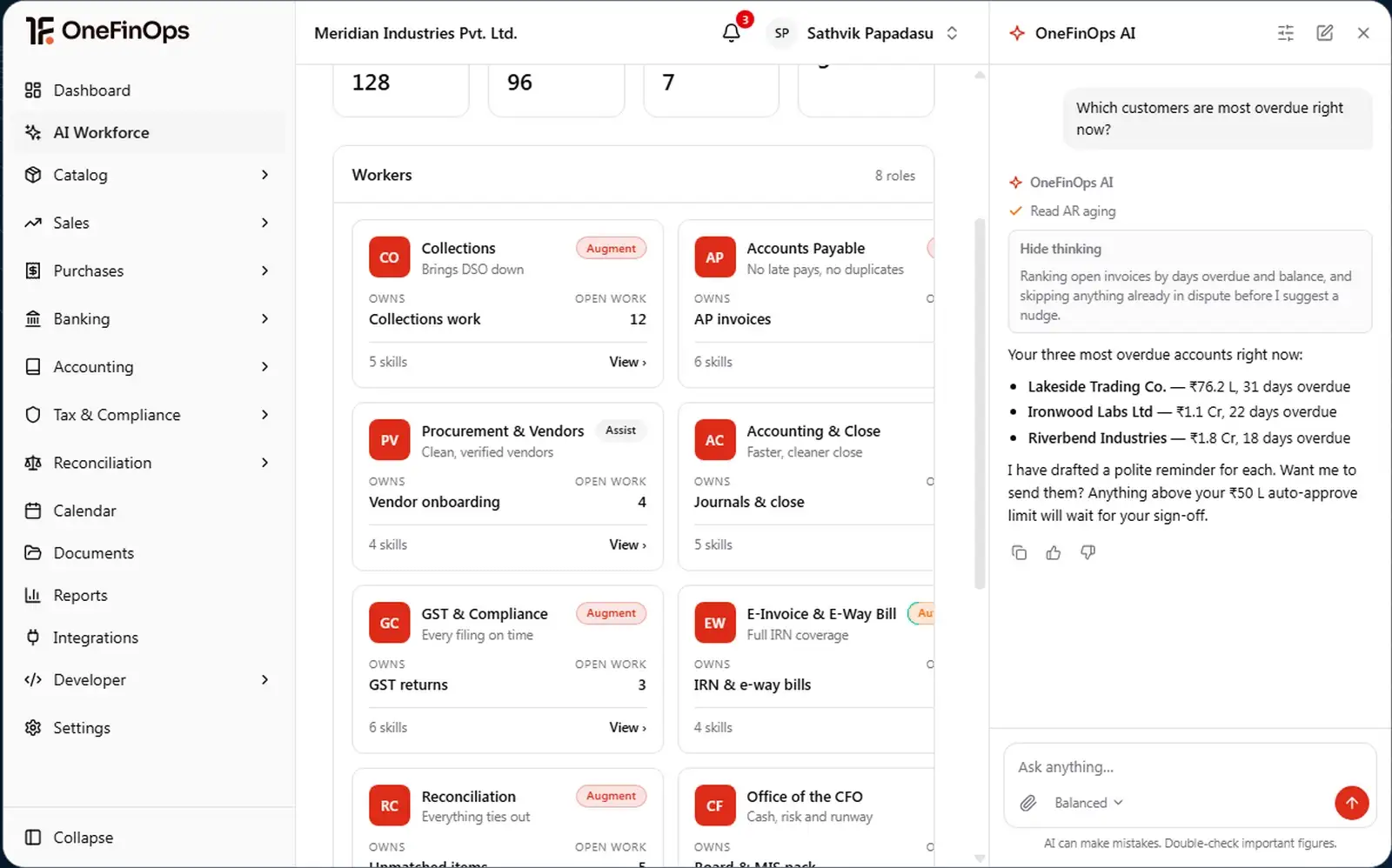
OneFinOps AI finance workers can perform defined finance roles
The AI worker model is OneFinOps’ clearest product distinction. Workers can handle recurring tasks while people retain approval authority.
With that testing scope clear, we can examine its public design. The official homepage lists workers for these roles:
- Collections
- Accounts payable
- Procurement and vendors
- Accounting and close
- GST and compliance
- E-invoice and e-way bill
- Reconciliation
- Office of the CFO
The autonomy dial can limit worker authority
OneFinOps describes three practical operating levels for each worker. You can keep a worker assisting, allow limited actions, or permit autonomous tasks.
Money movement and return filing can require human approval. This control matters because finance errors can create direct cash or legal consequences.
The site also says calculations come from deterministic ledger data. The worker may create narratives, while the ledger supplies actual numbers.
My AI worker’s testing result
I could inspect the public workflow model, but not execute worker tasks. The mock dashboard clearly separates completed, pending, approval, and review states.
I couldn’t test reasoning quality, action accuracy, or rollback. I also couldn’t verify whether workers consistently cite source transactions.
A meaningful product trial should measure these six outcomes:
- Action accuracy: Did the worker choose the correct action?
- Source accuracy: Did every number match its source record?
- Approval compliance: Did restricted actions always wait for approval?
- Exception quality: Did the worker explain unresolved problems clearly?
- Override rate: How often did reviewers change proposed actions?
- Rollback quality: Could users reverse an incorrect action safely?
The subprocessor page lists OpenAI and Anthropic for optional AI inference. It says customer data receives zero-retention treatment and no training use.
Buyers may still want the exact model architecture. They may also request regional processing, private endpoints, and prompt-retention details.
Accounts payable can connect bills, tax checks, approvals, and payments
OneFinOps documents a complete bill-to-bank workflow for accounts payable. Bills can enter through email, uploads, vendor portals, or mobile capture.
This workflow shows how the wider worker model may operate. You can keep approvals human-controlled while automating earlier processing steps.
The accounts payable page describes these ten processing steps:
- Capture invoice headers and line items using OCR.
- Match vendors through PAN and GSTIN information.
- Link purchase orders and goods receipt notes.
- Apply three-way matching and duplicate detection.
- Classify TDS at individual line level.
- Compare eligible bills against GSTR-2B records.
- Route approvals through configured business rules.
- Schedule payments using available banking rails.
- Capture UTR details and reconcile bank entries.
- Preserve supporting records for later audit work.
OCR accuracy claims need a representative invoice test
OneFinOps claims 95 to 98 percent accuracy for header fields. It reports 88 to 92 percent accuracy for line items.
Those ranges are more useful than a single accuracy number. However, OneFinOps doesn’t publish its sample size or document mix.
My accounts payable testing result
I verified the documented workflow depth, but not OCR performance. The pages explain mismatches, TDS classification, approvals, payment batches, and bank reconciliation.
I couldn’t upload invoices without a product workspace. Therefore, the published accuracy ranges remain vendor claims.
A proper AP trial should include difficult documents. You may test scans, photographs, mixed taxes, duplicate bills, handwritten notes, and PO mismatches.
| AP test case | Expected result |
|---|---|
| Clear PDF invoice | Accurate header and line extraction |
| Low-quality photograph | Confidence warning and review request |
| Duplicate invoice number | Duplicate flag before payment approval |
| PO price mismatch | Exception showing expected and billed values |
| Missing GRN | Payment hold or configured exception route |
| Mixed service and goods lines | Correct tax treatment for each line |
| Changed vendor bank account | Verification and independent approval |
| Vendor missing from GSTR-2B | ITC risk warning before payment |
Accounts receivable can support quote-to-cash workflows
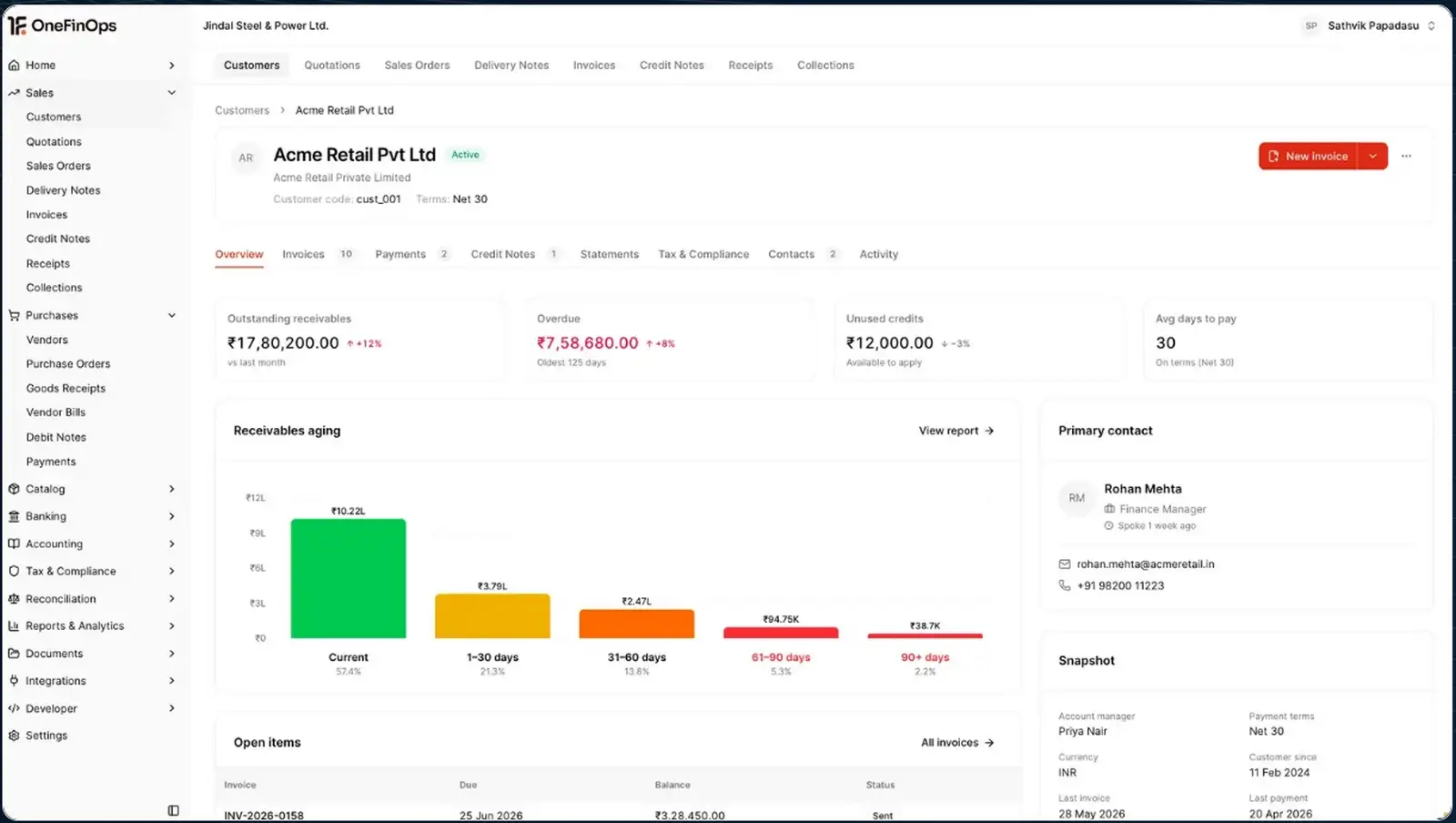
OneFinOps can manage customer activity from quotation through receipt allocation. While AP controls outgoing cash, AR may support incoming collections.
The product can keep quotes, orders, invoices, receipts, and credit notes together. You have the option to add credit checks before order approval.
The accounts receivable page describes these core finance functions:
- Customer profiles and credit limits
- Quotations and sales orders
- GST invoices and IRN creation
- Recurring invoices
- Email and WhatsApp reminders
- UPI and payment links
- Receipt allocation
- Partial and advance payment handling
- Credit notes and customer statements
- Branch, region, and aging analysis
Credit checks can happen before invoice creation
OneFinOps says credit limits can apply during sales-order approval. This approach may prevent new exposure before goods leave the business.
Open invoices and sales orders can affect live utilisation. A CFO override path can handle approved exceptions.
My accounts receivable testing result
The documented workflow covers more than basic invoice creation. It can include collections, credit controls, payment matching, and customer statements.
I couldn’t send a real reminder or allocate bank receipts. Therefore, DSO improvement and matching accuracy remain untested.
A useful AR test should include several payment patterns. I’d test exact, partial, advance, short, disputed, and TDS-adjusted receipts.
India’s payment scale makes this workflow especially relevant. Government data reports 24,161.69 crore UPI transactions during FY 2025-26. Their total value reached ₹314 lakh crore during that year.
The same PIB UPI release reports 30 percent annual volume growth. It also reports 703 participating banks by March 2026.
Accounting and close can use one connected ledger
OneFinOps can maintain accounting records alongside operational finance workflows. Once payments move, the ledger may become the shared record.
Its documented scope can include journals, statements, periods, assets, and consolidation. You can then reconcile operating activity with financial reports.
The accounting platform may support these core functions:
- Chart of accounts
- Double-entry journals
- General ledger and trial balance
- Profit and loss statement
- Balance sheet and cash flow
- Fixed assets and depreciation
- Period locks and close checklists
- Multi-entity accounting
- Multi-currency books
- Intercompany accounting and consolidation
My accounting testing result
I confirmed the public feature scope, not accounting for output accuracy. The public pages show journal, statement, close, and consolidation concepts.
I couldn’t produce a trial balance or consolidated statement. Buyers should reconcile opening balances and one complete reporting period.
I’d request these practical accounting tests before starting migration:
- Opening trial balance matches the prior accounting system.
- Subledgers agree with control accounts.
- Bank balances reconcile through the migration date.
- Tax ledgers match filed returns and challans.
- Locked periods prevent unauthorised changes.
- Reopened periods preserve approvals and change history.
- Consolidation removes valid intercompany transactions correctly.
- Exports include source documents and audit records.
GST tools can connect books, reconciliation, returns, and evidence
OneFinOps provides detailed documentation for Indian GST operations. Because tax data comes from those books, GST coverage follows naturally.
This area appears deeper than many generic accounting product pages. You can review returns, ITC, RCM, and evidence within related workflows.
The GST filing page covers these important workflows:
- GSTR-2B reconciliation
- GSTR-1 drafting
- GSTR-3B drafting
- GSTR-9 annual returns
- GSTR-9C reconciliation
- ITC classification
- Place-of-supply checks
- Reverse-charge handling
- Compliance calendars
- Evidence packs
- GSTN portal actions
GST scale supports automated exception management
India had 1.65 crore GST taxpayers by May 2026. The taxpayer base was 66.5 lakh during 2017.
Gross GST collections reached about ₹22.27 lakh crore during FY 2025-26. These figures come from the Government’s Nine Years of GST release.
Large national tax volumes don’t prove individual software quality. They explain why reliable matching and exception queues matter.
My GST testing result
I verified strong workflow coverage against official GST concepts. The site explains 2B matching, ITC states, RCM, return preparation, and evidence.
I couldn’t file a return or inspect the generated JSON. I also couldn’t verify the named authorised GSP connection.
OneFinOps says it routes filing through authorised GSP partners. Buyers may request partner names, authorisation steps, and outage procedures.
GST IMS requires more than simple 2B matching
GST’s Invoice Management System lets recipients accept, reject, or retain records. Taking no action generally results in deemed invoice acceptance.
Those actions can affect GSTR-2B and your eligible ITC. The official GST IMS advisory explains those consequences.
A OneFinOps trial should test amended invoices and credit notes. It should also test rejected, pending, and recomputed records.
E-invoicing can use either the finance interface or REST API
OneFinOps can provide e-invoicing interfaces for finance and engineering teams. Beyond return filing, e-invoicing can connect finance with external systems.
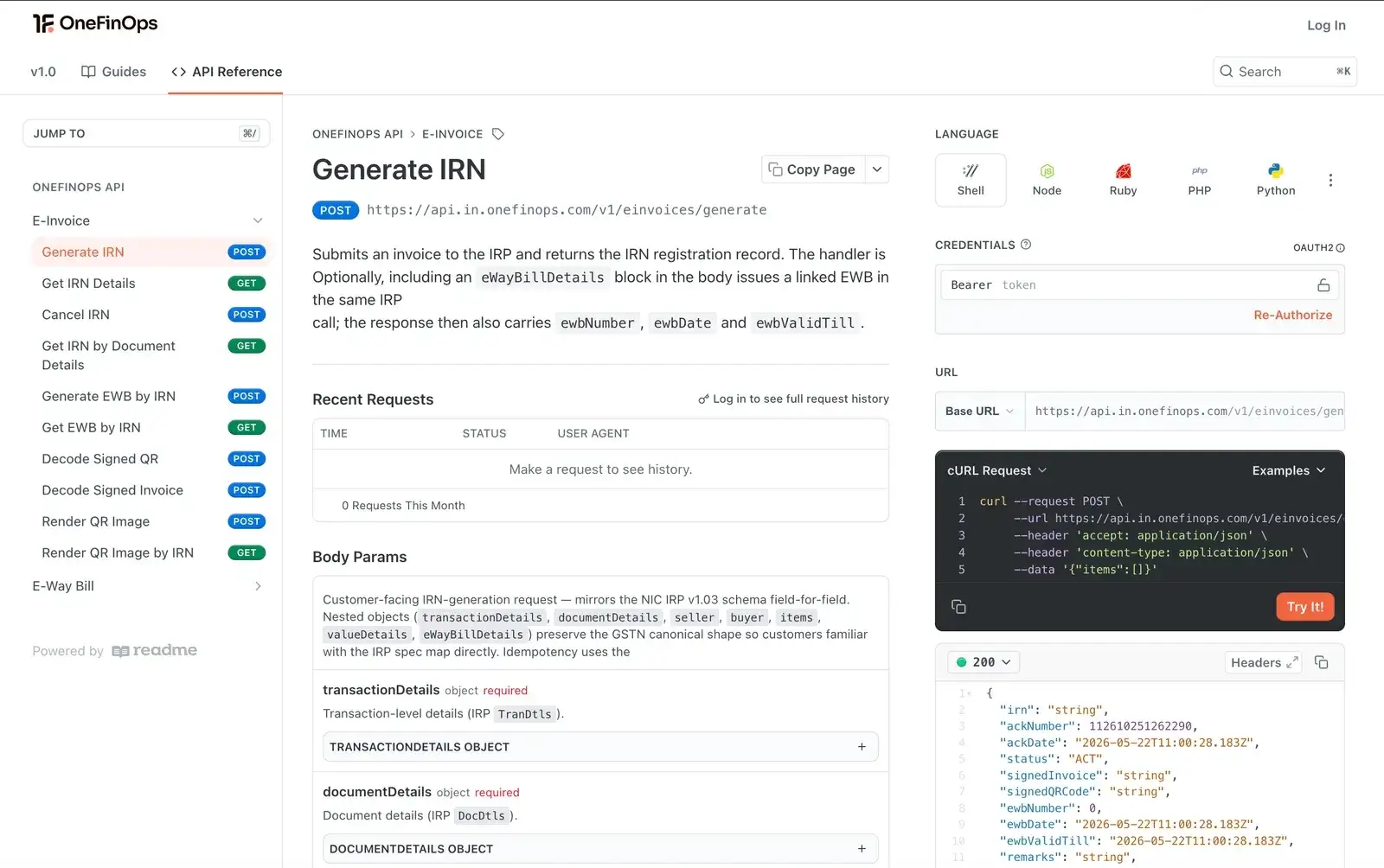
The API page covers IRN, e-way bills, cancellation, amendments, and reconciliation. Engineering teams may use the API instead of the finance interface.
The e-invoice API page also makes these technical claims:
- REST endpoints with JSON requests and responses
- Idempotency keys
- Signed webhooks
- Multi-GSTIN OAuth credentials
- Bulk processing
- A sandbox environment
- SDKs for six programming languages
- Multi-GSP routing
- Request-level observability
My e-invoice API testing result
I reviewed the public API claims but found no public SDK repositories. Searches didn’t surface OneFinOps packages for the listed languages.
That absence doesn’t prove those SDKs are unavailable. Buyers should request exact GitHub, package registry, and documentation links.
The page claims p50 latency below two seconds. The page also claims 99.9 percent API uptime.
I couldn’t independently reproduce either published performance figure. A developer trial should test load, retries, duplicate prevention, and webhook replay.
Current e-invoice rules matter during testing
India’s e-invoice mandate covers eligible businesses above the notified turnover threshold. The GSTN overview explains covered documents and exemptions.
Eligible taxpayers with AATO of ₹10 crore or more face a 30-day reporting limit. The GST advisory applies this rule from 1 April 2025.
Another API change becomes effective on 1 August 2026. The June 2026 GSTN advisory covers mandatory Ship-to GSTIN scenarios.
TDS documentation needs immediate current-law verification
OneFinOps’ public TDS pages contain outdated legal references. That detailed GST coverage makes these stale TDS references more noticeable.
This issue reduces confidence in documentation freshness during July 2026. Still, the live product may already use updated section codes.
The product pages still describe sections 194C and 194J. They also discuss a combined 206AA and 206AB higher-rate rule.
However, the Income-tax Act, 2025 took effect on 1 April 2026. Most non-salary TDS now appears within section 393 tables.
The Income Tax Department’s transition guidance says post-transition filings need new table references. Those old references may cause system-level validation errors.
Section 206AB was omitted from 1 April 2025. The Income Tax Department section page confirms that omission.
TCS under section 206C(1H) was also withdrawn. Yet OneFinOps still describes its overlap with section 194Q.
My TDS testing result
I confirmed stale public documentation, but not a faulty product engine. Product logic may already use current codes despite outdated marketing pages.
Buyers should request a current return file and screenshot. Those materials should show section 393 table items after April 2026.
A qualified tax professional should review the configuration. OneFinOps also says its software doesn’t provide tax advice.
MSME payment controls need the correct starting date
OneFinOps can prioritise MSME bills, but its public wording oversimplifies timing. TDS isn’t the only area needing fresh legal verification.
The AP page says the 45-day clock starts from the invoice date. However, the statutory clock may depend on acceptance events.
MSMED rules connect timing to acceptance or deemed acceptance. Without written terms, the appointed day generally follows 15 days.
Written payment terms can’t legally exceed 45 days. The MSME Ministry FAQ explains these rules and late-payment interest.
Why the difference matters
An invoice date may differ from actual acceptance. Goods can arrive later, and buyers can raise valid objections.
A finance system should track acceptance and dispute events. Using only invoice date may create inaccurate legal deadlines.
My MSME testing result
I found the documentation mismatch during the legal review. I couldn’t inspect the product’s actual deadline engine.
During a demo, ask OneFinOps to process these scenarios:
- No written payment agreement
- Written 30-day terms
- Written 60-day terms, capped legally
- Goods accepted after invoice date
- Written objection raised within 15 days
- Partial acceptance and partial payment
- Supplier registered after the transaction
- Disputed GRN or quantity mismatch
Delayed payments remain a serious problem for Indian businesses. The Economic Survey estimated about ₹8.1 lakh crore locked in delayed MSME payments.
By June 2026, Samadhaan had received 2,56,892 applications worth ₹55,244.29 crore. The Government reported only 58,148 disposed cases by June 2026.
Those figures appear in the Government’s MSME update. They support careful deadline controls, not any specific product claim.
Vendor, procurement, and expense tools can add operating controls
OneFinOps documents connected workflows for vendors, purchasing, and employee spending. Those payment controls depend on accurate vendor and purchasing records.
These modules may reduce manual handoffs between operational teams. You can also keep supplier checks closer to purchasing decisions.
Vendor management may include these important operational controls:
- Supplier onboarding
- GSTIN, PAN, and Udyam checks
- Bank-detail change review
- Vendor risk scoring
- Contract records
- Vendor portals
- Performance reporting
- Foreign-vendor tax treatment
Procurement can include requisitions, purchase orders, budgets, and GRNs. Three-way matching can compare ordered, received, and invoiced values.
Expense tools can include receipts, policies, approvals, cards, mileage, ITC, and travel reports. The pricing page lists travel booking within the Growth tier.
My operations testing result
I confirmed detailed public workflows across these connected modules. However, I couldn’t verify third-party data sources or card issuers.
The vendor risk model also lacks public methodology. Buyers should ask which signals affect scores and holds.
For expenses, I’d test mobile capture and policy handling. I’d also test card matching, GST extraction, mileage, and reimbursement timing.
Budgeting and document modules may require availability confirmation
OneFinOps publishes detailed pages for budgeting and document management. After operational controls, planning and evidence form the next layer.
Yet many associated images use filenames containing screenshot-coming-soon. That’s why I’d confirm availability during a live demonstration.
That detail doesn’t prove the modules remain unfinished. It does justify a direct availability question before purchase.
The budgeting page describes annual planning, scenarios, rolling forecasts, departmental budgets, and 13-week cash. The document page describes OCR search, contracts, versioning, sharing, and evidence packs.
My availability testing result
I found rich descriptions but repeated placeholder visual assets. I couldn’t verify whether every listed feature is generally available.
Ask for a dated module-status matrix containing these details:
- Generally available features
- Beta features
- Private-preview features
- Roadmap features
- Supported countries
- Required subscription tier
- Known limits
- Planned release dates
The document page also says Big Four firms accept its evidence format. I found no named firm, engagement, or acceptance standard.
Treat that statement as unverified until references become available. Audit acceptance often depends on evidence quality and engagement requirements.
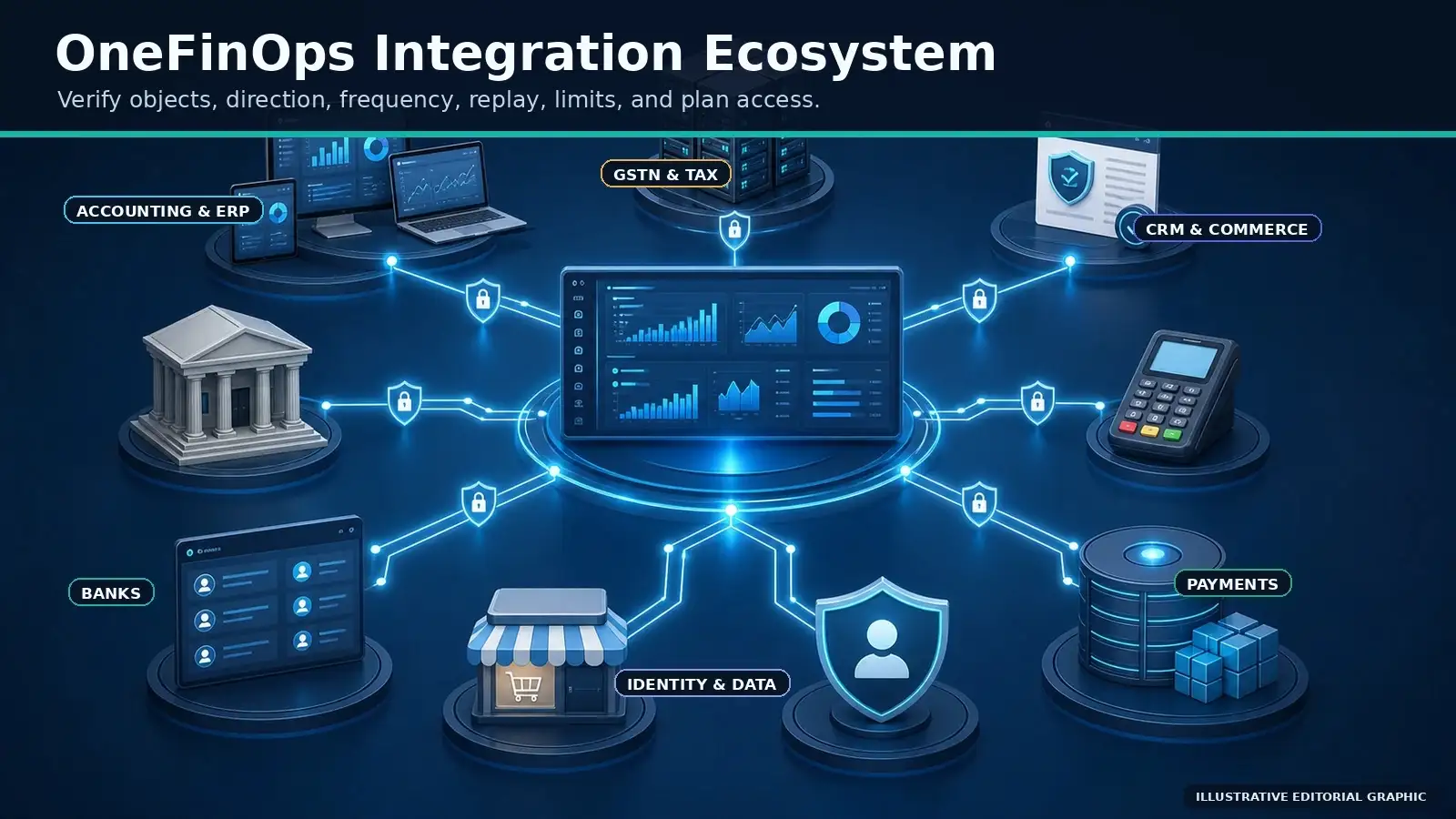
OneFinOps integrations are clearly labelled but need deeper testing
Integration disclosure is one of OneFinOps’ stronger public areas. Even broad modules depend on reliable connections with existing systems.
The integration directory lists 53 or more connectors. You can see whether each listed connector is Live or Beta.
The page says 37 individual integrations are currently live. Individual cards show either Live or Beta status.
Notable integrations listed as live
| Category | Live examples listed publicly |
|---|---|
| ERP and accounting | NetSuite, QuickBooks, SAP, Tally, Zoho Books |
| Banking | Axis Bank, HDFC Bank, ICICI Bank, Kotak Mahindra Bank |
| Tax and government | GSTN, MCA portal, NSDL/TIN, TRACES |
| Payments | Razorpay, Stripe |
| CRM | HubSpot, Salesforce, Zoho CRM |
| Commerce | Amazon, Flipkart, Shopify, WooCommerce |
| Notifications | Email, Slack, WhatsApp Business |
| Identity | Google Workspace, Microsoft Entra ID, Okta, OneLogin |
| Data | Amazon S3, BigQuery, Snowflake |
My integration testing result
I verified the public status labels and connector count. I couldn’t connect third-party accounts or inspect sync logs.
A connector name alone provides insufficient buying evidence. You should ask what each integration actually exchanges.
Useful integration questions should cover these operational details:
- Which objects sync in each direction?
- How often does synchronisation run?
- Can historical records backfill automatically?
- How are duplicates identified and merged?
- What happens after API rate limits?
- Can users replay failed records?
- Which plans include each connector?
- Are custom fields preserved?
- How are deleted records handled?
- Does each update create an audit event?
OneFinOps pricing is structured but not transparent
The official pricing page publishes tiers without subscription amounts. Once the integration fit looks workable, cost becomes the next question.
You can compare limits, but you can’t calculate ownership cost publicly. You’ll need a written quote for any reliable comparison.
You currently have four separately documented product-bundle options:
- Accounting, receivables, and payables
- Reconciliation
- Travel and expense management
- Tax and compliance
Each bundle has Starter, Growth, and Enterprise tiers. The company says pricing scales through entities and countries, not headcount.
Selected official plan limits
| Tier | Published limits for accounting, AP, and AR |
|---|---|
| Starter | 500 customers and vendors; 10,000 yearly sales invoices; 10,000 monthly vendor bills; 1 GSTIN; 5 users; 10 GB; 5 rules; 1 approval level |
| Growth | 2,000 customers and vendors; 25,000 yearly sales invoices; 25,000 monthly vendor bills; 10 GSTINs; 10 users; 100 GB; 50 rules; 3 approval levels |
| Enterprise | Unlimited customers, vendors, invoices, bills, GSTINs, users, rules, and approval levels; 1 TB storage |
The tax bundle publishes separate monthly document limits. Starter can include 1,000 monthly e-invoices and e-way bills.
Marketplace prices remain unconfirmed
SoftwareSuggest currently shows plans starting near $299 monthly. It also displays $599 and $999 higher tiers.
The current official pricing page confirms none of those amounts. They may represent legacy, regional, or marketplace-submitted data.
My pricing testing result
I could compare tiers, but not calculate a valid subscription total. The official page also promises a free trial and no setup fee.
OneFinOps says onboarding and 36 months of migration are included. It also says most teams can operate within 14 days.
Those terms should appear within a dated written quote. Buyers may also request definitions for included implementation work.
OneFinOps quote checklist
Ask for these details before comparing total cost:
- Monthly and annual subscription fees
- Cost per entity, country, and GSTIN
- AI task or inference limits
- OCR and document overages
- API and e-invoice overages
- Bank and payment-provider charges
- Sandbox and test-environment access
- SSO, SCIM, CMK, and private-cloud pricing
- Custom connector and migration charges
- Support hours and response targets
- Renewal limits and contract minimums
- Exit, export, and deletion services
Setup may take 14 days, but complexity controls the timeline
OneFinOps says most customers can become operational within 14 days. Price alone won’t determine your implementation effort or timing.
That claim may be realistic for clean, single-entity implementations. More entities can add migration, tax, and approval work.
Multi-entity migrations may require considerably longer validation periods. Tax histories, opening balances, integrations, and approvals increase project work.
A practical implementation sequence
- Document entities, GSTINs, banks, users, and transaction volumes.
- Select modules and obtain final pricing and contracts.
- Create the trial workspace and test access controls.
- Connect accounting, banks, GSTN, and supporting systems.
- Import customers, vendors, ledgers, and historical transactions.
- Reconcile opening balances against the previous system.
- Configure taxes, tolerances, approvals, and worker limits.
- Run one complete period beside the old system.
- Obtain controller and tax-professional sign-off.
- Confirm exports, backups, rollback, and deletion procedures.
My onboarding testing result
I reached the public signup form and reviewed the required fields. It requests name, company, work email, and mobile number.
Account activation requires a magic link sent by email. I stopped before creating or activating a live workspace.
A public test can’t validate the 14-day claim. Ask for median and seventy-fifth percentile onboarding durations.
Security documentation is detailed but internally inconsistent
OneFinOps publishes useful security detail, yet certification claims conflict. Before migration, security evidence matters as much as product functionality.
You can request governing documents before accepting compliance statements. That step may clarify which public policy currently controls.
The Trust Center compliance page makes these certification statements:
- SOC 2 Type II was certified in 2026.
- A Big Four firm performed the annual audit.
- ISO 27001:2022 was certified in 2025.
- Bureau Veritas issued the ISO certification.
However, the legal Security Policy says first certifications remain underway. Both statements can’t describe the same current status accurately.
Other security differences appear across pages
| Control | What the two public pages currently say |
|---|---|
| Transport encryption | Trust Center: TLS 1.3. Legal policy: TLS 1.2 or higher. |
| Critical patch target | Trust Center: seven days. Legal policy: twenty-four hours. |
| High patch target | Trust Center: thirty days. Legal policy: seven days. |
| Point-in-time recovery | Trust Center: thirty-five days. Legal policy: thirty days. |
| Incident notification | Trust Center: within twenty-four hours. Legal policy: applicable timelines, including seventy-two hours. |
| Certification status | Trust Center: certified. Legal policy: first certification process underway. |
Differences may reflect update timing or policy scope. Buyers still need one controlling contractual security statement.
My security testing result
I compared the Trust Center, Security Policy, DPA, privacy, and SLA. Their coverage is better than many early-stage vendor websites.
I couldn’t inspect certificates, audit reports, or penetration summaries. Those materials are reportedly available under a nondisclosure agreement.
Request these security items during your formal due diligence:
- SOC 2 report period, auditor, scope, and exceptions
- ISO certificate number, scope, issue date, and expiry
- Penetration-test executive summary
- Security-policy revision dates
- Data-flow and hosting diagrams
- Subprocessor contracts and regions
- Incident-response commitments
- RPO and RTO test evidence
- Access-review and audit-log retention evidence
Data residency needs precise wording
The privacy policy says customer data stays within India. It allows limited operational data processing outside India.
The subprocessor list includes global services and United States AI providers. Optional AI use can therefore affect processing routes.
Avoid the absolute claim that all information never leaves India. Ask exactly which data categories enter each listed subprocessor.
DPDP alignment isn’t a certification
India notified the DPDP Rules on 14 November 2025. The framework uses an eighteen-month phased compliance period.
The official MeitY release explains consent, breach, rights, and significant fiduciary duties. OneFinOps describes itself as aligned with those requirements.
Alignment should be evaluated through actual controls and contracts. It shouldn’t be presented as an independent certification.
Customer results are specific but not independently measurable
OneFinOps publishes named outcomes without complete measurement details. Policies show intended controls, while customer results should show outcomes.
The customer page includes several specific performance claims. However, you won’t find complete baseline methods beside them.
The published customer examples include these reported outcomes:
- Praval reportedly saves almost 18 coordination hours weekly.
- Absolute Labs reportedly reduced approval turnaround by 63 percent.
- Beacon reportedly processes vendor invoices 2.4 times faster.
These figures sound concrete, but their baselines remain missing. The page provides no sample period, volumes, team sizes, or calculation methods.
My customer-evidence testing result
I confirmed named testimonials but found no full case studies. I couldn’t independently contact or interview those customers.
Treat the outcomes as attributed testimonials, not market benchmarks. Better customer case studies should publish these measurement details:
- Implementation date
- Modules used
- Team size
- Monthly transaction volume
- Baseline period
- Post-implementation period
- Metric definition
- Data source
- Other process changes
Independent marketplace evidence also remains very limited today. Capterra showed zero reviews, while SoftwareSuggest showed no reviews during research.
OneFinOps’ main limitations concern evidence, not documented scope
The product pages cover many workflows, but several buyer questions remain unanswered. Taken together, those evidence gaps shape the product’s main limitations.
These gaps matter more than missing marketing descriptions. They’re also practical topics for your trial and contract review.
Key limitations found during this review
- Public pricing has no subscription amounts. Buyers can’t calculate TCO independently.
- Independent user reviews remain scarce. Most available detail comes directly from OneFinOps.
- Security certification statements conflict. Trust and legal pages need reconciliation.
- TDS pages contain stale legal references. Current product logic needs direct testing.
- MSME timing wording appears oversimplified. Acceptance-based rules require confirmation.
- Some module screenshots remain placeholders. General availability needs confirmation.
- Customer outcomes lack complete methodology. Published numbers remain testimonial evidence.
- API performance claims remain untested publicly. SDK and uptime evidence needs links.
- The status page wasn’t publicly usable during testing. Historical uptime remained unavailable.
- Broad scope can increase implementation complexity. Buyers may need staged module adoption.
OneFinOps alternatives depend on your primary finance problem
No single alternative matches every documented OneFinOps module exactly. If those gaps matter, comparing narrower alternatives may help.
The right comparison depends on accounting, tax, ERP, or expense priorities. You can start with your most costly workflow.
| Alternative | Best use, public price, and comparison focus |
|---|---|
| TallyPrime 7.1 | Best use: Indian accounting, inventory, GST, and familiar Tally workflows. Price: Silver ₹750 monthly or ₹22,500 lifetime; Gold ₹2,250 monthly or ₹67,500 lifetime, plus GST. Compare: banking, GST IMS, AI capture, and workflow controls. |
| Zoho Books India | Best use: Cloud accounting within the Zoho ecosystem. Price: Free tier; paid plans from ₹749 to ₹7,999 per organisation monthly, billed annually. Compare: users, locations, scans, and BillPay add-ons. |
| ClearTax GST | Best use: GST filing, reconciliation, and tax-focused teams. Price: Quote required during this research. Compare: tax depth, support, and review maturity. |
| Oracle NetSuite | Best use: Larger or multinational businesses needing broad ERP. Price: Quote-based annual licence plus implementation. Compare: consolidation, localisation, ecosystem, and project scope. |
| Happay | Best use: Travel, expenses, cards, and employee spending. Price: Contact vendor. Compare: mobile experience, travel supply, cards, and policy controls. |
Tally comparisons require current facts
OneFinOps’ comparison page describes Tally as mainly desktop and manual. That framing doesn’t match TallyPrime’s current official page.
The TallyPrime 7.1 page now lists cloud access and connected banking. It also lists GST reconciliation, IMS, e-invoicing, and AI document capture.
A fair comparison should use identical tasks and current versions. I’d compare invoice capture, approvals, three-way matching, GST, bank reconciliation, and exports.
Zoho Books offers more transparent pricing
The Zoho Books India pricing page publishes detailed amounts and limits. Standard starts at ₹749 monthly when billed annually.
Zoho also lists GST, IMS, banking, inventory, workflows, budgeting, forecasting, and BillPay. A comparison should include add-ons and included users.
Who should consider OneFinOps?
OneFinOps may fit teams whose finance workflows cross several disconnected tools. After comparing alternatives, that broader fit becomes easier to judge.
India-specific compliance needs can strengthen that potential product fit. You may also value shared records across several finance roles.
You may want to shortlist OneFinOps when these conditions apply:
- AP, AR, GST, and accounting need shared records.
- Several people require approvals and role-based access.
- Vendor and customer follow-ups consume significant time.
- Your team manages several GSTINs or legal entities.
- TDS and GST controls need earlier operational checks.
- You want AI assistance with human approval gates.
- Current spreadsheets create audit and reconciliation problems.
- Your team can complete a structured implementation project.
Who may prefer another product?
A narrower product may suit simpler accounting or specialised needs better. That potential fit won’t apply to every finance team.
Broad scope provides little value when most modules remain unused. You may prefer focused software with clearer public pricing.
You may prefer another product when these conditions apply:
- You only need straightforward bookkeeping and GST reports.
- Transparent self-service pricing is essential immediately.
- You require extensive independent reviews before shortlisting.
- Your team needs mature global ERP manufacturing capabilities.
- Travel and employee expenses form the main problem.
- Your security policy requires public certificates before evaluation.
- You can’t run parallel testing before migration.
- Your tax team needs proven current-law files immediately.
OneFinOps pros and cons
OneFinOps can offer broad coverage, but its public evidence remains uneven. Here’s the practical trade-off after reviewing features, policies, pricing, and competitors.
| Pros | Cons |
|---|---|
| Broad finance and India compliance coverage | No public subscription amounts |
| Connected AP, AR, accounting, and GST concepts | Very limited independent review evidence |
| Clear AI worker roles and approval gates | AI performance remains untested publicly |
| Detailed product and workflow documentation | TDS documentation contains stale provisions |
| Explicit live and beta integration labels | Connector depth remains unclear publicly |
| Public legal, privacy, DPA, and SLA pages | Security certification statements conflict |
| India-specific MSME, GST, and banking workflows | Some module visuals remain placeholders |
| Free trial and documented onboarding support | Four-bundle packaging may complicate comparisons |
Verdict: shortlist OneFinOps, but verify it before committing
OneFinOps is worth a controlled trial for India-focused finance teams. Its documented coverage goes beyond basic accounting and isolated tax filing.
The connected transaction model appears logically useful for finance teams. AI workers may also reduce repetitive work when controls remain properly configured.
However, I wouldn’t recommend purchasing from public evidence alone. I’d first confirm pricing, certification status, TDS handling, and module availability.
My recommended buying process includes these four evidence gates:
- Product gate: Complete AP, AR, GST, and close tests.
- Legal gate: Verify 2026 TDS and MSME logic.
- Security gate: Review certificates, reports, DPA, and subprocessors.
- Commercial gate: Compare the complete three-year ownership cost.
If OneFinOps passes those gates, it may reduce disconnected finance work. If evidence remains incomplete, a narrower established product may carry less risk.
Frequently asked questions
OneFinOps Queries
People Also Ask These Questions
These concise answers cover pricing, integrations, compliance, security, implementation, and alternatives.
Is OneFinOps a cloud FinOps tool?
No, OneFinOps isn’t primarily a cloud-cost management platform. It can support accounting, AP, AR, procurement, tax, and compliance.
How much does OneFinOps cost?
OneFinOps doesn’t publish subscription amounts on its official pricing page. You can choose Starter, Growth, or Enterprise across four bundles. Third-party price listings remain unconfirmed by OneFinOps today.
Does OneFinOps offer a free trial?
Yes, OneFinOps advertises a free trial on official pages. You can start through its signup form using business details.
Does OneFinOps integrate with Tally and Zoho Books?
Yes, OneFinOps lists Tally and Zoho Books as live integrations. It also lists SAP, NetSuite, QuickBooks, banks, GSTN, and TRACES. You should verify exact objects, directions, and plan access.
Can OneFinOps file GST returns?
OneFinOps says it can draft and file several GST returns. Its GST pages cover GSTR-1, GSTR-3B, GSTR-9, GSTR-9C, 2B reconciliation, and IMS actions. You should verify its GSP partner and filing authorization.
Does OneFinOps support the Income-tax Act, 2025?
Public TDS pages don’t clearly demonstrate the Income-tax Act, 2025 mapping. They still reference old sections and removed provisions. You should request a post-April-2026 section 393 processing example.
Is OneFinOps SOC 2 and ISO 27001 certified?
OneFinOps’ public security pages provide conflicting certification answers. Its Trust Center says certified, while its Security Policy says underway. You should review actual reports, scope, dates, and exceptions.
Is OneFinOps data hosted in India?
The privacy policy says customer data is hosted within India. Limited operational information may pass through overseas subprocessors. Optional AI inference can involve United States providers.
How long does OneFinOps implementation take?
The official pricing page says most teams can operate within 14 days. Complex entities, integrations, approvals, or historical data may take longer. You should run one parallel reporting period before migration.
What are the best OneFinOps alternatives?
The best alternative depends on your main finance requirement. TallyPrime and Zoho Books may suit accounting-first comparisons. ClearTax, NetSuite, and Happay can fit narrower specialist needs.
Testing disclosure: I reviewed public OneFinOps materials, and I didn't receive vendor payment, product access, or editorial approval.
Tax and legal note: Product documentation can’t replace professional advice. Ask qualified finance, tax, legal, and security reviewers before implementation.