Beyond the Glass Slab: 4 Advanced Technology Systems That Will Make Your 2026 Smartphone Look Like a Rock
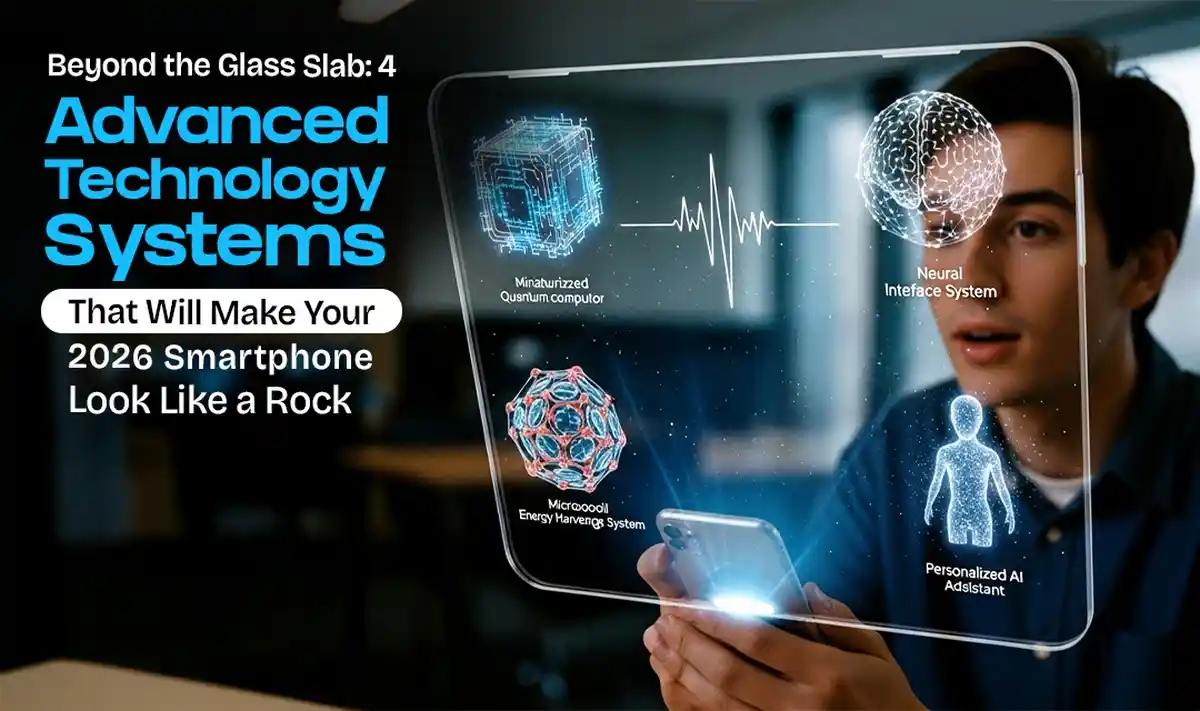
Your phone feels smart, yet it can be surprisingly fragile. Screens break easily and batteries run out faster than you expect. However, that is about to change, as euronews reports that new materials, such as graphene, could make devices 200 times stronger than steel. In 2026, smartphones will manage tasks efficiently and become far tougher and more reliable than today’s devices.
Day-to-day improvements in materials and artificial intelligence are solving real-world problems. Stronger screens reduce repairs, better batteries keep you connected all day, and AI organises apps and notifications to match how you use your phone. In this guide, we will explore four advanced technology systems that will make your 2026 smartphone almost unbreakable.
Notable Highlights:
- 2026 smartphones will be faster, stronger, and more energy-efficient than current models.
- Agentic AI will make phones think and act like intelligent digital partners.
- Silicon-carbon and solid-state batteries will provide twice as much battery life.
- Graphene cooling systems maintain the stability of phones during heavy use.
- The Future smartphones will sense emotions and the environment through advanced biosensors.
The Foundational Gap – Why Today’s Phones Will Become Rocks
The smartphone business expanded rapidly, but its foundations now seem weak. People want more power along with endurance. They want their phones to think fast and last all day. An Android headlines report reveals that 54% of users consider battery life the most important feature. This requirement reveals a distinct and clear gap between users’ needs and the current advanced technology system.
This gap is similar to the challenges students face when they have many tasks to handle. Just as an affordable essay writing service helps students complete papers efficiently and meet their goals, phone makers need solutions that bridge the gap between user expectations and device performance.
Market Reality
Every year, brands promise better AI and smoother gaming features. But these technological advancements consume more energy. Larger AI models require intensive processing, which can drain batteries and generate excessive heat. Even larger batteries cannot keep up. People want their devices to perform optimally.
The Processor Wall
The CPUs and GPUs deliver power and waste energy. Running AI models on-device can heat the phone and slow it down. Old processor designs cannot support the task of real-time processing. The smartphone now has to evolve beyond its glass and metal body.
Future Vision
The new age of advanced technology will blend power and intellect. Emerging advanced technology systems will help bridge the gap between hardware limitations and the boundless potential of AI. In the upcoming years, phones will not only react but also predict. They will run your calendar, sense your mood, and respond immediately.
4 Advanced Technology Systems That Will Make Your 2026 Smartphone Look Like a Rock
Smartphones in 2026 will be more powerful and reliable. Advanced technology systems will make this possible. These systems focus on improving the features to meet users’ growing demands. These four advanced technology systems are mentioned below:
1: The Silicon Revolution and Hyper-Efficient Processing
The year 2025 marks the beginning of a new era in chip design. They use a technique called INT2 precision. This format enables AI models to process data efficiently with reduced power consumption. MIT Energy Initiative has shown that INT2 systems reduced energy use compared to standard chips.
Old processors only rely on CPUs and GPUs. The new processor now features Neural Processing Units (NPUs) specifically designed for AI applications. NPUs can process images and pattern tasks at very high speed. A neuromorphic chip goes a step further. It follows how the human brain learns and adapts. This design would enable phones to power AI tools.
B. Agentic AI and Predictive Computing
Agentic AI lets your smartphone act without waiting for commands. It predicts your needs and handles tasks automatically. It can organise your schedule and edit photos automatically. This makes your phone more helpful and saves you time every day.
This is an advanced technology system designed to construct workflows. It can summarise a lengthy text in seconds and update your lighting or monitor stress through sensors. ARM stated that ARM and SME2 technology are now able to summarise 800 words in a single second.
2: Power and Endurance and the Battery Density Leap
The next advanced technology system focuses on endurance. A powerful phone means nothing if it dies halfway through the day. The future of smartphones depends on a revolution in energy storage and management.
A. Silicon-Carbon and Solid-State Batteries
Li-ion batteries have powered our phones. But they have their limits. Now, the industry is moving to Silicon-Carbon batteries with higher capacity. Pacgadgetaid stated that they already use batteries with a capacity of between 6,000 and 6,500mAh, which grant long life without any heat accumulation.
The next breakthrough is Solid-State Batteries. These rely on solid rather than liquid electrolytes. They save more energy and stay cooler. Solid-state batteries also last longer and undergo more charge cycles. A solid-state battery will give phones a two-day life even while AI-equipped features are running. Technology has made qualitative data analysis faster and more accurate by revealing patterns and trends in large datasets.
Silicon-heavy batteries often faced one issue. During charging, silicon expands, resulting in stress and wear. But new coatings and hybrid layers control this. The consequence is a powerful, stable battery that powers advanced chips without any damage.
B. Graphene Thermal Management
Now, graphene has become a game-changer in smartphone design.. This thin and flexible material transfers heat more quickly than copper. Brands such as Huawei use graphene sheets in their recent phone models to control temperature.
The outcome is a smooth, reliable performance without overheating your smartphones. You can play a game and edit for hours; your device will always stay cool. The rock difference is clear, and your phone will no longer burn out under pressure.
3: Zero-Latency Connectivity and the Sensing Layer
The next step in connectivity is 6G. Its global rollout is expected by 2030, but early tests have already started. 6G will bring ultra-reliable, low-latency communication, which is known as URLLC. Tech research online suggests that transfer speeds of 6G networks could reach up to 1 terabit per second, and latency could fall below 1 millisecond.
This transforms remote surgeries and XR streaming ultra-fast. For smartphones, this shows the zero-lag video calls and seamless cloud gaming. You will also have your phone directly linked to wearables and smart city systems. Your phone will no longer act alone. It will provide a digital hub, taking care of your health and home in real-time.
B. Advanced Environmental and Bio-Sensing
The next generation of smartphones will connect you not only to the web but also to everything around you. High-tech sensors will monitor air quality and skin or facial stress levels. According to an NIH study, next-generation biosensors can accurately trace emotional stress by measuring skin microcurrents.
These sensors will generate real-time health feedback. Your phone may alert you to spikes in pollution or stress levels before you even notice them. It will also read micro-expressions and change settings to put you in a more tranquil mood.
This technology goes beyond personal health. It supports public safety. Phones could share live pollution or weather data with city systems. It will act as a living sensor, understanding you and your environment. This technology extends beyond personal health. It supports public safety. Phones might upload real-time pollution or weather readings to city systems.
4: Form Factor Evolution and Digital Interaction
Foldable phones came on the scene in fragile form. But now the time is over. The new materials and the hinge systems are durable and water-resistant. Gadgets such as the Google Pixel 11 Pro Fold carry IP68 ratings and show almost no creases when opened.
The newest Micro-OLED screens are sharper and easier to read, even in the bright light. Titanium and Flexible polymer frames make the smartphones stronger and more reliable for heavy use. If you are busy with your essays or urgent deadlines coming to an end, having a gadget that keeps up with your workload can make all the difference. For tasks that demand extra help, using top-rated essay writing services in the UK ensures that your work stays on track without compromising the quality of content.
B. The Post-Smartphone Interface (XR and BCI)
The next biggest change is not in shape, but in experience. In 2030, Augmented Reality and Virtual Reality will begin to replace smartphones. These XR devices will project the apps and messages into your sight.
According to a PwC report, 66% of organisations use XR wearables for communication. The next frontier is Brain-to-Computer Interfaces. The first neurochips will allow you to take action with just a thought, such as taking a photo or answering calls.
Final Words
The future of smartphones is not just about size or look. It is about power and intelligence. The devices of 2026 will react more quickly and think faster than we do. They will run longer and connect to the world in real-time. From solid-state batteries to 6G networks and AI-powered systems, each step will make the phones smarter and more human.
The fragile glass slab that you are using right now will be transformed into a solid powerhouse that fits your needs. Now it’s time to get ready for this leap. Smartphones of the future are going to be more than just palm-sized. It will define how you live, work and relate to one another every day.
FAQs
What Are Advanced Technology Systems?
Advanced technology systems are new mechanical or electrical machines that demonstrate the current advancement in science and engineering to solve a specific problem. They entail smart chips, speedy networks, and intelligent software that can think and learn.
These are the systems that make devices faster, stronger, and more reliable. In smartphones, they help accelerate speed and performance. They’re also why today’s phones can handle complex tasks with ease, and remain cool, efficient, and ready for the daily task.
How Do Advanced Technology Systems Work?
Advanced technology systems operate in concert between smart hardware and software. Smartphones use AI and high-level chips to execute data right away without waiting.
Sensors and networks enable devices to connect and act in the real world. Phones like these are getting smarter in ways other than programming. They know what people want before the people even think to ask, and they learn from use and do things faster using less energy.
What Are the Benefits of Advanced Technology Systems?
High-tech systems can provide convenience, security, and even improve our own efficiency in life. They extend the life of devices, make them work faster, and also make them think smarter. In smartphones, they extend battery life and regulate heat while speeding up processing. They protect data and advance privacy. These processes support performance enhancements for work, gaming, or communication. Across the board, they are building more robust and resilient technology that adjusts to human use. It is very suitable for everyday life in a comfortable, harmonious way.